
Introduction
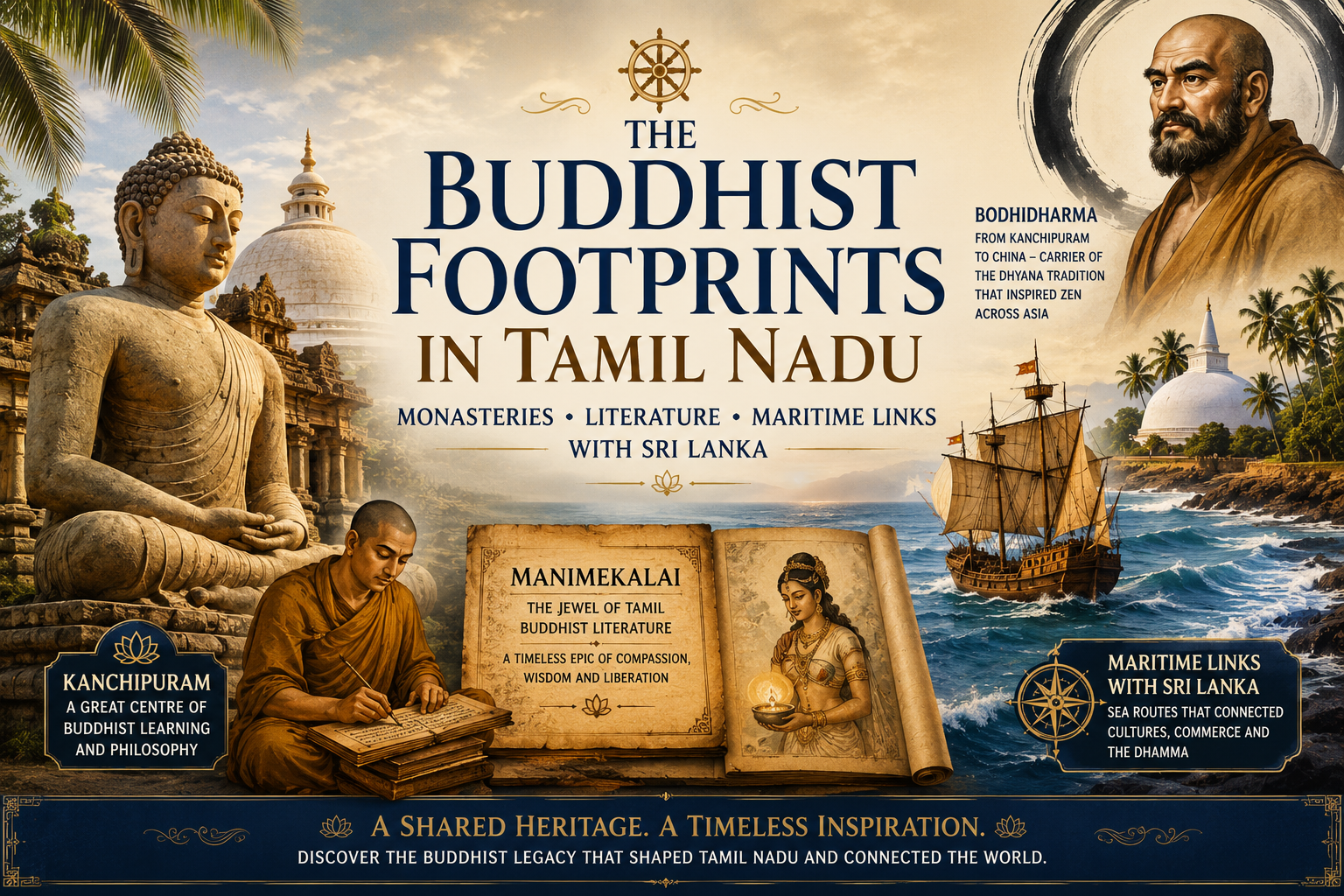
When the history of Buddhism in India is discussed, regions such as Bihar, Uttar Pradesh, and Madhya Pradesh often dominate the narrative. Yet, the southern state of Tamil Nadu preserves a remarkable and often overlooked Buddhist legacy that contributed significantly to the intellectual, literary, and maritime history of the Indian subcontinent.
From the flourishing monasteries of Kanchipuram to the philosophical depth of Tamil Buddhist literature and the vibrant maritime links connecting Tamil ports with Sri Lanka, Buddhism played an important role in shaping the cultural landscape of ancient Tamilakam. This heritage reflects centuries of exchange, scholarship, and spiritual inquiry that connected South India with the wider Buddhist world across Asia.
Buddhism in Ancient Tamilakam
Historical evidence suggests that Buddhism reached Tamilakam within a few centuries of the Buddha’s passing. The growth of trade networks across the Indian Ocean facilitated the movement of merchants, monks, and ideas between northern India, Sri Lanka, and the Tamil coast.
By the early centuries of the Common Era, Buddhist communities had become established in important urban and port centers. Archaeological discoveries, literary references, and accounts of foreign travelers indicate that Buddhist institutions existed alongside other religious traditions, contributing to a rich and diverse intellectual environment.
The Tamil region became not merely a recipient of Buddhist teachings but also a center of Buddhist scholarship that influenced the wider Buddhist world.
Kanchipuram: The Great Buddhist Center of South India
Among all Buddhist centers in Tamil Nadu, Kanchipuram occupies a special place.
Known today primarily as a sacred temple city, Kanchipuram was also one of the most important Buddhist centers in South India during the early medieval period. Chinese pilgrim Xuanzang, who visited India in the seventh century, recorded the presence of numerous Buddhist monasteries and a thriving community of monks in Kanchipuram. Historical traditions also associate the city with several distinguished Buddhist scholars and teachers.
Scholars connected with Kanchipuram include:
- Dignaga, one of the most influential Buddhist logicians.
- Dharmapala, whose philosophical works influenced later Buddhist thought.
- Bodhidharma, traditionally regarded as the monk who carried the Dhyana tradition from India to China, where it later developed into Chan and eventually Zen Buddhism.
Kanchipuram thus served as a bridge between South Asia and East Asia, transmitting ideas that would shape Buddhist traditions far beyond India.
The city’s importance demonstrates that Buddhist learning in India was not confined to the Gangetic plains. Southern India also contributed substantially to the development and international spread of Buddhist philosophy.
Bodhidharma: Tamil Nadu’s Global Buddhist Legacy
One of the most fascinating figures associated with Tamil Nadu is Bodhidharma.
According to traditional accounts, Bodhidharma was born in Kanchipuram and later traveled to China during the fifth or sixth century. There he became known as the transmitter of the meditation tradition that evolved into Chan Buddhism. Through later historical developments, Chan gave rise to Zen traditions in China, Korea, Japan, and Vietnam.
Whether every aspect of the traditional biography can be historically verified remains a subject of scholarly discussion. However, Bodhidharma’s enduring influence across East Asia illustrates the far-reaching cultural connections that originated in South India.
Today, his legacy continues to attract attention from scholars, practitioners, and cultural historians across the world.
Manimekalai: The Jewel of Tamil Buddhist Literature
No discussion of Buddhism in Tamil Nadu is complete without the epic Manimekalai.
Composed by the poet Sattanar, Manimekalai is one of the Five Great Epics of Tamil literature and remains the most important surviving Buddhist literary work in Tamil. Scholars generally place its composition in the post-Sangam period, making it one of the earliest and most valuable sources for understanding Buddhism in South India.
The epic narrates the spiritual journey of Manimekalai, the daughter of Kovalan and Madhavi, characters known from the celebrated Tamil epic Silappatikaram.
Beyond its literary beauty, the work offers valuable insights into:
- Buddhist ethical teachings.
- Social life in ancient Tamil society.
- Maritime trade networks.
- Urban culture and commerce.
- Philosophical debates of the period.
The text presents key Buddhist concepts such as compassion, impermanence, karma, and the pursuit of liberation. It also reveals the cosmopolitan nature of Tamil port cities, where merchants, travelers, and religious communities interacted regularly.
For historians, Manimekalai serves as both a literary masterpiece and a historical window into the Buddhist culture of ancient Tamilakam.
Maritime Buddhism and the Sri Lankan Connection
One of the most fascinating aspects of Tamil Buddhist history is its maritime dimension.
The waters separating Tamil Nadu and Sri Lanka were not barriers but channels of cultural exchange. For centuries, merchants and monks traveled between the two regions, creating strong intellectual and religious connections.
Tamil ports such as Kaveripumpattinam played a significant role in these interactions. Buddhist monks from Sri Lanka visited Tamil centers of learning, while scholars from South India contributed to Buddhist developments across the island. Historical sources indicate sustained cooperation between the Buddhist Sanghas of South India and Sri Lanka.
The epic Manimekalai itself reflects these maritime connections. The narrative includes journeys across the sea and references to locations associated with Sri Lanka, demonstrating how closely linked the Buddhist communities of the two regions had become.
These exchanges helped create a shared Buddhist cultural sphere across the Bay of Bengal and the Indian Ocean.
Buddhism and Tamil Intellectual Culture
The influence of Buddhism extended beyond monasteries and religious institutions.
Tamil Buddhist thinkers contributed to philosophy, ethics, logic, literature, and education. Their works reveal a sophisticated engagement with questions of human suffering, morality, knowledge, and liberation.
Research on Tamil literary traditions shows that Buddhist ethical values became deeply embedded within the cultural and literary landscape of the region. Themes such as compassion, charity, self-discipline, and social responsibility appear prominently in Buddhist-inspired Tamil texts.
This intellectual heritage highlights the role of Tamil Nadu as an important center of philosophical creativity within the broader Buddhist world.
Archaeological Traces and Living Memory
Although many ancient monasteries have not survived intact, archaeological discoveries continue to reveal traces of Tamil Nadu’s Buddhist past.
Buddha images, inscriptions, relics, and structural remains have been found at various locations across the state. These findings help scholars reconstruct the historical geography of Buddhism in South India and better understand its role in regional society.
In recent decades, renewed academic interest has encouraged fresh research into these sites, opening new avenues for the study of Tamil Buddhist history.
Conclusion
The Buddhist heritage of Tamil Nadu represents one of the most fascinating yet underappreciated chapters of India’s civilizational history.
From the monasteries of Kanchipuram and the global legacy of Bodhidharma to the literary brilliance of Manimekalai and the maritime networks connecting Tamilakam with Sri Lanka, Buddhism left a lasting imprint on the cultural landscape of South India.
This heritage reminds us that ancient India was connected through networks of learning, trade, and spiritual exchange that extended across oceans and continents. The story of Buddhism in Tamil Nadu is therefore not only a regional history but also a chapter in the broader story of Asia’s interconnected past.
As research continues and archaeological discoveries emerge, the Buddhist footprints of Tamil Nadu will undoubtedly receive the wider recognition they deserve as an integral part of India’s rich and diverse heritage.
Recommended Sources for Further Reading
- Manimekalai (Tamil Buddhist Epic)
https://tamilnation.org/literature/epics/manimekalai/ - Journal of Buddhist Education and Research:
“History of Buddhism in India with Reference to the Culture in Tamil Nadu”
https://so06.tci-thaijo.org/index.php/jber/article/view/243047 - International Research Journal of Tamil:
“Buddhist Ethics in Tamil Classical Epics”
https://irjt.iorpress.org/index.php/irjt/article/view/801 - Studies on Kanchipuram’s Buddhist Heritage
https://www.bodhidharma.co.in/monks.html - Research on Tamil Buddhist Connections with Sri Lanka
https://sangam.org/2009/06/Tamil_Buddhists.php

Thanks for the info.