Is Buddhism Truly Gender-Equal? Examining the Status of Women in Buddhist Traditions
Is Buddhism truly gender-equal? Explore women’s status in Theravada, Mahayana, and Vajrayana, from early nuns to today’s ordination debates.

Is Buddhism truly gender-equal? Explore women’s status in Theravada, Mahayana, and Vajrayana, from early nuns to today’s ordination debates.

Explore the most influential Buddhist books ever written — from the Pali Canon and Heart Sutra to modern classics by Thich Nhat Hanh and the Dalai Lama.
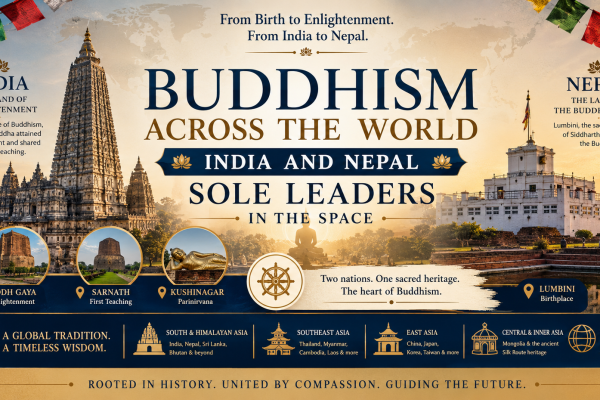
Buddhism is one of the world’s great transnational religions, with a presence stretching from the Himalayas and South Asia across Southeast Asia, East Asia and, increasingly, North America, Europe and Australia. Yet the geography of Buddhism tells a story that is more complicated than simply counting the number of Buddhists in each country. According to Pew Research Center’s latest global estimates, approximately 324 million people identified as Buddhist in 2020. Nearly 98% lived in the Asia-Pacific region, and the ten countries with the largest Buddhist populations accounted for about 91% of the global Buddhist population. Countries such as Thailand, Cambodia, Myanmar, Sri Lanka, Bhutan, Laos and Mongolia have Buddhist majorities. Japan, China, Vietnam, Taiwan, South Korea, Singapore, Malaysia and others have substantial Buddhist communities or deep Buddhist cultural traditions. Buddhism has also established communities in countries far beyond Asia, including the United States, Canada, Australia and several European countries. But if Buddhism is understood not merely as a demographic category, but as a civilizational, historical and pilgrimage tradition, two countries occupy a uniquely important position: India and Nepal. Buddhism’s Asian heartland Buddhism began in the Indian subcontinent more than two millennia ago and subsequently spread throughout Asia. Today, its strongest demographic presence is concentrated in East, Southeast and South Asia. Thailand and Cambodia are among the world’s most heavily Buddhist societies, with Buddhists making up approximately 94% and 97% of their populations respectively, according to Pew’s 2020 estimates. Myanmar is about 89% Buddhist, Bhutan about 75%, Sri Lanka about 70%, Laos about 64%, and Mongolia about 51%. Other countries have large Buddhist populations without Buddhist majorities. China, Japan, Vietnam, South Korea, Taiwan, Malaysia and Singapore all contain significant Buddhist populations or retain important Buddhist cultural institutions. This distinction matters. A country can have millions of Buddhists without being the historical centre of Buddhism, while another country can have relatively few Buddhists today but possess extraordinary importance to Buddhist history. India is the clearest example. India: the birthplace of the Buddhist tradition Modern India is not a Buddhist-majority country. Pew estimates that roughly 9.6 million Indians identified as Buddhist in 2020, representing less than 1% of India’s population. Yet demographic size alone cannot measure India’s importance to Buddhism. The Buddha’s teachings emerged in the Indian subcontinent, and many of the foundational events of his life occurred in what is now India. The region became the setting for the development of Buddhist philosophy, monastic institutions, universities, artistic traditions and pilgrimage networks that subsequently influenced much of Asia. Most importantly, India contains Bodh Gaya, traditionally regarded as the place where Siddhartha Gautama attained enlightenment. The Mahabodhi Temple Complex at Bodh Gaya is a UNESCO World Heritage Site and one of the four principal holy sites associated with the Buddha’s life. UNESCO describes Bodh Gaya as the place associated with the Buddha’s enlightenment and notes that it has been venerated by Buddhists from around the world for centuries. India is also home to other foundational Buddhist sites, including Sarnath, where the Buddha is traditionally understood to have delivered his first sermon, and Kushinagar, associated with his passing into parinirvana. The result is a remarkable paradox: India is not among the world’s leading countries by percentage of Buddhists, yet it remains arguably the most important country in Buddhist sacred geography. That distinction gives India a form of leadership that demographic tables cannot capture. Nepal: the sacred geography of Buddha’s birth Nepal’s importance is complementary to India’s. In southern Nepal lies Lumbini, traditionally recognized as the birthplace of Siddhartha Gautama, the Buddha. UNESCO identifies Lumbini as one of the holiest and most significant places associated with one of the world’s major religions. Archaeological remains at the site demonstrate the existence of Buddhist pilgrimage activity dating back to antiquity. Lumbini is not simply a historical attraction. It is a living international pilgrimage centre, visited by Buddhists from across Asia and the wider world. The site’s importance is reinforced by archaeological evidence, including the Ashoka Pillar and remains of ancient Buddhist monasteries and stupas. UNESCO notes that Emperor Ashoka visited Lumbini and erected the commemorative pillar in the third century BCE. Nepal therefore possesses something no other modern nation can replicate: the birthplace of the Buddha itself. And when combined with India’s Buddhist sacred sites, the two countries form a remarkably coherent pilgrimage geography. India and Nepal: two halves of Buddhism’s sacred core The relationship between India and Nepal is especially significant because the most important places associated with the Buddha’s life do not fit neatly within today’s political borders. Nepal holds Lumbini, the Buddha’s birthplace. India holds Bodh Gaya, associated with his enlightenment; Sarnath, associated with his first teaching; and Kushinagar, associated with his passing. Together, they form the central pilgrimage circuit of the Buddha’s life. This gives India and Nepal a unique position in the global Buddhist landscape. Thailand may have a larger Buddhist population. Cambodia may have a higher percentage of Buddhists. Japan and China possess immense Buddhist artistic and intellectual legacies. Sri Lanka has preserved an exceptionally influential Theravada tradition. But India and Nepal possess the physical geography of the Buddha’s life itself. That is a fundamentally different kind of leadership. The wider Buddhist world The Buddhist world can broadly be understood through several major cultural zones. South and Himalayan Asia include India, Nepal, Sri Lanka and Bhutan. Sri Lanka became a major centre of Theravada Buddhism, while Bhutan developed a distinctive Himalayan Buddhist tradition. Southeast Asia includes Thailand, Myanmar, Cambodia and Laos, where Theravada Buddhism remains deeply embedded in national culture and everyday life. Cambodia, Thailand and Myanmar are among the countries with the world’s highest proportions of Buddhists. East Asia includes China, Japan, South Korea and Taiwan. These societies developed distinctive forms of Mahayana Buddhism and, in Japan, traditions such as Zen and Pure Land Buddhism. Central and Inner Asia historically played an important role in the movement of Buddhism along trade routes linking India with China and beyond. Mongolia today remains one of the world’s Buddhist-majority countries. Beyond Asia, Buddhist…

Buddhist philosophy is a multifaceted tradition with numerous philosophers who have significantly shaped its development over centuries. Here is an extended list of influential Buddhist philosophers and a brief overview of their contributions and philosophies.
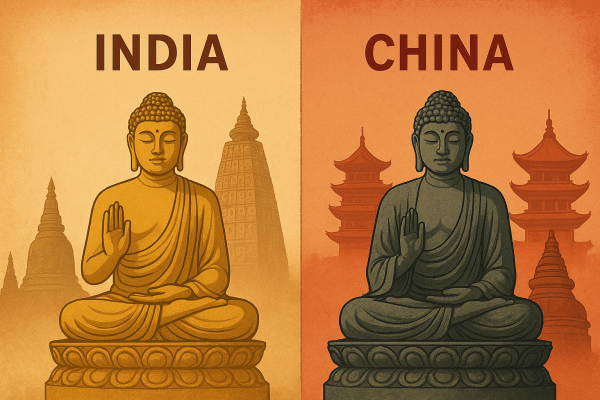
Buddhism, born over 2,500 years ago in the Indian subcontinent, has re-emerged in the twenty-first century as a powerful tool of diplomacy. Both China and India are harnessing Buddhism’s soft power potential to build cultural bridges and influence regional geopolitics. Yet the two nations’ methods and motivations could not be more different.
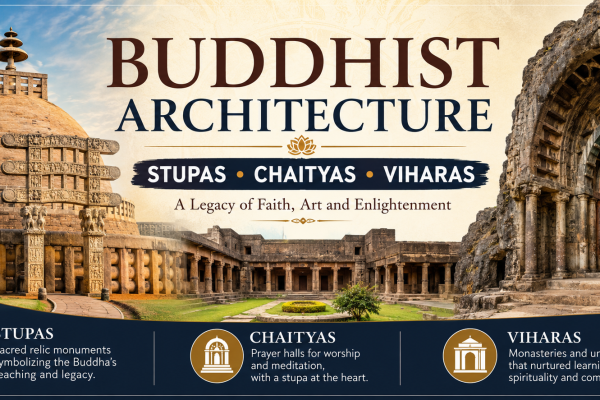
Explore the fascinating world of Buddhist architecture through its three iconic forms—Stupas, Chaityas, and Viharas. Learn about their history, architectural features, symbolism, famous examples like Sanchi, Ajanta, and Nalanda, and their lasting contribution to India’s cultural and architectural heritage.
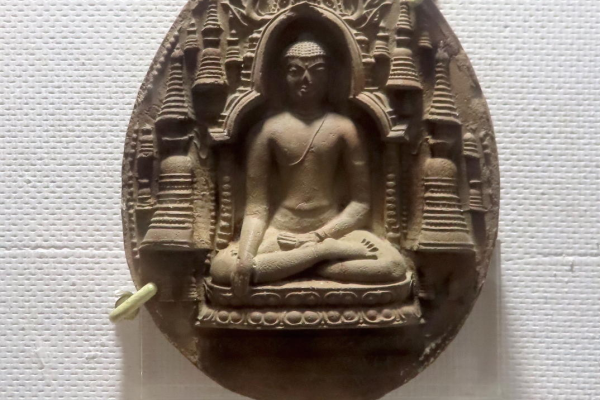
Buddhist heritage is far more than a collection of ancient monuments or religious traditions; it is a living legacy that continues to shape cultures, societies, and global thought. Rooted in the teachings of Siddhartha Gautama, Buddhism has influenced philosophy, art, architecture, literature, governance, and ethical values for over two millennia. As it spread across Asia and later to the rest of the world, it fostered cultural exchange, intellectual dialogue, and peaceful coexistence among diverse civilizations. In the contemporary era, Buddhist heritage occupies a significant place in global discourse, contributing to conversations on peace, sustainability, intercultural understanding, heritage conservation, and human well-being. Examining Buddhist heritage through historical, cultural, and international perspectives reveals its enduring relevance as both a repository of the past and a guiding framework for addressing the challenges of an increasingly interconnected world.
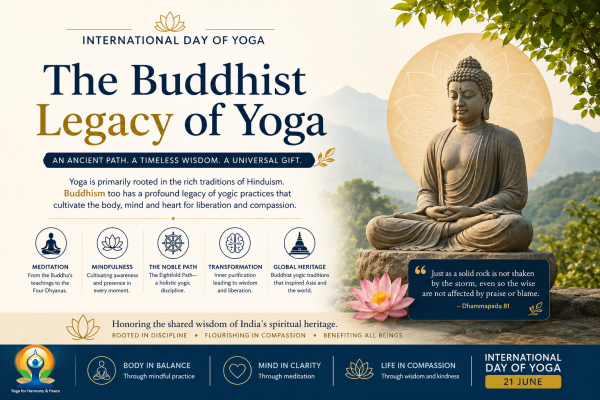
Explore the Buddhist legacy of yoga on International Day of Yoga, from the Buddha’s meditation teachings to Tibetan yogic traditions and mindfulness.
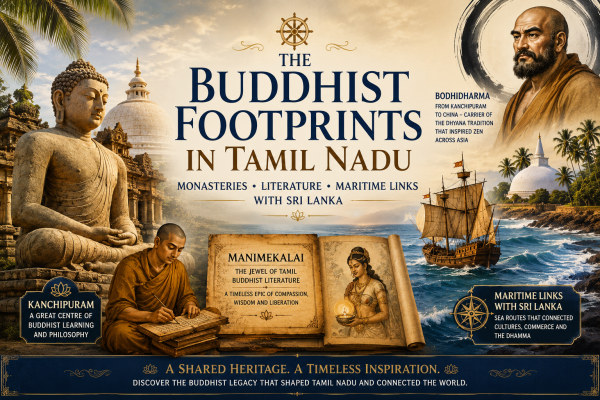
When the history of Buddhism in India is discussed, regions such as Bihar, Uttar Pradesh, and Madhya Pradesh often dominate the narrative. Yet, the southern state of Tamil Nadu preserves a remarkable and often overlooked Buddhist legacy that contributed significantly to the intellectual, literary, and maritime history of the Indian subcontinent.

Explore Kapilavastu, the ancient capital of the Shakya kingdom and childhood home of Lord Buddha. Discover its deep significance in Buddhism and its powerful cultural and spiritual link between India and Nepal, symbolizing peace, unity, and shared heritage.
