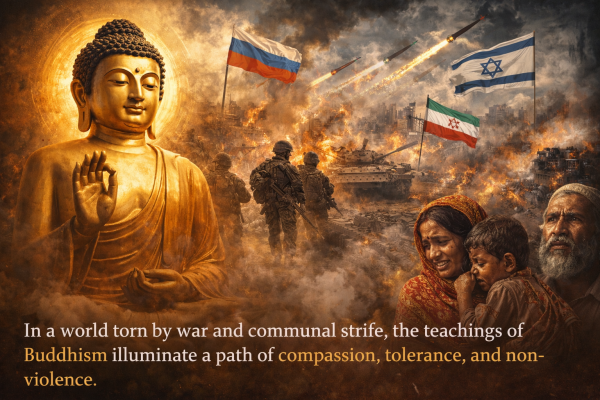
The World Needs Buddhism in the Age of Wars

Why the World Needs Buddhism in the Age of Wars

In an age marked by wars, rising tensions, and communal violence, the teachings of Buddhism offer a path toward compassion, tolerance, and non‑violence. From the Russia–Ukraine conflict to Iran–Israel tensions, and even internal strife in Pakistan and Bangladesh, the philosophy of Buddha reminds humanity that lasting peace begins with empathy, dialogue, and ethical reflection.

Read More

How Buddhism Spread Across Europe — And India’s Timeless Role

Buddhism, born over 2,500 years ago in northeastern India, remains one of the world’s most enduring spiritual traditions. From its origins under Prince Siddhartha Gautama in the ancient kingdoms of Magadha and Kosala, Buddhism’s message of peace, compassion, and inner transformation journeyed far beyond the Indian subcontinent — across Asia, through the ancient Silk Routes, and ultimately into Europe. India’s role in this global flowering is foundational not only as the cradle of the Buddha’s teachings but as the seedbed from which these teachings sprouted and adapted in new lands. Indo-Buddhist Heritage Forum+1 The Roots: India as the Cradle of Buddhism India’s contribution to Buddhism is profound. It is the land where Siddhartha attained enlightenment beneath the Bodhi Tree at Bodh Gaya and lived the dhamma that would transform human history. Under Indian patronage — most notably by the Mauryan emperor Ashoka in the 3rd century BCE — Buddhism expanded across the subcontinent, fostered monastic universities like Nalanda and Vikramashila, and forged networks of scholars and monks who carried the dhamma along trade routes into distant regions. Indo-Buddhist Heritage Forum+1 The Silk Route, an ancient network of land and sea pathways originating in northwestern India, became the vital conduit through which Buddhism traveled into Central Asia, China, Korea, Japan, and beyond. Merchants, pilgrims, monks, and artisans carried scriptures, art, and teachings — blending them with local cultures — establishing Buddhism as both a spiritual force and a cultural bridge across continents. Indo-Buddhist Heritage Forum+1 Early Contacts with the West Although Buddhism did not take strong institutional root in Europe in antiquity, early contact did occur. During and after the campaigns of Alexander the Great (4th century BCE), cultural exchange between Hellenistic and Indian spheres encouraged early forms of syncretism now known as Greco-Buddhism, particularly in the region of Gandhara (modern Pakistan and Afghanistan). There, Buddhist ideas and iconography intersected with Greek aesthetic influences, creating some of the earliest anthropomorphic images of the Buddha and signaling Buddhism’s westward intellectual reach. Wikipedia+1 Modern Transmission to Europe It was not until the 19th and 20th centuries that Buddhism began to establish a visible presence in Europe as a living tradition, rather than as an academic curiosity. European scholars, often influenced by their study of Indian texts and archaeological discoveries, helped introduce Buddhist ideas into Western intellectual circles. Encyclopedia Britannica https://ibhforum.org/buddhism-study-its-origins-and-global-footsteps/ By the late 1800s and early 1900s, translated Buddhist scriptures, lectures by Asian teachers, and encounters between European Orientalists and Indian culture deepened European engagement with Buddhism. Philosophers, poets, and writers began to explore Buddhist teachings on consciousness, ethics, and the nature of existence, creating fertile ground for spiritual seekers. BHARATA BHARATI 20th-Century Growth and Institutions The post-World War II era saw rapid growth of Buddhist practice in Europe. Immigrants from China, Japan, and Southeast Asia brought rich traditions that formed diasporic communities and established temples and centers. Simultaneously, European converts helped found organizations such as the European Buddhist Union, which continues to foster cooperation among Buddhist communities across the continent. Wikipedia Today, although Buddhists remain a minority in Europe, countries like Italy, Germany, Hungary, France, and the UK host vibrant Buddhist communities. These include practitioners of Theravada, Mahayana, and Vajrayana traditions — all of which trace their lineage ultimately back to Indian origins. Wikipedia India’s Enduring Cultural Influence India’s contribution to Buddhism goes beyond its historical beginnings. The philosophical depth of early Buddhist texts — preserved in languages like Pali and Sanskrit — continues to inform Buddhist study worldwide. Indian heritage sites, from Sanchi Stupa to Bodh Gaya, serve as pilgrimage destinations for practitioners and students from Europe, nurturing a living connection between Indian soil and European Buddhist identity. Indo-Buddhist Heritage Forum+1 Furthermore, contemporary interest in practices such as mindfulness and meditation — rooted in Buddhist contemplative traditions — demonstrates how core Indian-Buddhist insights have entered mainstream European life, influencing psychology, education, and healthcare. Encyclopedia Britannica Conclusion: A Shared Spiritual Heritage Buddhism’s journey from India to Europe illustrates the universal appeal of the Buddha’s teachings. Rooted in the Indian experience of liberation, the dhamma crossed mountains, deserts, and seas, adapting to diverse cultures while maintaining its core message of compassion, wisdom, and inner freedom. Today, Europe’s engagement with Buddhism reflects not only historical transmission but a dynamic and ongoing relationship — one that highlights India’s central role as the source of a universal spiritual legacy.https://ibhforum.org/the-world-of-buddhism-vibrant-lands-hidden-faith-and-indias-influence/

Read More
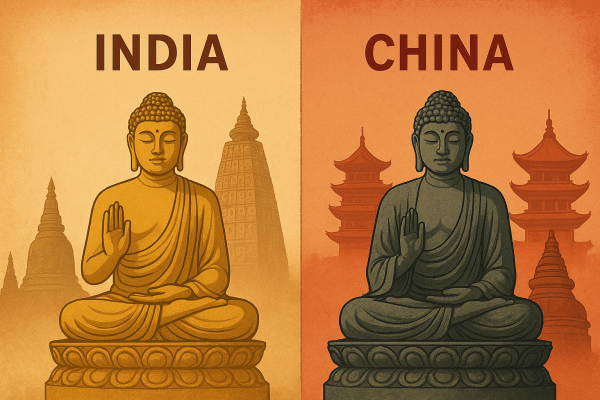
China vs India in Buddhism

How China and India Are Spreading Buddhism — and Why India’s Path Rings Truer

Buddhism, born over 2,500 years ago in the Indian subcontinent, has re-emerged in the twenty-first century as a powerful tool of diplomacy. Both China and India are harnessing Buddhism’s soft power potential to build cultural bridges and influence regional geopolitics. Yet the two nations’ methods and motivations could not be more different.

Read More

Buddhism, Hong Kong and Philosophy : An insightful journey

1. Buddhism  a. What drew you to Buddhism initially, and how has your relationship with the Dharma evolved over time? I am a journalist of religion. I loved writing ever since childhood, exploring my creativity and ideas in reflective pieces, short stories, and prose. I have always been fascinated by the idea of the transcendent or the divine since high school. I pursued this interest more fully at university when I studied religion and philosophy. It was during this time that I was particularly influenced by Catholicism and Buddhism, but after reading the Huayan jing (Avatamsaka Sutra), I made the decisive shift toward Buddhism and took refuge in the three treasures in the Chinese Buddhist tradition in 2008, the third year of my undergraduate studies. By 2012, I had the good fortune to combine my Buddhist beliefs with a career in journalism after completing two Masters in Buddhist Studies and Christianity and interreligious relations respectively.    b. Are there any particular Buddhist teachings or practices that have had a profound impact on your life? If so, could you share how they have influenced you?Since I initially converted to Buddhism many years ago based on the cosmic, mystic vision of the  Huayan jing, I have also aligned with Pure Land Buddhism, which is based around the Buddha-invocation of Amitabha Buddha. But I also enjoy delving into early Buddhist practices, and I am particularly interested in the meditative and contemplative practices that can be feasibly dated closer to the pre-recorded Buddha-era.      c. In your opinion, what sets Buddhism apart from other spiritual traditions, and what do you believe are its most compelling aspects? Most certainly, the Buddha’s insight into no-self (anatta) is the most unique idea in the history of the world’s great religions, since every other single tradition preaches the existence of a soul. It is also the most counter-intuitive and most difficult to practice in our everyday life, simply because we rely so much on conventional language and conceptual constructs like, “I,” “me,” “mine,” and more: the construction of the false ego. We depend on this false ego to exist in our society, yet the Buddha advises that this is not the right way to live. One might almost think that he was posing a near-impossible challenge to humanity. But if he thought this insight was worth preaching despite its counter-intuitiveness, even unattractiveness, then no-self must have a very important core of truth to it.  2. Buddhistdoor Global a. Could you tell us more about Buddhistdoor Global and its mission? Founded in 1995, BDG is a platform focused on reporting on Buddhist personalities, trends, and news around the world. It is non-sectarian and embraces all mainstream Buddhist traditions. We have a team based around the world, complete with contributors and columnists. Its beginnings were initiated in Vancouver by Mr. Robert H. N. Ho, a Buddhist philanthropist.   3. Hong Kong Society of Dharma Supporters a. As the Vice-chairman and director of the Hong Kong Society of Dharma Supporters, what are some of the key initiatives or projects that the organization is currently involved in? HKSDS is a non-profit organization that supports various Buddhist activities in Hong Kong. These can be in the form of retreats or Dharma talks. Apart from events, we have also sponsored small publications by certain Buddhist teachers. In this sense, the Society carries on a tradition that has been the mainstay of Buddhist laypeople in China and Hong Kong since the turn of modernity.  b. How do you envision the role of the society in promoting Buddhist teachings and fostering community engagement in Hong Kong? Hong Kong is stereotypically seen as a very unhappy, stressful city. However, it also has a very rich and precious Buddhist heritage, and the Society sees the propagation of the Dharma as critical to the wellbeing of the city’s people.  4. Heythrop Association a. As a Trustee of the Heythrop Association, what inspired you to become involved with this organization? In 2012, before beginning my career in Hong Kong, I did an MA in Christianity and Interreligious Relations at a constituent college of the University of London called Heythrop College. In 2018, this Jesuit college closed permanently for various unpleasant reasons, but it institutionally lives on in the Heythrop Association, which is a registered charity in the UK and whose membership is made of former alumni and associated academics.  b. Could you share some of the activities or initiatives that the Heythrop Association is undertaking to support its mission? The HA hosts events among its membership, including lectures by former professors of Heythrop College and tours of various Jesuit and Christian sites. We continue the Heythrop heritage by supporting fruitful discussions about the place of faith in today’s world, with a focus on philosophy and theology.  5. Life Journey and General Philosophical Questions a. What experiences or events have shaped your personal and spiritual journey, leading you to where you are today? As far as I can remember, there was no formative moment or event that defined my path to where I currently stand. Rather, I see it as a constellation of karma, self-initiative, and luck that pushed me in various directions, culminating in who I am today. It is an ongoing process, life after life, and even when one attains bodhisattvahood or Buddhahood, the project to help liberate sentient beings across the cosmos never stops.  b. How do you navigate the balance between your professional commitments and your personal spiritual practice? I see both as one and the same. At least, that is the ideal. The reality is that spiritual commitment cannot be like a piece of clothing like a shirt or dress, to be picked up and dropped in the span of a day. If how we behave at work (or our choice of industry) is not aligned with our religious practice, then we will be living inauthentically, in bad faith. On the other hand, we are human and we will always make mistakes, sometimes big ones. I would rather ask: in BOTH our professional and spiritual lives,…

Read More