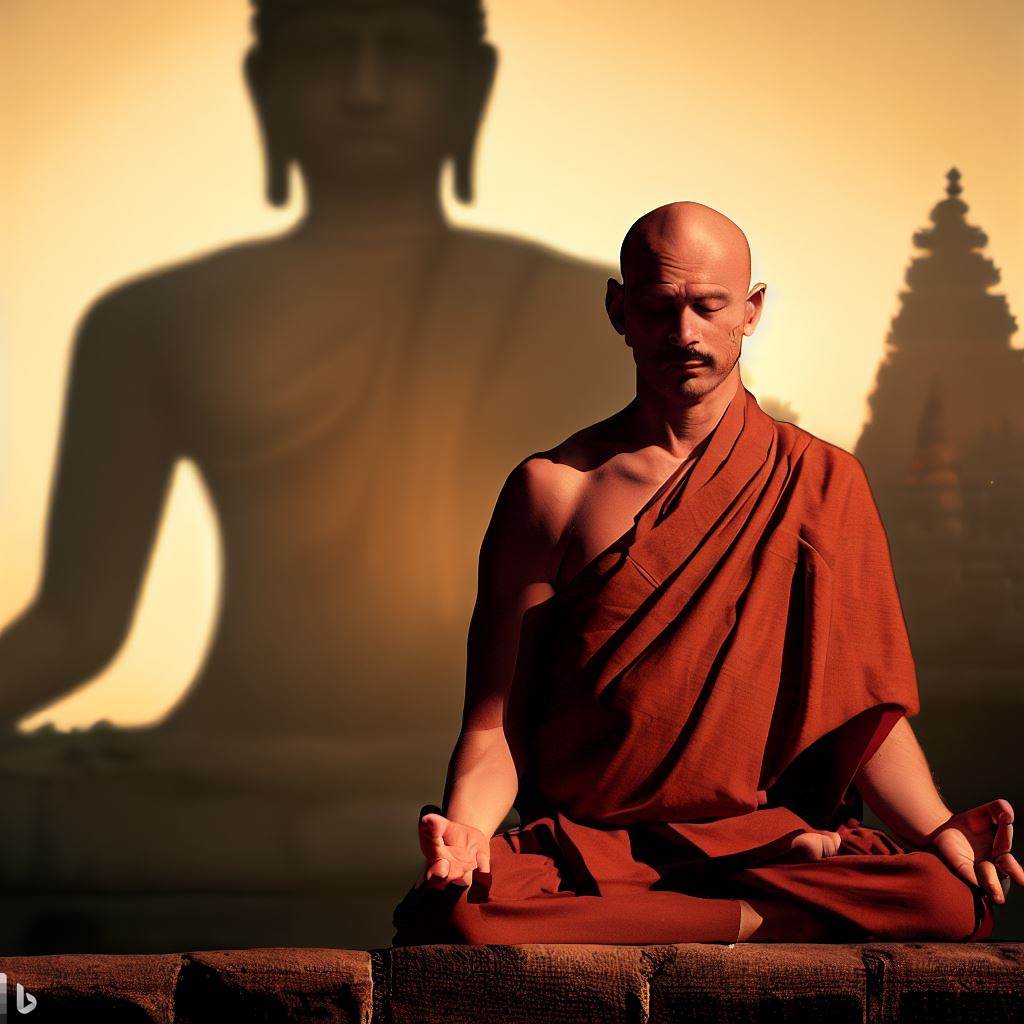
Zen Buddhist meditation

Zen Buddhism, the Udumbara Flower

First, a general background to Zen, then a brief, as long as it may be, this is a brief description of Japanese Zen and a summary of Western Zen as well, both in no way conclusive, followed by thoughts for the future of Zen. I won’t go too deeply into explaining the practice of Zen except where it’s appropriate for context. I suggest going to other sources for that. However, any comments on contemporary Zen and its future must be understood in some context of past and present East and West development and practice. I’ll use the conventional term Western Zen, though there is no such thing as such, for shorthand discussing Zen in the West, just as it can be argued there is no such thing as ‘Japanese Zen’ in much the same way, ultimately, there is only Zen. The influence of Korean and Vietnamese Zen is substantial, but for reasons I’ll outline as I go, I will concentrate here on the relationship between Japanese Zen and Western Zen. Overall, Zen Buddhism is a Mahayana school and, as such, carries characteristics and framework of the tradition and, therefore, some familiar to other traditions in the Mahayana movement as well. That means teachings of the Bodhisattva Way – Compassion doctrine, religious rituals, and customs from India intermingled with the development of Chinese customs and the development of Chinese Mahayana scriptures and practices. Its meditation practices combine and evolve Samatha and Vipassana and are mainly developed in India. It’s challenging to go into the development of Zen in India, and I won’t try here in any great detail; that would be an essay on its undertaking after Venerable Sakyamuni, the historical Buddha, but Zen claims to continue his example of personal searching and direct insight, and this forms the core of the tradition that was transmitted to China. The notion of evolving Dharma is quite crucial in Zen. This, among other things, sets Zen apart and is quite crucial to this discussion; the capacity for evolution sets Zen and other Mahayana schools apart from contemporary Theravada Buddhism, which in any country or epoch looks the same and stands in principle on that. Zen Buddhism is considered to have spread from India to China in the 5th century C.E., and traditional dates and people are somewhat representative. It’s questionable whether the exact historical details will ever be known. Nonetheless, the school continued to develop in China, and by the 9th Century, its distinctiveness had taken shape sufficiently to spread from there to Vietnam and Korea and, finally, during the Sung Dynasty, to Japan. This staged spread resulted in differences between lineages in the development of thought and practice, with their ethnic dimension and temporal characteristics depending on when they split from the main lineage in China. Rinzai Zen amalgamates several Sung dynasty schools and their methodologies, known for the Chinese Zen master Rinzai Kigen. Zen in Asia remained mainly monastic, though as a Mahayana school, it has civil characteristics, and it is impossible not to consider a solid relationship to culture. Buddhism and the Arts have always gone hand in hand in China and Japan, hence the narrative in China that Bodhidharma introduced Tea, Martial Arts and painting into China. Naturally, this is a legend; of course, there’s broad archaeological evidence that China’s cultural arts predate the introduction of Zen Buddhism, but the narrative illustrates the role Zen has played in providing metaphorical inspiration and spiritual depth in all the societies it has been practised in. Both Artists and Monks work to ‘See’ and to ‘act’ truthfully, so it’s naturally convergent that Zen training provides a vehicle to do that, and the world of the temple is also that of the artist and many others who seek the same. Zen entered Japan in the 12th century, corresponding with the late Chinese Sung dynasty; well-developed Rinzai teaching centred for the most part on Zen meditation, which developed in India as a combination of Samatha and Vipassana practices, and koan practice developed in China, often misunderstood as enigmatic riddles but in fact tools for triggering metaphorical understanding. Chinese and Indian literature and ritual liturgy are similar to any other school of Mahayana Buddhism. To understand the development of Koans in the Zen tradition, see Hogen Sori’s work Zen Sand, in which he gives an in-depth discussion of the format and function of the tradition, I’ll say here that koans form a unique metaphorical insight method of Zen. Shingon and Tendai Buddhism were introduced into Japan by the priests Kukai and Saicho, respectively, in the 8th century, and it was predominantly from these two sects of monks who took up Zen, among the most famous was Esai, a Japanese Tendai sect monk, regarded as the founder of Kenninji Zen Temple, and Enni Bennin a former Shingon monk regarded as the founder of Tofukuji Zen Temple, Ehei Dogen founder of Soto Zen in Japan was also a former Tendai master. This relationship has left a character on Japanese Rinzai and Soto Zen. 13 Chinese Rinzai Zen masters were invited to Japan, and numerous Japanese monks travelled to China in the 11th and 12th centuries, and together established the Rinzai and Soto lineages that survive today. A second wave of Chinese Zen teachers arrived in Japan in the 1600s, introducing latter-day Rinzai practice as it was in China by then, and that lineage became known as Obaku Zen in Japan to differentiate its practices and lineage from those established earlier. Obaku Zen never became widespread and has largely died out in the post-war period. To briefly mention, though it’s of solid importance both in Japan’s past and the future of global Zen, the introduction of Zen into Japan concurred with the rise of the Samurai warrior class as a power in Japanese society, and this too contributed to the establishment of Zen Buddhism, and Zen to the growth in cultural arts which the Samurai wished to take up in emulation of the Japanese aristocracy. This interstate…


Read More

An Exploration of Anicca, Anatta and Dukkha in Buddhism

In the profound tapestry of Buddhist philosophy, two threads stand out as the very heart of its wisdom: Anicca and Anatta. These concepts, deeply rooted in the teachings of the Buddha himself, offer a unique perspective on the nature of existence and self. Anicca: The Dance of Impermanence Anicca, often called impermanence, directs our attention to the ever-changing nature of all things. It is a reminder that in the grand symphony of life, there are no constants; everything is in a perpetual state of flux. From the rhythmic rise and fall of our breath to the shifting seasons, impermanence weaves its melody through every facet of our existence. Understanding Anicca is akin to acknowledging the impermanent nature of the world and our own experiences. It urges us to recognize the transient quality of joy and suffering alike. By comprehending the fleeting nature of our attachments, we unravel the causes of our suffering. This profound insight encourages us to let go of our clinging, for we understand that grasping at the ephemeral only deepens our anguish. Anatta: The Illusion of Self Anatta, often translated as ‘no-self,’ challenges a fundamental assumption – the existence of an unchanging, permanent self. It guides us to inspect the notion of ‘I’ or ‘self’ we hold dear. According to this teaching, what we perceive as our self is not an unalterable entity but a composition of ever-changing components. The concept of Anatta strips away the illusion of an enduring self. Instead, it reveals that the self we cling to is a dynamic interplay of thoughts, emotions, and physical sensations. This revelation forces us to question the attachments we harbour toward this constructed ‘self.’ As the illusion of an unchanging self dissolves, so does the ego’s stronghold on our actions and perceptions. The Triad of Dukkha: Understanding the Roots of Suffering In the heart of Buddhist philosophy lies the concept of Dukkha, often translated as ‘suffering’ or ‘unsatisfactoriness.’ Dukkha is the third integral concept that, together with Anicca and Anatta, forms the core of Buddhist wisdom. Dukkha reminds us that suffering is an intrinsic part of life. It encompasses not only the apparent pain and hardship but also the subtle sense of dissatisfaction that permeates our existence. Whether it’s the fleeting nature of pleasure or the relentless yearning for more, Dukkha teaches us that suffering is an ever-present companion on life’s journey. Understanding Dukkha is the key to addressing the causes of our suffering. By recognizing the inherently unsatisfactory nature of worldly pleasures and attachments, we are prompted to seek a more profound, lasting form of contentment. The Buddha’s teachings guide us towards a path of liberation by unravelling the roots of suffering and illuminating a way to transcend it. As we grasp the triad of Anicca, Anatta, and Dukkha, we embark on a transformative journey towards a life free from suffering and rich in wisdom, compassion, and inner peace. The Liberating Path of Understanding Anicca and Anatta are not merely abstract ideas; they are profound lenses through which we perceive the world. By integrating these concepts into our daily lives, we embark on a transformative journey toward liberation. This journey does not lead to nihilism, as some might fear, but to a deeper engagement with life. We are liberated from the illusions of permanence and self. The relentless pursuit of stability gives way to an authentic embrace of life’s impermanence. It is a shift from illusion to insight, from suffering to freedom. The path to awakening in Buddhism is intrinsically tied to grasping Anicca and Anatta. These concepts invite us to see through the veils of permanence and self, guiding us towards an enlightened existence. They grant us the wisdom to navigate life’s uncertainties with equanimity. In embracing Anicca and Anatta, we unlock the core of Buddhist wisdom, transcending the ordinary and touching the profound. These teachings beckon us to dive deep into the nature of existence, offering a unique path to liberation – one that is both radical and profoundly serene. Browse our YouTube Channel : https://www.youtube.com/@ibhforum

Read More
quiz, exam, icon-3644414.jpg

Test Your Buddhist Wisdom and win exciting awards.

The Winners of the Quiz are: 1.Palmo Kyidtodpa 2.Namgyal Wangchuk Nyima 3.Thokmay Bongpatsang The winners will contacted through e-mail. The contest for $20 is over. You can still attempt the quiz for practice. Are you ready to challenge your knowledge of Buddhism? We’re hosting a Buddhist quiz with five intriguing questions, and here’s your chance to win $20! 🧠 Test your understanding of Buddhist teachings and symbols. 💰 Win $20 for being one of three lucky winners. The names of the winners will be displayed on this page on the 5th of November, 2023

Read More

Manjusri, 1 of the most Prolific BODHISATTVA of Zen

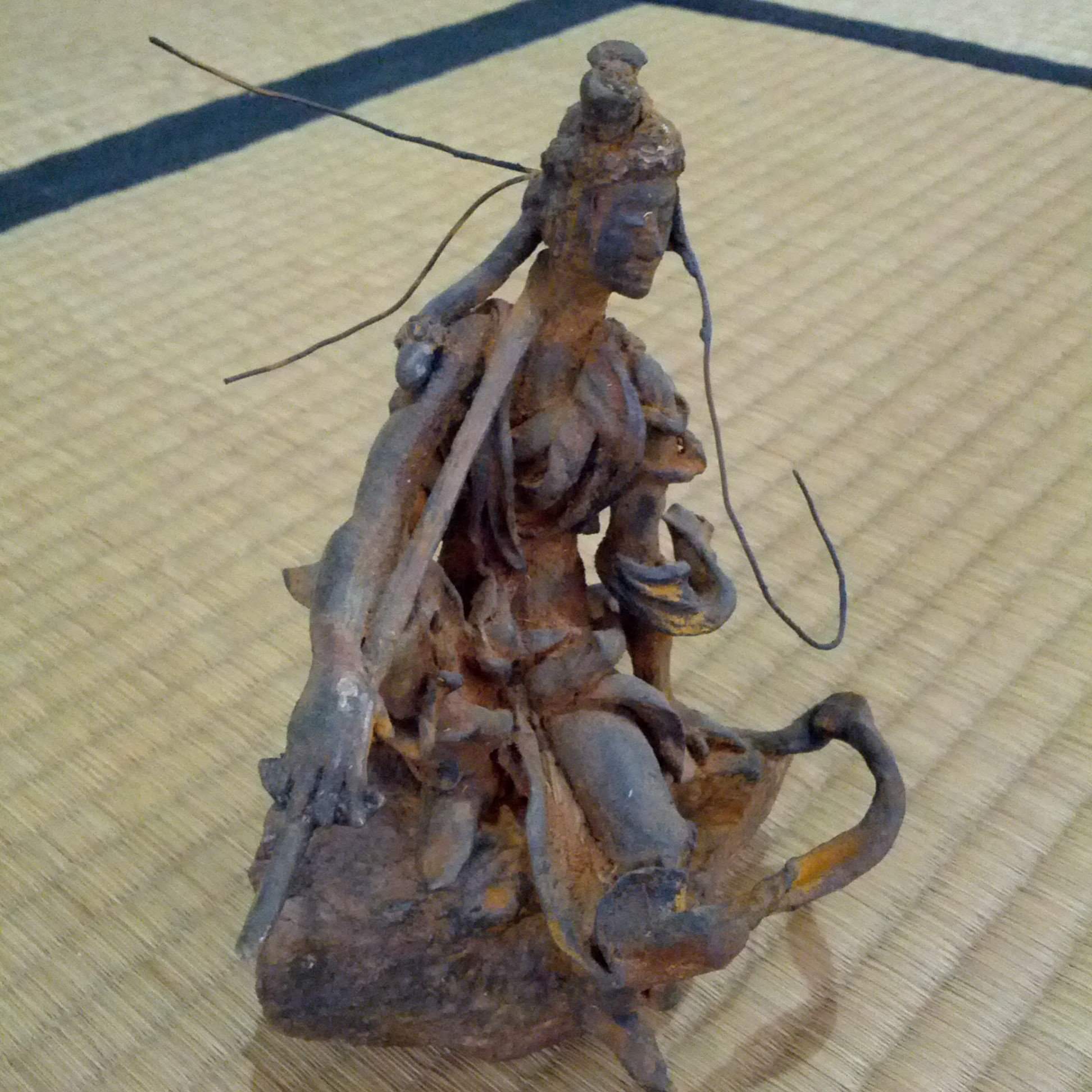
Mahayana Buddhism expounds that all beings are potential Buddhas and Bodhisattva. In the Zen school, which is a branch of the Mahayana, adherents strive to realize Buddhahood or live as a Bodhisattva in this lifetime as Zen claims to be both the historical descendent school of Venerable Sakyamuni Buddha and vehicle to Prajna Wisdom in this lifetime, freeing the devotee of Zen from ignorance. Therefore, Manjusri  Bodhisattva, the Bodhisattva of Wisdom, may be seen as a tutelary example of how Zen Buddhists should strive in their training to open the Dharma’s eye. In the West, Zen is often portrayed as people in black sitting doing zazen in white rooms and not much more. Often in the West, Zen Buddhism is portrayed in the popular as an Eastern form of Stoicism, which it shares near principles with. Or it is sometimes imagined as a Protestant Buddhism’, simple and without symbolism. Thousands of books are now in publication in Western Countries in English, French, German and other languages, and it’s been estimated in the United States that more than 60% of Buddhists are practising Zen, but this is not the complete picture of Zen Buddhism. Undoubtedly, this has contributed to the spread of Zen Buddhism in the West, and how this came about is a complex of causes derived in part from the background of Westerners who travelled to Asian countries like Japan and Korea and then returned to their countries. A prime example of this is the famous book Zen and Archery by Eugen Herrigel, published in the 1930s, which laid considerable groundwork for the idealized expectations of Europeans. Zen and the Art of Archery, like many books like it, only told the partial practice of Zen Buddhism, perhaps because lay authors like Herrigel did not have time to delve deeply while they stayed in Asia or because they filtered what they wanted. Many early Zen people in the West were from secular Protestant Christian backgrounds and little interested in ritual and legend. When Asian teachers arrived in Western countries, they, too, were faced with predominantly lay students who were equally disinterested in anything they deemed superfluous to Zen. Of course, the nature of Zen is to emphasise reductive simplicity to get to the Fundamental point of things, to emphasise ‘Prajna’ insight. And this continues even today in Western Zen centres. This, in contrast to the next largest lineage of Buddhism, is  Vajrayana, or ‘Tibetan’ Buddhism as it’s colloquially often referred to in the West.  We associate Vajrayana Buddhism in the popular consciousness with Bodhisattva, Guardians and Devas, and subsequent rituals to invoke the superstitious power of such beings to help and guide. However, ritual is not limited to the Vajrayana lineages and is found in Zen Buddhism as well.  Zen Buddhism is part of the Mahayana movement, which can be described as a federation of lineages that spread out of India. Zen is traditionally considered to have arrived in China around the 7th Century C.E., making it a historical latecomer to the Chinese Buddhist dysphoria. Zen Buddhism is an outlier in the Mahayana movement, having strong characteristics that would be more likely to be matched with Theravada Buddhism that spread to and survived in Southern India as part of Southern Buddhism. Zen and Theravada lineages, for the most part, put emphasis on meditation, Vipasanna for Theravada, and Dyanna, a method of meditation derived from Samatha and Vipasanna, and critical scriptural studies and dialogues. However, Theravada spread further south, eventually into what are now Sri Lanka, Thailand, Burma, and Laos predominately, while Zen Buddhism spread into China [1]. As a Mahayana school, Zen, therefore, inherited the Legendary traditions of Mahayana while still adhering to historicity and rationalism. Hence, in the Zen school, Venerable Sakyamuni is the ‘Historical Buddha’ while not denying his previous births. The historical Buddha remained paramount in Zen, with Venerable Mahakashyapa as the first  Indian Ancestor and Zen revering 26 subsequent Indian Ancestors, including Venerable Nargajuna. The lineage of Zen is another deep subject, however, only touched on here. As part of the Mahayana, Zen inherited the teaching that multiple births led to the birth of Venerable Sakyamuni, his teaching and his Parinirvana supported by the various guardians, Bodhisattva, Devas, generals messengers and others. In China, the Sacred Mountain of Wu-tai, historically associated with the golden age of Zen Buddhism, is considered the mythic earthly home of Manjusri Bodhisattva. Manjusri In Art In Buddharupa images, the Bodhisattva Manjusri is depicted with a sword in their right hand, typically to cut the bonds of ignorance away, representing Wisdom and freedom or sometimes a White Lotus representing the purity of the teachings. Manjusri Bodhisattva may appear in Indian or Chinese forms, resembling other Bodhisattvas. Additionally, in Chinese and subsequent Korean, Japanese and Vietnamese lineages of Zen and Mahayana Art, as riding a Celestial dog or, less commonly, an elephant as in the original Indian depiction. The Celestial Animal represents the Cannon of the Teachings, the Tripitaka. Manjusri Buddha rupa are traditionally sculpted in stone, bronze or wood; stone Buddharupa typically will be set in the temple’s precinct, while wooden and bronze are set in the Buddha Hall. Line and coloured paintings are also made on paper or on wood panels. In paintings, associations with Manjusri Bodhisattva not only take the form of illustrating the Bodhisattva but also the aforementioned Wu-tai mountain and scenes from the sutras depicting the Layman Vimalakirti and others as he debates with the Bodhisattva. Famous and easily seen examples of statuary Buddharupa in the Rinzai Zen school are the Great Buddha Halls or Dai Hondo at Kenninji, Tofukuji and Nanzenji in Kyoto, Japan, where you will find large wooden Buddharupa settings. In Practice In Zen temples, the Bodhisattva Manjusri is often enshrined in the main hall of the Buddhas and Bodhisattva, where commemorative rituals are carried out. Usually in a grouping called Shaka sanzon, opposite the Bodhisattva Samantabhadra (O-Fugen-sama), the Bodhisattva of training. Another type of grouping found in some Buddha halls is the Four…

Read More
buddhist symbols and meanings

Buddhist symbols and their inspiring meanings

One of the world’s oldest religions, Buddhism, is a spiritual path deeply entwined with symbolism. It employs a rich tapestry of Buddhist symbols and imagery to convey profound teachings, inspire devotion, and lead its practitioners to enlightenment. These physical and metaphysical symbols offer a glimpse into the complex world of Buddhist spirituality. This article delves deeply into Buddhist symbolism, investigating the symbolic physical attributes of Buddhist monks, the eight auspicious signs, and their significance in various Buddhist traditions. Symbolic Physical Attributes The Buddhist Robes Buddhist monastic attire, also known as robes, plays a vital role in conveying Buddhist monks’ identity and spiritual commitment. These robes’ style and design indicate the specific Buddhist sect, tradition, or country and carry profound symbolic meanings. In most Buddhist cultures, the robe worn by a Buddhist monastic is a representation of renunciation. It symbolizes the detachment from material possessions and worldly desires, emphasizing a life dedicated to spiritual growth. Each tradition, sect, and country may have variations in robe colour, style, and wearing methods. This diversity of robes illustrates the rich tapestry of Buddhist culture. For instance, when Buddhism spread to China in the sixth century BCE from India, showing much skin was inappropriate. This led to robes with long sleeves designed to cover both arms. In contrast, Tibetan monks have historically shown their shoulders, and their attire consists of two pieces rather than one. In Japan, a unique addition to the robe known as “koromo” includes a bib and long sleeves designed explicitly for their Zen tradition. This distinct style serves practical as well as symbolic purposes, indicating their monastic affiliation. Another ritual act rich in symbolism is shaving one’s head. This act represents the willingness to embark on the monastic path and give up worldly attachments. It’s a powerful gesture representing letting go of the ego and embracing a life dedicated to spiritual growth. The Begging Bowl Buddhist monks’ traditional begging bowl contains profound symbolism. The monk’s reliance on the generosity of others for their basic sustenance is symbolised by this simple alms bowl. By accepting alms from laypeople, the monks create a spiritual link between the monastic and lay communities. It represents humility, material wealth’s transience, and interdependence’s significance. Begging for food is still a part of the monastic way of life in many Buddhist traditions. While begging has evolved as a practical necessity over time, its symbolic significance remains deeply ingrained in Buddhist monastic culture. The Ritual Tools Buddhist rituals are replete with symbolic tools and instruments that deepen the spiritual experience. Bells, for example, play a significant role in marking the beginning of rituals. The sound of the bell is believed to ward off negative energies and invite the protective presence of the Buddha during these sacred ceremonies. Bells, representing the “Mystic Law,” have a profound role in initiating Buddhist rituals across various sects. Drums, wooden fish instruments, trumpets, keisaku (a staff used in Zen monasteries for waking practitioners), and tantric tools like the vajra and bell are all integral to Buddhist rituals. These instruments are not merely practical aids but hold deep symbolic significance. Their sounds, rhythms, and forms contribute to the overall sacred atmosphere of the ritual. Physical Gestures Mudras, or physical gestures, are another essential form of Buddhist symbolism. The practice of joining hands in prayer or during rituals (Anjali mudra) is widespread. Buddhists compare their fingers to lotus flower petals, which represent purity and spiritual unfolding. Another physical gesture that represents reverence is bowing. Buddhists bow to a Buddha statue or another person to acknowledge the Buddha nature present within themselves and others, not to the physical entity. Mudras, or hand gestures with specific positions, are used in Buddhist practice to elicit particular states of mind. These gestures are frequently depicted in artistic depictions of the Buddha. Each mudra serves a dual purpose: it conveys a message to the practitioner and those who perceive it. Read about various Buddhist Mudras only on Ibh Forum here. The Eight Auspicious Signs A standard set of Indian “eight auspicious Buddhist symbols” is frequently used in Mahayana Buddhist art. Originally associated with kingship in pre-Buddhist India, these symbols found their way into Buddhist tradition, carrying profound meanings. These essential symbols in Tibetan and East Asian Buddhism guide practitioners on their spiritual journeys. The most common set of “Eight Auspicious Symbols” is as follows: 1. Padma (Lotus Flower): The lotus grows in muddy water but emerges untainted. This represents purity, spiritual enlightenment, and the ability to rise above the trials of everyday life. 2. The Endless Knot (Srivasta or Granthi): This knot symbolises the interconnectedness of all things, demonstrating how all phenomena are interconnected. It represents the Dharma’s continuity and the cyclical nature of existence. 3. Golden Fish (Matsyayugma) Pair: These fish represent abundance because they are prolific breeders. Because fish are free to move in water, they also represent liberation from the cycle of birth and rebirth. 4. Victory Banner (Dhvaja or Dhaja): The victory banner represents knowledge and wisdom triumphing over ignorance. It symbolises the triumph of the Buddha’s teachings. 5. Dharma Wheel (Dharmacakra or Dhammacakka): The wheel represents the Noble Eightfold Path with its eight spokes. It represents the Buddha’s teachings as well as the path to enlightenment. 6. Treasure Vase (Kumbha): The treasure vase represents abundance and wealth, not in the material sense, but in the Dharma’s richness. It is symbolic of spiritual wealth and abundance. 7. Jeweled parasol (Chatra or Chatta): The parasol represents spiritual protection and shelter. It symbolises the Buddha’s compassion and concern for all beings. 8. White Conch Shell (Sankha): The conch shell represents the Dharma’s far-reaching call to all beings to awaken. It also represents the triumph of speech and wisdom over ignorance. Symbols on the Feet of Buddha The Buddha’s feet, whether in statues or paintings, frequently bear distinguishing marks and Buddhist symbols. These “Lakshana” marks are thought to be present on a Buddha’s body as a sign of his spiritual and physical perfection. The Dharmachakra represents the turning of…

Read More
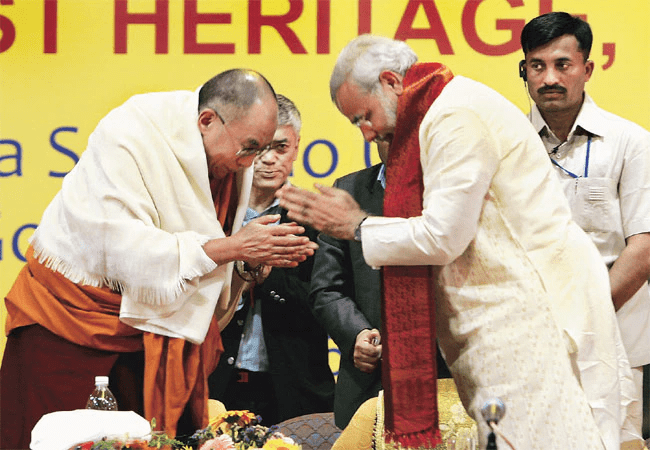
PM Modi and HH Dalai Lama greeting each other (File)

Dalai Lama commends Historic G20 in a heartfelt wish for PM Modi

On the occasion of India’s Prime Minister Narendra Modi’s seventy-third birthday today, His Holiness Dalai Lama has written to him to offer his sincere greetings and wish him many happy returns of the day. His Holiness wrote, “May I also take this opportunity to congratulate you on the success of India’s G20 presidency, culminating in the summit on the theme of ‘Vasudhaiv Kutambakam—One Earth, One Family, One Future’. This is a theme that resonates strongly with me. I firmly believe in the oneness of humanity and encourage other people to appreciate its importance whenever I can. “As India’s longest staying guest, I have found it a great privilege and source of satisfaction to witness India’s growing stature on the international stage, reflected in events such as the G20 summit. That meeting also provided a great opportunity to highlight the interdependence of our shared world. “India’s traditions of ahimsa and karuna are more than 1000-years old. As the largest democracy and most populous nation on the planet, with a long tradition of inter-religious harmony, India presents an example to the world. In addition to this, India’s growing scientific and technological capabilities enhance its emerging leadership. “On behalf of the Tibetan people, may I once again express deep gratitude to the government and people of India for their hospitality and generous assistance to us over the last 64 years. His Holiness concluded his letter with prayers and wishing the Prime Minister “continued good health and success in fulfilling the hopes and aspirations of the people of this great country, and in contributing to the creation of a more compassionate, peaceful world.” Significance In extending his warm birthday wishes and acknowledging India’s global leadership, His Holiness the Dalai Lama underscores the values of compassion, harmony, and the shared interconnectedness of our world, core principles of Buddhism. As he continues to be India’s longest-staying guest, His Holiness symbolises the enduring friendship between Tibet and India. With prayers for Prime Minister Narendra Modi’s health and success, this gesture reflects the personal rapport between these two prominent figures and the spirit of unity and goodwill that transcends borders. It serves as a reminder of the importance of fostering a compassionate and peaceful world where nations can collaborate and thrive in harmony, mirroring the teachings of Buddhism that promote peace and enlightenment. Credits : Dalai Lama

Read More
Buddha with knowledge book

The Pali Canon

According to tradition, the text of the Pali Canon was settled at a Council held at Rajagaha immediately after the Teacher’s passing, having been memorised by leading Elders, who were highly realised practitioners of the Dhamma. It is clear that the collection as we have it originated over a more extended period. The Canon was preserved in oral form until the first century B.C., when it became apparent that the sacred texts might vanish from the earth if not recorded in writing. They were accordingly written down under King Vattaghani in Sri Lanka, though some portions may already have been committed to writing earlier. The feat of memory in preserving such an extensive body of text orally for so long may seem extraordinary to us, but it was pretty usual in ancient India. Writing was certainly known in India in the Buddha’s time but was not used for such purposes. It must, however, be remembered that in the course of forty-five years, the Buddha preached, doubtless often in a standardised form to many thousands of people and that most of the monks and nuns had trained minds and memories and will have known full well the meaning of what they were repeating. From the time of the Second Council, held at Vesdi one century after the Buddha’s passing, we hear of divisions and the formation of sects within the Order. This led eventually to the rise of the Mahayana schools. An up-to-date account of these developments can be found in A.K. Warder’s Indian Buddhism. Here, we need merely note that the Theravada type of Buddhism was carried early to Ceylon and later to Burma, Thailand and other parts of Southeast Asia, whereas the forms of Buddhism that spread to Tibet, China, Japan and other more northern regions were of the developed, Mahayana type. Portions of the early scriptures of some of the schools that arose have been preserved in Sanskrit or, very often, in Chinese and/or Tibetan translations. THE PALI LANGUAGE Strictly speaking, the word Piti means ‘text’. But the expression Palibhasa, meaning ‘language of the texts’, was early taken to be the name of the language itself. Its use is confined to Buddhist subjects only in the Theravada school. Its exact origins are the subject of learned debate. While we cannot go too deeply into the matter here, it may be said that the traditional equation with the language of the ancient kingdom of Magadha and the assertion that Pali is, literally and precisely, the language spoken by the Buddha himself cannot be sustained. All the same, the language the Buddha said was, in all probability, not very different from Pali. From the point of view of the non-specialist, we can think of Pali as a kind of simplified Sanskrit. Its development, like that of other early Indian dialects, can be thought of as similar to an early form of Italian just breaking away from Latin. A close parallel is found in the word for ‘seven’, where Latin septem has become Italian sette, the pt being simplified by assimilation. The Sanskrit equivalent sapta is in Pali satta, and similar types of simplification are found in hundreds of words. The grammar, too, has been slightly simplified, though not nearly so much as that of Italian. But the two languages are still so close that it is possible to convert whole passages of Sanskrit into Pali simply by making the necessary mechanical transposition. THE AUTHENTICITY OF THE PALI CANON Indeed, not all parts of the Pali Canon are equally old or can be taken to be the Buddha’s precise words. This is plain common sense and does not mean altogether rejecting their authenticity. Recent research has gone far to vindicate the claim that the Pali Canon holds at least a prime place among our sources in the search for ‘original’ Buddhism, or, in fact, ‘what the Buddha taught’. No attempt can be made here to go into any detail concerning questions of authenticity or the chronological stratification of the materials found in the Digha Nikaya. Some indications of scholarly opinion on this subject can be found, mainly in Pande’s Studies in the Origins of Buddhism (1967), though not all his findings are equally acceptable. Almost all doctrinal statements put directly into the mouth of the Buddha can be accepted as authentic, and this seems to be the most crucial point. THE DIVISIONS OF THE PALI CANON The Pali Canon is divided into three main sections (Tipitaka: the Three Baskets): I. Vinaya Pitaka This deals with monastic discipline for monks and nuns. 2. Sutta Pitaka The ‘Discourses’ (Suttas): the portion of the Canon of most interest to lay Buddhists (see below). 3. Abhidhamma Pitaka The ‘further doctrine’ is a highly schematised philosophical compendium of seven books. The Nikayas in Sutta Pitaka There are five nikayas (collections) of suttas: Digha Nikāya This includes The Greater Discourse on the Foundations of Mindfulness, The Fruits of the Contemplative Life, and The Buddha’s Last Days. There are 34 long suttas in this Nikaya. Majjhima Nikāya This includes Shorter Exposition of Kamma, Mindfulness of Breathing, and Mindfulness of the Body. There are 152 medium-length suttas in this nikaya. Samyutta Nikaya According to one reckoning, there are 2,889, but according to the commentary, 7,762, shorter suttas in this Nikaya. Anguttara Nikāya These teachings are arranged numerically. According to the commentary’s reckoning, it includes 9,565 short suttas grouped by number from ones to elevens. According to Keown, “there is considerable disparity between the Pāli and the Sarvāstivādin versions, with more than two-thirds of the sūtras found in one but not the other compilation, which suggests that much of this portion of the Sūtra Piṭaka was not formed until a fairly late date.” Khuddaka Nikāya This heterogeneous mix of sermons, doctrines, and poetry is attributed to the Buddha and his disciples. The contents vary somewhat between editions. Importance of Pali Canon After two and a half millennia and six major rehearsals, the Pali Canon of Buddhism has been recognised as the oldest, most original, most complete, and most accurate…

Read More
Zen Buddhist meditation

Exploring Zen and Buddhism

Can you explain Zen and its core principles to those unfamiliar with the practice? Zen Buddhism remains true to the original teaching of Venerable Sakyamuni, the historical Buddha. Both that the root practice of zazen and that we wake up one day realising our situation in this world,  and look for an answer to it, then maturation of wisdom, and finally going back into the world to make it better. Because spiritual Awakening is only valid if it functions, as Venerable Nagarjuna taught, so we follow the personal example of Venerable Sakyamuni and sit zazen, and engage in face-to-face transmission of the Dharma, which has continued to this day. How does Zen meditation contribute to personal well-being and inner peace in today’s fast-paced world? Zazen creates a space in which we see our lives and the connection we have to all things. It is not that the practice of zazen is to retreat from the world, it is to directly experience what Venerable Sakyamuni did as Mara assailed him, and see as he did into the nature of illusion. Seeing into the nature of illusion, we emerge.  I feel in this regard, the present era is irrelevant; on this spiritual level, people are people, as they always have been. However, yes, our cities have become larger, and people are moving from agrarian lifestyles to work in those cities. So I see the temple, or practice centre, as a vital repository through which people find the Heart in life. Whether the temple is located in a city or village, in the 21st century, the temple can contribute to preserving human and natural values, such as arts, and culture, even the simple fact a temple has a garden in a place where people cannot have gardens of their own. This answer possibly reflects my own relationship with gardening and art, but it is a deep tradition in the Rinzai school to maintain arts and culture, which is it’s self-value handed down from India. How have you seen Zen practice positively impact individuals or communities during your experience at the Perth Zen Centre Jizoan? Locally I think there is an appreciation of the tradition and the temple, Many local people know the temple, and I think Buddhism has a good reputation in Australia. People seem to connect with the fact that the tradition preserves arts and humanistic values associated with that. Australians don’t see Buddhism as a religion the same as Christianity, they don’t associate it with state violence especially, even though I teach a martial art as an adjunct to my life as a priest. I have had people come and sit because they are struggling with addiction issues, family issues, or because they wonder about their place in the world. I also find myself being emailed or called by people in academia about various aspects of the tradition, whether it’s because they themselves are practising Buddhism or because they wish to clarify something that’s relative to their studies. Recently I’ve made good relationships with leaders in Christian and other traditions locally and in other parts of Australia as well, which I think is a good opportunity to inform, and it’s interesting to hear the respect and admiration for the tradition they have. Could you share your observations on the differences and similarities in the practice of Buddhism between Australia and Japan? Japan has had Buddhism for more than 1200 years, and Buddhism was established as a state religion until the Meiji Restoration in 1868. In Australia, Buddhism is relatively new, only being freely practised and taught since 1975. In Japan, although Buddhism is divided into many sects, each having been established in China at different periods, it’s essentially homogeneous. Temples and priests, and practices are similar, only divided by emphasis on what part of the Dharma teaching they have inherited. In Australia, Buddhism is divided through largely ethnic lines. Certain temples identify as Chinese temples, some as Tibetan and so forth, and their ethnicity dominates. Japanese Buddhist sects seem to be on good terms with each other, while in Australia, Buddhists are often highly sectarian and ethnically divided. While it is possible to see differences in practice between different Buddhist sects in Japan, on the whole they share more in common than not. To many Westerners, they all seem the same. While in Australia, the outer differences appear wider. A Zen Centre or temple in Australia I think, looks greatly different from Tibetan, Thai, or Chinese temples. This, to some degree, contributes to the diaspora in Australian Buddhism. I have often reflected on the fact that Korean Zen also arrived in Japan, and Korean temples exist today there, but they are notable in their division from wider Japanese Buddhism. How does each country’s cultural context shape how Buddhism is perceived and practised? Both Japan and Australia are secular civil societies; both, therefore, are focused on what is potentially good for the larger society. Mahayana teaching fits both. Neither country is religious in the conventional sense, though the Japanese are inclined to be superstitious, which is not the same. Theravada Buddhism is present in Australia as well, but it’s social relationship is limited by the nature of its retreat emphasis and the relationship between Theravada monks and lay society. In Japan, for the most part, it is seen as part of the history and culture of Japan; a Japanese saying goes, for example, ‘Zen Culture is Japanese culture, and Japanese Culture is Zen culture’, as just a small example. Buddhism is welded into the language and customs of Japan, and it dominates Japanese people’s way of thinking. To Japanese people, this world is always on a level, illusion and temporary. Australia has a history of British colonialism; although mono-culture is giving way, it is largely replaced by multi-culture, which still divides people into identities. So, Buddhism has a long way to go to see it practised properly without consideration for identity. Typically large temples or organizations with multiple groups are ones…

Read More
Buddhism Mudras

The Profound Language of Mudras in Buddhist Art and Practice

In the tapestry of Buddhism’s rich history and intricate symbolism, mudras stand as silent but profound communicators. These intricate hand positions, known as “mudras,” are not mere gestures but bridges between the mundane and the divine, the outer and the inner, the physical and the spiritual. They adorn Buddhist art and are integral to the practices that bring practitioners closer to enlightenment. Each mudra, rooted in symbolism and purpose, narrates a story. Understanding the Essence of Mudras Mudra, a Sanskrit term translating to “seal” or “sign,” encapsulates a fusion of gesture and intention. These hand positions are not arbitrary but deeply rooted in Buddhism’s teachings. Every mudra embodies an outer/symbolic and an inner/experiential purpose. It’s a language that simultaneously speaks to the practitioner and the observer, revealing facets of the enlightened mind. The Iconic Mudras and Their Meanings Dhyana Mudra (Samadhi or Meditation Mudra) Also referred to as the Samadhi or Yoga Mudra, the Dhyana Mudra is characterized by two hands resting on the lap. The right hand is gently placed on the left with fingers extended and the thumbs facing upward, while the other fingers of both hands rest upon each other. This serene gesture graces the figures of Buddha Shakyamuni, Dhyani Buddha Amitabha, and the compassionate Medicine Buddha, embodying their profound connection to meditation and inner contemplation. Vitarka Mudra (Teaching Mudra) Positioned at chest level, the right hand faces outward with the thumb and forefinger forming a circle. The left-hand points downward or rests palm-up in the lap, signifying the teaching act and the continuous knowledge-sharing cycle. Dharmachakra Mudra (Wheel-Turning Mudra) The thumbs and forefingers of both hands form circles that touch. The left hand faces inward, while the right-hand faces outward. Held at heart level, this mudra represents the turning of the Wheel of the Teaching, perpetuating the cycle of the Dharma. In Sanskrit, Dharmachakra translates to “Wheel of Dharma.” This mudra represents one of the most significant occasions in the life of the Buddha: the Deer Park at Sarnath, where he delivered his first speech to his companions following his Enlightenment. The Wheel of the teaching of the Dharma is said to have been set in motion by this occasion. Bhumisparsha Mudra (Earth-Touching Mudra) In this mudra, the left-hand rests in the lap with the palm facing upward, while the right-hand rests palm-down on the knee. It signifies Buddha’s victory over the forces of illusion and temptation, summoning the earth to witness his enlightenment. Abhaya Mudra (Fearlessness or Blessing Mudra): With the right hand raised and facing outward, this gesture radiates reassurance and protection. Buddha employed it after his enlightenment, projecting a sense of fearlessness and compassion. Varada Mudra (Generosity Mudra) The right-hand points downward with the palm facing outward. This mudra embodies the spirit of giving and signifies generosity and compassion. Bodhyagri Mudra (Mudra of Supreme Wisdom) Here, the right forefinger is enclosed within the fist of the left hand. This mudra holds various interpretations, including the union of wisdom and appearances or the protection of the practitioner by the elements. Anjali Mudra (Greeting Mudra): Universally recognized as a gesture of respect and greeting, the Anjali Mudra is formed by pressing the palms together at the heart level. The fingertips point upward, connecting the heart and the mind in a respectful salute. Beyond the Physical: Mudras in Practice Mudras are more than artistic elements or aesthetic embellishments; they are gateways to altered states of consciousness. In the Vajrayana school, mudras intertwine with mantras and visualization, unlocking esoteric realms. Though relatively austere in ritual, Zen Buddhism embraces the Dhyani and Anjali mudras, underscoring their enduring significance. In the hands of the Buddha and the practitioner alike, mudras unravel layers of meaning and open doors to understanding. They are the bridge connecting the external world to the realm of the enlightened mind. Through the language of mudras, Buddhism’s timeless wisdom flows from generation to generation, whispering truths that words alone cannot convey.

Read More

India’s Enduring Commitment to Promote Buddhism Globally: Insights from Ambassador Pavan Kapoor’s Address

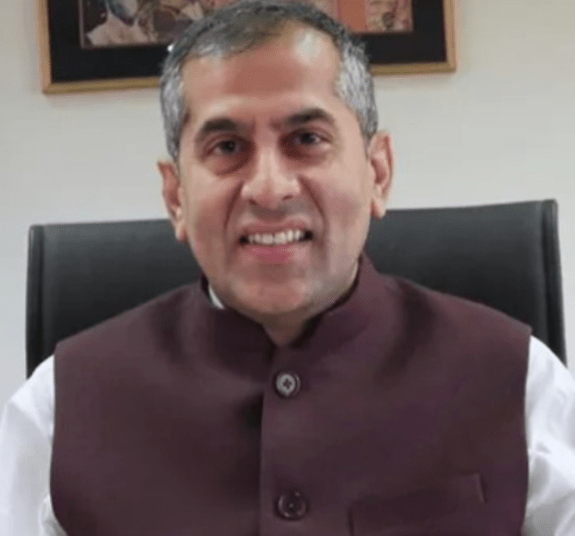
On August 18, 2023, the Indian Ambassador to Russia, Pavan Kapoor, delivered an inspiring address underscoring India’s unwavering dedication to upholding and spreading the principles of Buddhism across the world. Kapoor’s remarks were made in the presence of Pandito Khambo Lama, the senior lama of a Buddhist monastery in Mongolia and Russia, during the International Buddhist Forum held in Buryatia. This significant event brought together dignitaries, scholars, and practitioners to celebrate and explore the profound spiritual connections between India and Russia. Highlighting the Rich Spiritual Ties Ambassador Kapoor emphasized the ancient spiritual ties between India and Russia that stretch back millennia in his address. Kapoor’s statement resonated deeply with the attendees as he acknowledged the shared heritage and cultural affinities fostered by these spiritual connections. This profound bond has woven Buddhism into the fabric of both nations’ cultural identities. Shared Spiritual Heritage Kapoor’s Twitter update captured the essence of his address, stating, “Spoke about the spiritual roots of Buddhism and the shared heritage this provides among countries, including Russia. Also mentioned are GOI (Government of India) initiatives to promote Buddhism.” This acknowledgement underlined the importance of Buddhism in Russia, where it is one of the four officially recognized religions. The echoes of Buddhism reverberate throughout Russia, particularly in regions like Buryatia, Tuva, and Kalmykia, where approximately 1.5 million Buddhists reside. Buddhism’s Universal Values Kapoor’s words echoed the profound teachings of Buddhism, emphasizing compassion, wisdom, peace, and harmony. He highlighted how Buddhism has been an integral part of Indian society for centuries and continues to be a beacon of these principles globally. Kapoor recognized the enduring power of spirituality in bridging geographical and cultural gaps, cementing the Indo-Himalayan and Russian Buddhist traditions as living testaments to this transcendent potential. India’s Initiatives Ambassador Kapoor took pride in sharing India’s substantial efforts in nurturing the spirit of Buddhism. He highlighted the establishment of the ‘Buddhist Tourism Circuit,’ linking significant pilgrimage sites associated with Buddha’s life. Additionally, Kapoor unveiled an ambitious project in Lumbini, Nepal, where the foundation stone for the ‘India International Centre for Buddhist Culture and Heritage’ was laid in collaboration with the Nepalese government. This initiative reflects the deep commitment to preserving and propagating the legacy of Buddhism. A Shared Path Forward Kapoor’s address concluded with a call to action, urging attendees to draw inspiration from the shared heritage of Indo-Himalayan and Russian Buddhism. He encouraged them to utilize the wisdom embedded in this legacy to navigate contemporary challenges. Kapoor’s sentiment underscored the timeless relevance of these teachings, symbolizing the unity and enduring connection that transcend borders. Beyond the podium, Ambassador Kapoor engaged in discussions with Aleksey Tsedenov, the head of Buryatia, encompassing potential collaborations in culture, tourism, and the economy. Expressing his gratitude for organising the International Buddhist Forum, Kapoor’s interactions emphasized the potential for India and Russia to cultivate multifaceted partnerships inspired by their spiritual heritage. In a world seeking harmony and understanding, Ambassador Kapoor’s address served as a beacon of hope, reminding us of the universal values embedded in Buddhism and the transformative power they hold in shaping societies and fostering global unity. Source:https://organiser.org/2023/08/19/190812/world/india-upholds-promotes-principles-of-buddhism-globally-ambassador-to-russia-pavan-kapoor/

Read More