HH Dalai Lama

A Portrait of His Holiness the Dalai Lama 14th – The Advocate of the Nalanda and Ancient Indian Tradition

By Nhan Vo, Researcher on Nalanda and HH Dalai Lama Introduction His Holiness the Dalai Lama 14th (HHDL) stands as a major figure in the 20th-21st century. His unique life journey includes leadership of the Tibetan nation, patriarch of the Gelugpa Buddhist lineage, Nobel Peace Prize winner (1989), erudite Buddhist monk, and author of numerous bestselling books. This article explores specific aspects of HHDL’s life, focusing on his commitment to the Nalanda tradition and ancient Indian values. 1. Pursuit of Nalanda Tradition and India’s Ancient Values in His Four Commitments HHDL’s four commitments, detailed on his website, encompass devotion to universal happiness, harmony among religions, preservation of Tibetan culture, and a distinct commitment to the Nālandā tradition. His dedication to preserving Tibetan heritage, rooted in Nālandā teachings, positions him as an integral part of this ancient tradition. Furthermore, his last commitment underscores his mission to integrate ancient Indian knowledge into modern values. HHDL emphasizes the relevance of ancient Indian understanding, especially in the realms of the mind, emotions, and techniques like meditation. He envisions a synthesis of ancient and modern knowledge, fostering a more integrated and ethically grounded society. 2. Efforts to Connect Wisdom Between Buddhism and Science HHDL’s engagement with science, highlighted in works like “The Universe in a Single Atom” and the “Science and Philosophy in the Indian Buddhist Classics” series, showcases his interest in bridging Buddhism and science. Recognizing similarities in their approach to understanding reality, he sees science as a valuable tool for exploring the material world. His proactive involvement in dialogues, conferences, and collaborations with scientists reflects a commitment to mutual learning. HHDL aims not to unify science and Buddhism but to interrogate both, fostering a comprehensive understanding of the world. His assertion, “Buddhism is the Science of the Mind,” exemplifies his belief in the complementarity of the two disciplines. 3. Presentation and Classification of Buddhism Foundations Corresponding to Modern Constructs In connecting Buddhism with science, HHDL introduces a novel approach to presenting Buddhist teachings. Three subclasses, covering Buddhist science, philosophy, and beliefs, provide a modern scientific presentation of traditional Tripitaka content. This innovative method aims to facilitate a more accessible and non-intrusive approach for modern scientists and educators. 4. Promoting the Rebuilding of the Nalanda Lineage Through Spiritual and Moral Education HHDL actively contributes to the revival of the Nalanda lineage, particularly in India. His commitment to incorporating ancient Indian knowledge into modern education is evident in various initiatives, including becoming the Dean of the Faculty of Nalanda Studies at Goa University and establishing the Institute of Nalanda Ancient Studies in Bodhgaya. His emphasis on training the mind and reducing destructive emotions aligns with his belief in India’s potential to combine ancient psychology with modern education. Collaborations with Indian educational institutions and advocacy for programs in psychology, ethics, and philosophy reflect his dedication to this cause. 5. Conclusion His Holiness the Dalai Lama’s multifaceted contributions, from preserving Tibetan heritage to connecting Buddhism with science and promoting Nalanda’s revival, paint a portrait of a visionary leader. His commitment to integrating ancient wisdom into contemporary values reflects a profound understanding of the evolving human experience. References: Original Article

Read More

Manjusri, 1 of the most Prolific BODHISATTVA of Zen

Mahayana Buddhism expounds that all beings are potential Buddhas and Bodhisattva. In the Zen school, which is a branch of the Mahayana, adherents strive to realize Buddhahood or live as a Bodhisattva in this lifetime as Zen claims to be both the historical descendent school of Venerable Sakyamuni Buddha and vehicle to Prajna Wisdom in this lifetime, freeing the devotee of Zen from ignorance. Therefore, Manjusri  Bodhisattva, the Bodhisattva of Wisdom, may be seen as a tutelary example of how Zen Buddhists should strive in their training to open the Dharma’s eye. In the West, Zen is often portrayed as people in black sitting doing zazen in white rooms and not much more. Often in the West, Zen Buddhism is portrayed in the popular as an Eastern form of Stoicism, which it shares near principles with. Or it is sometimes imagined as a Protestant Buddhism’, simple and without symbolism. Thousands of books are now in publication in Western Countries in English, French, German and other languages, and it’s been estimated in the United States that more than 60% of Buddhists are practising Zen, but this is not the complete picture of Zen Buddhism. Undoubtedly, this has contributed to the spread of Zen Buddhism in the West, and how this came about is a complex of causes derived in part from the background of Westerners who travelled to Asian countries like Japan and Korea and then returned to their countries. A prime example of this is the famous book Zen and Archery by Eugen Herrigel, published in the 1930s, which laid considerable groundwork for the idealized expectations of Europeans. Zen and the Art of Archery, like many books like it, only told the partial practice of Zen Buddhism, perhaps because lay authors like Herrigel did not have time to delve deeply while they stayed in Asia or because they filtered what they wanted. Many early Zen people in the West were from secular Protestant Christian backgrounds and little interested in ritual and legend. When Asian teachers arrived in Western countries, they, too, were faced with predominantly lay students who were equally disinterested in anything they deemed superfluous to Zen. Of course, the nature of Zen is to emphasise reductive simplicity to get to the Fundamental point of things, to emphasise ‘Prajna’ insight. And this continues even today in Western Zen centres. This, in contrast to the next largest lineage of Buddhism, is  Vajrayana, or ‘Tibetan’ Buddhism as it’s colloquially often referred to in the West.  We associate Vajrayana Buddhism in the popular consciousness with Bodhisattva, Guardians and Devas, and subsequent rituals to invoke the superstitious power of such beings to help and guide. However, ritual is not limited to the Vajrayana lineages and is found in Zen Buddhism as well.  Zen Buddhism is part of the Mahayana movement, which can be described as a federation of lineages that spread out of India. Zen is traditionally considered to have arrived in China around the 7th Century C.E., making it a historical latecomer to the Chinese Buddhist dysphoria. Zen Buddhism is an outlier in the Mahayana movement, having strong characteristics that would be more likely to be matched with Theravada Buddhism that spread to and survived in Southern India as part of Southern Buddhism. Zen and Theravada lineages, for the most part, put emphasis on meditation, Vipasanna for Theravada, and Dyanna, a method of meditation derived from Samatha and Vipasanna, and critical scriptural studies and dialogues. However, Theravada spread further south, eventually into what are now Sri Lanka, Thailand, Burma, and Laos predominately, while Zen Buddhism spread into China [1]. As a Mahayana school, Zen, therefore, inherited the Legendary traditions of Mahayana while still adhering to historicity and rationalism. Hence, in the Zen school, Venerable Sakyamuni is the ‘Historical Buddha’ while not denying his previous births. The historical Buddha remained paramount in Zen, with Venerable Mahakashyapa as the first  Indian Ancestor and Zen revering 26 subsequent Indian Ancestors, including Venerable Nargajuna. The lineage of Zen is another deep subject, however, only touched on here. As part of the Mahayana, Zen inherited the teaching that multiple births led to the birth of Venerable Sakyamuni, his teaching and his Parinirvana supported by the various guardians, Bodhisattva, Devas, generals messengers and others. In China, the Sacred Mountain of Wu-tai, historically associated with the golden age of Zen Buddhism, is considered the mythic earthly home of Manjusri Bodhisattva. Manjusri In Art In Buddharupa images, the Bodhisattva Manjusri is depicted with a sword in their right hand, typically to cut the bonds of ignorance away, representing Wisdom and freedom or sometimes a White Lotus representing the purity of the teachings. Manjusri Bodhisattva may appear in Indian or Chinese forms, resembling other Bodhisattvas. Additionally, in Chinese and subsequent Korean, Japanese and Vietnamese lineages of Zen and Mahayana Art, as riding a Celestial dog or, less commonly, an elephant as in the original Indian depiction. The Celestial Animal represents the Cannon of the Teachings, the Tripitaka. Manjusri Buddha rupa are traditionally sculpted in stone, bronze or wood; stone Buddharupa typically will be set in the temple’s precinct, while wooden and bronze are set in the Buddha Hall. Line and coloured paintings are also made on paper or on wood panels. In paintings, associations with Manjusri Bodhisattva not only take the form of illustrating the Bodhisattva but also the aforementioned Wu-tai mountain and scenes from the sutras depicting the Layman Vimalakirti and others as he debates with the Bodhisattva. Famous and easily seen examples of statuary Buddharupa in the Rinzai Zen school are the Great Buddha Halls or Dai Hondo at Kenninji, Tofukuji and Nanzenji in Kyoto, Japan, where you will find large wooden Buddharupa settings. In Practice In Zen temples, the Bodhisattva Manjusri is often enshrined in the main hall of the Buddhas and Bodhisattva, where commemorative rituals are carried out. Usually in a grouping called Shaka sanzon, opposite the Bodhisattva Samantabhadra (O-Fugen-sama), the Bodhisattva of training. Another type of grouping found in some Buddha halls is the Four…

Read More
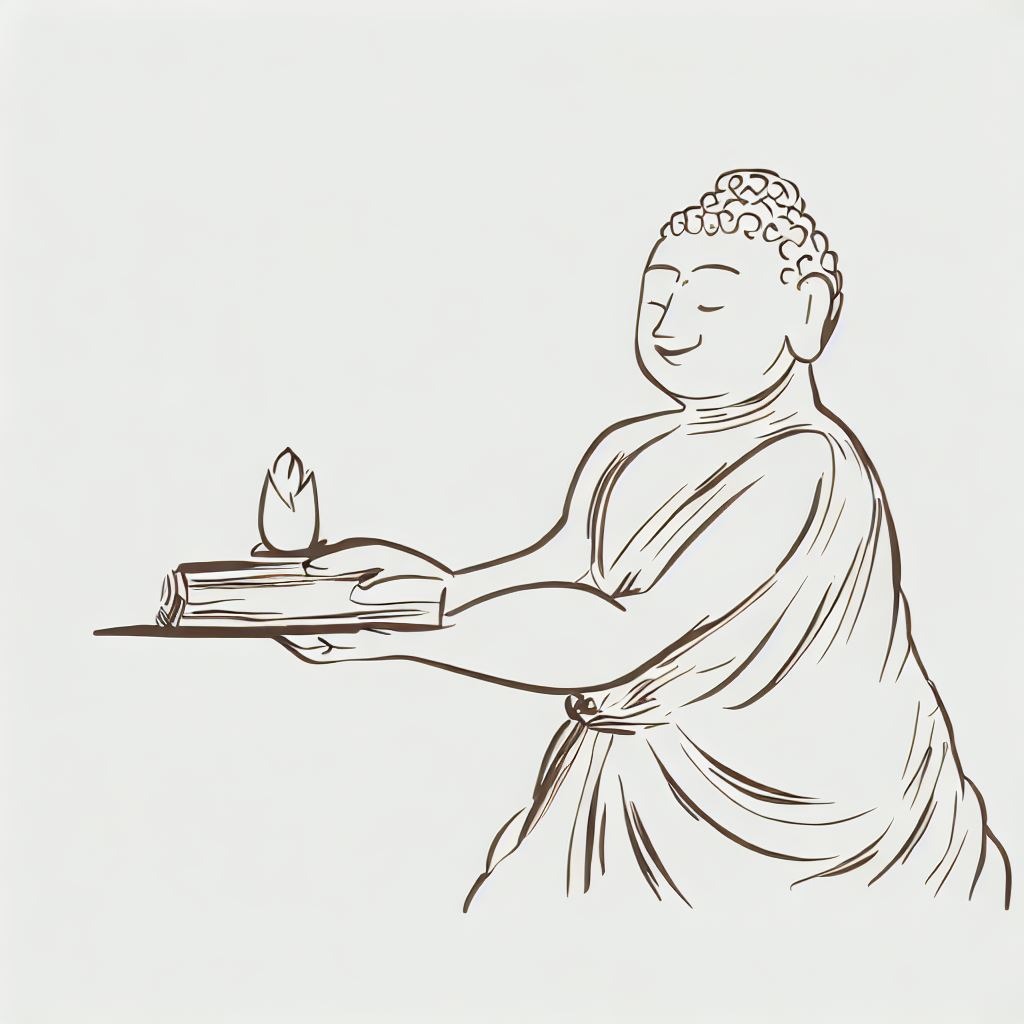
Buddha with knowledge book

The Pali Canon

According to tradition, the text of the Pali Canon was settled at a Council held at Rajagaha immediately after the Teacher’s passing, having been memorised by leading Elders, who were highly realised practitioners of the Dhamma. It is clear that the collection as we have it originated over a more extended period. The Canon was preserved in oral form until the first century B.C., when it became apparent that the sacred texts might vanish from the earth if not recorded in writing. They were accordingly written down under King Vattaghani in Sri Lanka, though some portions may already have been committed to writing earlier. The feat of memory in preserving such an extensive body of text orally for so long may seem extraordinary to us, but it was pretty usual in ancient India. Writing was certainly known in India in the Buddha’s time but was not used for such purposes. It must, however, be remembered that in the course of forty-five years, the Buddha preached, doubtless often in a standardised form to many thousands of people and that most of the monks and nuns had trained minds and memories and will have known full well the meaning of what they were repeating. From the time of the Second Council, held at Vesdi one century after the Buddha’s passing, we hear of divisions and the formation of sects within the Order. This led eventually to the rise of the Mahayana schools. An up-to-date account of these developments can be found in A.K. Warder’s Indian Buddhism. Here, we need merely note that the Theravada type of Buddhism was carried early to Ceylon and later to Burma, Thailand and other parts of Southeast Asia, whereas the forms of Buddhism that spread to Tibet, China, Japan and other more northern regions were of the developed, Mahayana type. Portions of the early scriptures of some of the schools that arose have been preserved in Sanskrit or, very often, in Chinese and/or Tibetan translations. THE PALI LANGUAGE Strictly speaking, the word Piti means ‘text’. But the expression Palibhasa, meaning ‘language of the texts’, was early taken to be the name of the language itself. Its use is confined to Buddhist subjects only in the Theravada school. Its exact origins are the subject of learned debate. While we cannot go too deeply into the matter here, it may be said that the traditional equation with the language of the ancient kingdom of Magadha and the assertion that Pali is, literally and precisely, the language spoken by the Buddha himself cannot be sustained. All the same, the language the Buddha said was, in all probability, not very different from Pali. From the point of view of the non-specialist, we can think of Pali as a kind of simplified Sanskrit. Its development, like that of other early Indian dialects, can be thought of as similar to an early form of Italian just breaking away from Latin. A close parallel is found in the word for ‘seven’, where Latin septem has become Italian sette, the pt being simplified by assimilation. The Sanskrit equivalent sapta is in Pali satta, and similar types of simplification are found in hundreds of words. The grammar, too, has been slightly simplified, though not nearly so much as that of Italian. But the two languages are still so close that it is possible to convert whole passages of Sanskrit into Pali simply by making the necessary mechanical transposition. THE AUTHENTICITY OF THE PALI CANON Indeed, not all parts of the Pali Canon are equally old or can be taken to be the Buddha’s precise words. This is plain common sense and does not mean altogether rejecting their authenticity. Recent research has gone far to vindicate the claim that the Pali Canon holds at least a prime place among our sources in the search for ‘original’ Buddhism, or, in fact, ‘what the Buddha taught’. No attempt can be made here to go into any detail concerning questions of authenticity or the chronological stratification of the materials found in the Digha Nikaya. Some indications of scholarly opinion on this subject can be found, mainly in Pande’s Studies in the Origins of Buddhism (1967), though not all his findings are equally acceptable. Almost all doctrinal statements put directly into the mouth of the Buddha can be accepted as authentic, and this seems to be the most crucial point. THE DIVISIONS OF THE PALI CANON The Pali Canon is divided into three main sections (Tipitaka: the Three Baskets): I. Vinaya Pitaka This deals with monastic discipline for monks and nuns. 2. Sutta Pitaka The ‘Discourses’ (Suttas): the portion of the Canon of most interest to lay Buddhists (see below). 3. Abhidhamma Pitaka The ‘further doctrine’ is a highly schematised philosophical compendium of seven books. The Nikayas in Sutta Pitaka There are five nikayas (collections) of suttas: Digha Nikāya This includes The Greater Discourse on the Foundations of Mindfulness, The Fruits of the Contemplative Life, and The Buddha’s Last Days. There are 34 long suttas in this Nikaya. Majjhima Nikāya This includes Shorter Exposition of Kamma, Mindfulness of Breathing, and Mindfulness of the Body. There are 152 medium-length suttas in this nikaya. Samyutta Nikaya According to one reckoning, there are 2,889, but according to the commentary, 7,762, shorter suttas in this Nikaya. Anguttara Nikāya These teachings are arranged numerically. According to the commentary’s reckoning, it includes 9,565 short suttas grouped by number from ones to elevens. According to Keown, “there is considerable disparity between the Pāli and the Sarvāstivādin versions, with more than two-thirds of the sūtras found in one but not the other compilation, which suggests that much of this portion of the Sūtra Piṭaka was not formed until a fairly late date.” Khuddaka Nikāya This heterogeneous mix of sermons, doctrines, and poetry is attributed to the Buddha and his disciples. The contents vary somewhat between editions. Importance of Pali Canon After two and a half millennia and six major rehearsals, the Pali Canon of Buddhism has been recognised as the oldest, most original, most complete, and most accurate…

Read More

Nalanda University: Unraveling the Legacy of Ancient Wisdom and Scholarly Excellence

(An insightful conversation with Nhan Vo, Researcher on Nalanda) Research Journey This is a long and not easy question, and it contains 3 points: My motivation, what causes the interest, and the main objectives.Since the question is related to many causes & conditions and the events that crossed my life in the past, I will try to describe it in the simplest way possible. I was born in a Vietnamese Buddhist family and grew up with a strong background in Math and Computer Science. So, when any new concept appears clearly in my mind, the attitude of doubting and questioning if it is true comes naturally. I first learned the term “Nalanda” when I attended the teaching of His Holiness the Dalai Lama in California (2006). At that time, the title Nālandā just arose in my mind. It came up with one irritating and critical question: Why am I a Buddhist for life, but still not knowing well about this “Nālandā”? As time passed, I learned that many great Mahayana Masters also lived and worked there; specifically, one of them is my favourite Master, Xuanzang (玄奘). A few years later, even with so much information I could collect/learn about the institute, my wonder about it did not decrease at all. However, the final decision for full engagement in research about Nālandā only came after a very vivid and sad dream (circa 2011-12). In a vivid dream, after coming back to Nālandā with a much younger religious brother from an errant duty after a few months. I saw Nālandā getting destroyed, and I was very frightened. All things that I know of were burnt to black; the remains are broken bricks and walls with a bad smell. I cried as a kid who lost his mom. The feeling was so natural and strong as I was there; the image in the dream was so alive that even after waking up from that night, and many times later when thinking about what I saw in the dream, I continued to cry and feel as if the event just happened. So this is the final trigger that pushed me to eventually stop my worldly job as a scientist and go to India for 5 years to learn the truth about Nālandā and also to understand deeper about the Buddhist tradition. For easy saying, the objectives of my research are: a. To resolve my quest about Nālandā, including the dream. b. As stated, not only myself but also many other Buddhists, specifically the Vietnamese, do not know what Nālandā is. So, it seems a big mistake if you earnestly learn Buddhism but don’t really know its true history or where the teachings that you currently learn and practice come from and how they were transferred to you. c. As same as all Buddhists, my goal in life is to see all sentient beings get their true happiness. So if my work may contribute some productive information or facts, which can help Buddhist students to know how authentic and how valuable the teachings that they are following are, then this is a cause for my happiness as well as the graceful appreciation for the schools, the traditions, and the places that have hosted the Dharma teachings for thousands of years also. Lastly: How do we define the “Nālandā” term? To me, it is not just the monastery itself since doing so will narrow down the most important factor that Nālandā was the main Buddhist philosophy centre in India particularly, and the largest philosophy centre in the world generally. Not only religious, but it is also the centre of logic school, art, and architecture. We may find that His Holiness the Dalai Lama’s 14th was fully true: Tibetan Buddhist tradition is Nālandā tradition (not more, not less). Chinese Buddhist tradition and some other Mahayana countries also are a kind of following Nālandā even though they may become self-transforming later. But at least at the time upto Xuanzang (玄奘) and Yijing (義淨) time, it fully adopted the Nālandā tradition. The scope of these essays is not to find the absolute facts about what happened over a long period of thousand years ago but to find a clearer picture of the place named as Nālandā and its role within Buddhism, especially Mahayana and its tantric subschools. It also tries as much as it can to indicate the earliest source of fact that can be found through scriptures, writings, and the evidence of archaeology. With all the above mentioned, the presentation of the essays contains two kinds of information :(1) The facts, including the creation, rise, and destruction of Nālandā, its activities, depicting how people live, learn, and practice, and lastly, the philosophy, the teachings, and the paths.(2) The information that is exposed in many other aspects about Nālalndā, but they are implied within stories or legendaries. Those are very important since they may indicate and be the imprint to show details that are the actual image of Nālandā. Research Methodology 2. We understand that your research involved extensive data collection from Tibetan, Indian, and Chinese scriptures, as well as archaeological evidence. Could you shed light on the research methods you employed, the challenges you faced, and how you ensured the accuracy and reliability of the gathered information? Following Buddha’s teachings, there should be reliable sources of valid cognition for the proper knowledge: Direct Sense, Inference by suitable logic/critical thinking, and the knowledge taught by reliable persons (such as Buddha himself and his excellent Bodhisattvas). So, pick this as a guideline; my strategy goes with three stages: Collect data, filter them, and select what to present. But where is a good and reliable source for collecting data in the regard of more than thousands of years of history? a. So, the first sources and facts are the archaeology evidence which may come from: the Nālandā area itself, any other related archaeology evidence that is tightly related to Nālandā (such as Vikramasila Monastery) and any other facts found directly mentioned or refer to Nālandaā and its tradition. Those…

Read More

History and Present Splendor of Buddhist Arts

Introduction Buddhism, a profound spiritual tradition that originated in ancient India, has gifted the world with a treasure trove of mesmerizing arts. From awe-inspiring stupas and sculptures to intricate paintings and manuscripts, the artistic heritage of Buddhism in India continues to captivate the hearts of enthusiasts and scholars alike. In this article, we embark on a journey through time, exploring the evolution and present status of these artistic wonders that celebrate India’s cultural and spiritual legacy. Unraveling the Majesty of Buddhist Architecture Buddhist architecture stands as a testament to the creativity and devotion of ancient artisans. The Great Stupa at Sanchi, an iconic masterpiece dating back to the 3rd century BCE, majestically rises on the Indian landscape, enshrining sacred relics of the Buddha. The viharas, ancient monastic complexes that once echoed with meditative chants, bear witness to the profound impact of Buddhism on India’s architectural heritage. These architectural marvels, impeccably preserved by the Indian government, draw pilgrims and travelers seeking spiritual enlightenment and architectural wonders. Carved in Stone: The Allure of Buddhist Sculptures Buddhist sculptures, carved in stone, wood, or metal, are a sight to behold, exuding divine grace and serenity. The Gupta period (4th to 6th centuries CE) saw the zenith of this art form, as artisans masterfully depicted the Buddha in various postures and bodhisattvas in timeless poses. The Mathura and Gandhara schools of sculpture were instrumental in shaping the early Buddhist art scene in India. Museums and galleries in India now treasure these priceless sculptures, ensuring their preservation and accessibility for generations to come. The Mesmeric Buddhist Art of Caves Step into the enchanting realm of Buddhist paintings adorning the Ajanta and Ellora Caves, a UNESCO World Heritage site. These awe-inspiring caves, hewn into the rock, display a rich tapestry of paintings and murals that narrate tales from the life of the Buddha and the Jataka stories. An exquisite blend of indigenous and foreign artistic styles, these ancient artworks provide a glimpse into India’s cultural confluence. The Indian government, supported by international organizations, meticulously conserves and restores these masterpieces, allowing art lovers to revel in their timeless splendor. Preserving Wisdom: Buddhist Literature and Manuscripts The wisdom of Buddhism is etched in ancient manuscripts, cherished in India for centuries. Pali and Sanskrit texts, adorned with intricate illustrations, contain the profound teachings of the Buddha and commentaries by esteemed scholars. The National Mission for Manuscripts in India diligently preserves and digitizes these invaluable manuscripts, making them accessible to scholars and enthusiasts worldwide. These literary gems serve as a bridge connecting contemporary minds to the wisdom of the past. Contemporary Buddhist Art in India Buddhist art continues to evolve in modern times, with Indian artists skillfully infusing traditional motifs with contemporary techniques. From innovative sculptures to captivating paintings, these creations draw inspiration from timeless Buddhist principles, promoting a sense of inner peace and harmony. Galleries and art festivals across India proudly showcase these artistic expressions, ushering in a renaissance of Buddhist art. Conclusion India’s Buddhist arts form a captivating tapestry that weaves spirituality, creativity, and cultural heritage into a harmonious whole. The majestic stupas, soul-stirring sculptures, and enchanting paintings stand as an ode to the profound influence of Buddhism on India’s artistic landscape. As the country diligently preserves and promotes this artistic heritage, it continues to inspire and enrich the world with the timeless beauty of Buddhist arts. Embarking on a journey through the past and present, we celebrate the enduring legacy of these masterpieces that bear witness to the eternal spirit of Buddhism in India.

Read More
Different Forms of Buddhism

A Journey Through the Diverse Forms of Buddhism

Buddhism, one of the world’s major religions, emerged in ancient India and has since evolved into various forms, each with distinct teachings, practices, and beliefs. This article delves into the origins and development of the most prominent branches of Buddhism, exploring their historical contexts and doctrinal differences. Theravada Buddhism Theravada, also known as the “Doctrine of the Elders,” is considered the oldest surviving form of Buddhism. It traces its roots back to the First Buddhist Council, held around 483 BCE, shortly after the passing of Siddhartha Gautama, the historical Buddha. This council, led by his senior disciples, compiled and preserved his teachings, known as the Tripitaka (Three Baskets). Theravada Buddhism emphasizes the importance of individual enlightenment through meditation and adherence to the original teachings of the Buddha. Mahayana Buddhism Around the 1st century BCE, Mahayana Buddhism emerged as a reformist movement within the Buddhist community. The term “Mahayana” translates to the “Great Vehicle,” signifying its aspiration to offer salvation to a broader spectrum of individuals. This branch introduced the concept of bodhisattvas, enlightened beings who postpone their own enlightenment to guide others towards liberation. The Mahayana scriptures, such as the Prajnaparamita Sutras and the Lotus Sutra, expanded the Buddhist canon beyond the Tripitaka. Vajrayana Buddhism Vajrayana, or Tantric Buddhism, originated in India during the 6th to 7th centuries CE. It represents an esoteric and mystical form of Buddhism, characterized by the use of mantras, mandalas, and rituals to attain enlightenment swiftly. Vajrayana incorporates elements from both Theravada and Mahayana while incorporating tantric practices aimed at achieving Buddhahood in one lifetime. Notable Vajrayana traditions include Tibetan Buddhism and Japanese Shingon Buddhism. Zen Buddhism Zen Buddhism also known as Chan Buddhism, was developed during the 6th century CE. Its origins are often attributed to the Indian monk Bodhidharma, who traveled to China and laid the foundation for the Chan tradition. Zen emphasizes direct experiential insight and meditation (zazen) as a means to enlightenment. The practice of koans (riddles or paradoxical statements) challenges the practitioner’s logical mind, leading to a direct experience of truth beyond words and concepts. Pure Land Buddhism Pure Land Buddhism, prevalent in East Asia, originated in India around the 2nd century CE and later developed into different schools, including Jodo Shinshu in Japan and Pure Land Buddhism in China. This form of Buddhism focuses on devotion to Amitabha Buddha and his Pure Land, a realm of enlightenment. By sincerely reciting the name of Amitabha (nembutsu), devotees aspire to be reborn in his Pure Land and attain liberation from the cycle of rebirth. Conclusion The development of Buddhism into various forms over the centuries reflects its adaptability and capacity to resonate with different cultural, philosophical, and spiritual perspectives. Each branch has its unique teachings and practices, catering to the diverse spiritual needs of individuals across different regions of Asia and beyond. Buddhism’s enduring legacy continues to inspire millions worldwide on their journey towards enlightenment and inner peace.

Read More
Nalanda University Getting Burned

Witnessing the Fall of Nalanda University: A Scholar’s Tale

As a Buddhist scholar fortunate enough to have studied at the prestigious Nalanda University, I never imagined that I would bear witness to the devastating destruction that would befall this beacon of knowledge and intellectual pursuit. In this narrative, I recount my personal experience of the fateful invasion led by Bakhtiyar Khilji, which forever altered the course of Nalanda’s history. A Scholar’s Haven Nalanda University was more than just an institution; it was a sanctuary of wisdom, a haven for scholars like myself who sought enlightenment through learning. The vibrant atmosphere, adorned with ancient stupas and sprawling halls of knowledge, fostered an unparalleled intellectual environment. Here, we explored the depths of Buddhist philosophy, engaged in rigorous debates, and absorbed the teachings of esteemed masters. The Shadow of Invaders Rumors of an impending invasion had been circulating for some time, but we, immersed in our studies and debates, remained blissfully unaware of the imminent threat. It was a day like any other when the tranquility of Nalanda was shattered by the thunderous clamor of approaching armies. Panic gripped the air as we realized that the dreaded invaders had arrived at our sacred grounds. Chaos and Destruction Bakhtiyar Khilji and his forces descended upon Nalanda with a ruthless vengeance. Chaos ensued as our peaceful abode transformed into a battlefield. The sanctity of our cherished institution was violated as flames engulfed the hallowed halls, reducing centuries of knowledge to ashes. The sounds of crumbling structures and the cries of despair echoed through the air, shattering the serenity that once defined Nalanda. The Loss of Wisdom As the flames consumed the libraries, the repository of ancient manuscripts, the essence of human wisdom, was lost forever. Countless volumes, painstakingly penned by scholars throughout the ages, were reduced to embers. With each book that turned to dust, I felt an unbearable weight in my heart, mourning not only the loss of knowledge but also the extinguishing of the light that had guided us for generations. We saw Nalanda University burn to the ground for six months, yet no one could stop it. The majority of the locals and scholars from all over the world who came to study at Nalanda University who lived in the vicinity had their families annihilated by the ferocious invasion. The Aftermath In the aftermath of the devastation, the once-majestic Nalanda lay in ruins. The physical remnants of the university may have crumbled, but the indomitable spirit of its scholars and the essence of Buddhist teachings would not be extinguished. We, the survivors, vowed to carry the torch of knowledge, to preserve the teachings that had been bestowed upon us, and to rebuild what had been lost. Moving Forward: Rebuilding Nalanda University’s Legacy As I reflect upon that tragic chapter in Nalanda’s history, I am reminded of the impermanence of all things, even great institutions of knowledge. Yet, the spirit of Nalanda lives on, transcending time and space. It serves as a reminder of the enduring power of wisdom, the resilience of the human spirit, and the eternal quest for enlightenment. Let us honor the legacy of Nalanda by continuing to seek knowledge, fostering intellectual exchange, and preserving the teachings that guide us on the path to enlightenment.

Read More
BuddhistCouncils

The Buddhist Councils and Summits : Preserving and Propagating the Dhamma

The Buddhist Councils and summits: Preserving and Propagating the Dhamma The Buddhist Councils hold significant importance in the history of Buddhism. These gatherings brought together esteemed monks and scholars to safeguard the Buddha’s teachings and address challenges faced by the Buddhist community. The councils were instrumental in preserving the authenticity of the Dhamma and disseminating it to future generations. In this essay, we will delve into the details of each Buddhist council, exploring their objectives, outcomes, and contributions to the development of Buddhism. First Buddhist Council (486 BC) The inaugural Buddhist Council took place in Rajagriha soon after the Buddha’s passing. Led by Venerable Mahakassapa, 500 arahants gathered to recite and preserve the Buddha’s teachings under the patronage of the king Ajātasattu. This council laid the foundation for the Tripitaka, categorizing the scriptures into three divisions: Vinaya Pitaka, Sutta Pitaka, and Abhidhamma Pitaka. The teachings were orally transmitted to ensure their authenticity and subsequently passed down through generations. Second Buddhist Council (383 BC) The Second Buddhist Council convened in Vaishali, addressing disagreements within the monastic community. It was initiated by King Kalasoka while it was presided by Sabakami to resolve disputes concerning monastic rules. The council witnessed a schism between the orthodox and liberal factions, leading to the formation of the Mahasanghika sect. Though it resulted in a division, the council highlighted the importance of upholding the Buddha’s original teachings. Third Buddhist Council (250 BC) Emperor Ashoka organized the Third Buddhist Council in Pataliputra to purify and clarify the Dhamma. Under the guidance of Moggaliputta Tissa, 1,000 arahants participated in the council. It aimed to combat distortions and false interpretations that had emerged. According to tradition, the Third Buddhist Council was called in order to purge the Sangha of corruption, including enemies who had infiltrated the Sangha under the guise of supporters and monks who held heretical beliefs, specifically those of the Mahasangika Sect of Buddhism (according to Ashoka’s perception). The council advised the emperor Ashoka to review the Pli Canon and remove 60,000 Mahasangika spies. The compilation of the Abhidhamma Pitaka during this council deepened the understanding of Buddhist philosophy. Ashoka’s efforts to propagate Buddhism beyond India were also reinforced through the council. Fourth Buddhist Council (Sarvastivada tradition, 1 AD) The Kushan ruler Kanishka called the Fourth Buddhist Council of the Sarvastivada tradition in the Kundalvana vihara in Kashmir. Theravadins do not consider the Fourth Council of Kashmir to be canonical; yet, accounts of this council may be found in texts that belonged to the Mahayana school. The Sarvastivadin Abhidharma writings served as the foundation for some of the Mahayana tradition’s literature. 500 monks led by Vasumitra were convened by Kanishka during the council to prepare in-depth comments on the Sarvastivadin Abhidharma, however it’s conceivable that some editing was done to the already-existing canon. The enormous commentary known as the Mahavibhasa(“Great Exegesis”), a comprehensive compilation and reference work on a section of the Sarvastivadin Abhidharma, is what came of it. Fourth Buddhist Council (Theravada Buddhism, 29–17 BCE) King Vattagamani Abhaya convened the Fourth Buddhist Council in Anuradhapura, Sri Lanka. Its primary objective was to preserve the Tripitaka and purify the Sangha. Scholars and monks worked diligently to compile commentaries and sub-commentaries, providing further insight into the Buddhist scriptures. This council played a pivotal role in ensuring the accuracy of the teachings amidst changing times. The council was established in reaction to a year in which Sri Lanka’s harvests were very meager, leading to the starving deaths of several Buddhist monks. The remaining monks understood the risk of not recording the Pali Canon because it was at the time oral literature that was kept in multiple recensions by dhammabhanakas (dharma reciters). Following the Council, the finished Canon was sent to nations like Burma, Thailand, Cambodia, and Laos on palm-leaf manuscripts. Fifth Buddhist Council (Theravada Buddhism, 1871 CE) The Fifth Buddhist Council, held in Mandalay, Burma, under King Mindon’s patronage, aimed to preserve the Tripitaka in written form. The Dhamma was inscribed on marble slabs and palm-leaf manuscripts for wider distribution. The council’s emphasis on accurate transcription solidified the accessibility and longevity of the Buddhist scriptures. Recent Summits on Buddhism Summit in Myanmar The council, also known as the “Sixth Buddhist Synod,” took place from 1954 to 1956 in the city of Yangon (formerly Rangoon). Its primary purpose was to recite and reaffirm the entire Tipitaka (the Buddhist scriptures). The council was initiated by the government of Myanmar, led by Prime Minister U Nu. The objective was to preserve and promote the authentic teachings of Buddhism and ensure their accuracy in the face of potential errors or inconsistencies that may have arisen over time. During this summit, a large assembly of monks and scholars from various Theravada Buddhist countries gathered to meticulously recite and examine the scriptures. The recitation process aimed to verify and ensure the correct pronunciation and intonation of the Pali texts. Monks chanted and recited the entire Tipitaka, which includes the Vinaya Pitaka (rules for monastic discipline), Sutta Pitaka (discourses of the Buddha), and Abhidhamma Pitaka (philosophical analysis). World Buddhist Summit (1998, 2002, 2008) The World Buddhist Summit is an international gathering that takes place periodically to promote inter-Buddhist dialogue and understanding. It aims to foster unity among Buddhist traditions and address common challenges faced by Buddhists globally. International Buddhist Conclave (2012–2020 Biennially) The International Buddhist Conclave is an event organized by the Government of India in collaboration with Buddhist organizations. It brings together Buddhist leaders, scholars, and enthusiasts from various countries to celebrate and explore the Buddhist heritage of India. World Buddhist Forum (Since 2006 Triennially) The World Buddhist Forum is an influential international conference initiated by the Chinese Buddhist community. It aims to promote Buddhist teachings, cultural exchange, and social harmony. The forum addresses topics such as ethics, education, and environmental sustainability from a Buddhist perspective. China being an atheist country has been steadily building its own home-grown narrative on Buddhism, which hinges on a very controlled and regulated practice under the close supervision of the…

Read More
Rahula: The Enlightened Path of Buddha's Son

Rahula: The Enlightened Path of Buddha’s Son

Rahula: The Enlightened Path of Buddha’s Son In the development of Buddhism, Rahula, the son of Siddhartha Gautama (the Buddha), has played an important role. He offers unique insights into the teachings and tenets of Buddhism because of his journey as the offspring of an enlightened person, his upbringing, and his final spiritual enlightenment. The piece goes into Rahula’s life and considers the insightful lessons that may be drawn from it. Birth and Early Life Rahula was born in Kapilavastu, the ancient city where Prince Siddhartha spent his early years. His birth brought immense joy and hope to the royal family, but it also set the stage for a transformative journey ahead. Despite his noble lineage, Rahula’s father left the palace to seek enlightenment, leaving behind his young son and wife. Meeting His Father Years later, Rahula’s path crossed with that of Lord Buddha. It was when Lord Buddha visited Kapilavatthu for the first time after his Enlightenment and accepted Suddhodana’s invitation. On hearing of his father’s return, he sought permission from his mother princess Yaśodharā to become a monk and join Sangha. Siddhartha, recognizing the importance of Rahula’s spiritual development, welcomed him into the fold. Spiritual Lessons and Training Under the guidance of the Buddha, Rahula received comprehensive spiritual training. He learned the core teachings of Buddhism, including the Four Noble Truths and the Noble Eightfold Path. Rahula’s journey towards enlightenment became a testament to the potential for awakening inherent in all individuals, regardless of their background. Patience and Persistence Rahula’s spiritual journey was not without challenges. The young monk had to cultivate patience and perseverance as he faced various obstacles along the way. The teachings of his father, emphasizing the importance of self-reflection, mindfulness, and ethical conduct, served as a guiding light in overcoming these challenges. He was taught the value of expressing the truth by Gautam Buddha after he was accepted as a novice monk. This text is referred to as the Ambalatthika Rahulovada Sutta. The importance of the tenet of truth was demonstrated by him using clear examples. Rahula’s Vipassana meditation is based on two additional Rahulovada Suttas, one found in the Samyutta and the other in the Anguttara. Rahula was named as having the highest level of zeal for learning among all pupils by the Gautam Buddha (Pali:  sikkhākamānam), and in the Pali Udna, the Buddha listed him as one of eleven especially deserving students. According to Chinese sources, he was also renowned for his patience and was a leader in “practicing with discretion” (pinyin: mixing diyi), which refers to consistently practicing the Buddha’s teaching, adherence to the precepts, and study, but without seeking praise or taking pride in the fact that he was the Buddha’s son. Personal Transformation Over time, Rahula’s dedication to the Buddhist path led to a profound personal transformation. Through meditation and introspection, he gained insights into the nature of existence and the impermanence of worldly attachments. Rahula’s understanding deepened, allowing him to embrace the principles of compassion, wisdom, and liberation. Contributions to Buddhism Rahula played a pivotal role in the spread of Buddhism. As a revered disciple of the Buddha, he imparted teachings to both monastic and lay communities, sharing his wisdom and insights. His humility and devotion inspired others to embark on their own spiritual journeys and find liberation from suffering. He died in a young age though! (Image is of the statue of Rahula at Bodh Gaya in Bihar, India) According to Pali and Sanskrit language sources, Rahula was the Buddha-to-be’s son during a number of incarnations. In prior lifetimes, he established the habit of being accommodating and simple to instruct. Pali texts explain that in a previous life he was impressed by the son of a previous Buddha, and vowed to be like him in a future life. According to texts in the Mahayana tradition, Rahula is the eleventh of the 16 Elders (Sanskrit: Ṣodaśasthavira), enlightened disciples entrusted with overseeing the Buddha’s dispensation until Maitreya Buddha rises. According to tradition, Rahula will be alive until the next Buddha and resides with 1,100 of his students in an island known as ‘land of chestnuts and grains’. Conclusion The story of Buddha’s son Rahula, exemplifies the transformative power of Buddhism and the capacity for spiritual growth within each individual. Rahula’s commitment, perseverance, and ultimate enlightenment serve as an inspiration to seekers on the path of self-discovery. Through his journey, we learn that the teachings of Buddhism are not limited to the historical figure of Buddha but are accessible to all who seek truth, liberation, and inner peace.

Read More
Buddhism and India

The Rise and Rise of Buddhism in India

The Rise and Rise of Buddhism in India Buddhism, a spiritual tradition known for its emphasis on peace, compassion, and enlightenment, has a deep-rooted connection with India. Siddhartha Gautam founded it in the 5th century BCE in India. Buddhism has left an indelible mark on the Indian subcontinent, shaping its history, culture, and religious landscape. It was in the sacred land of India that Siddhartha Gautam attained enlightenment under the Bodhi tree in Bodh Gaya, Bihar and became known as the Buddha, or “Awakened One.”. The profound insights gained during his awakening laid the foundation for Buddhism’s rise. Historical sites like Sanchi and Sarnath hold immense significance as the places where Buddha preached his first sermon and expounded upon his teachings, respectively. Rise of Buddhism in the Ancient India India became a thriving hub of Buddhism, attracting followers from all walks of life. Under the patronage of King Ashoka, who embraced Buddhism in the 3rd century BCE, the faith received royal support and flourished throughout the Mauryan Empire. Ashoka’s edicts, inscribed on pillars and rocks, spread Buddhist teachings far and wide. Ashoka planned Buddhism to have lasting impact on the Indian Subcontinent, in fact one of the Buddhist edicts mentions Over time, various Buddhist monastic universities and centers of learning were established in India, such as Nalanda and Vikramashila, attracting scholars and students from different parts of the world. These centers became renowned for their scholarship and contributed significantly to the development and spread of Buddhist philosophy, art, and literature. In the seventh century CE, a Chinese Buddhist monk named Xuanzang paid a visit to Nalanda University. He spent 17 years there studying under the famed Buddhist scholar Shan Tsung. He proclaimed that, Misconceptions about the Middle Ages Despite the popular misconception that Buddhism declined in India, the truth is more nuanced. There are various factors that contribute to this misconception. It includes burning of Buddhist literature during invasions and the rise of Islamic rule during the middle ages. Both of them are correct as a testimony of time but Buddhism as an ideology never declined during this era. The ideology of peace, love and asceticism is still afresh in the psyche of everyone in India. At its core, Buddhism is a quest of inner tranquility and liberation from suffering. During the middle ages too, Buddhism helped cope people with the travesty of the time. Not only did the philosophy persevere, but so did Buddhist art and architecture, as seen by the breathtaking structures like that of Ajanta and Ellora caves, which have phenomenal paintings and sculptures reflecting Buddhist stories and teachings. Buddhism became a part of the ethos of the Indian society long back during the Mauryan Era and through successive Buddhist Councils . The invasions and the centuries long foreign rule were unable to tarnish this deep rooted association. It managed to survive during the middle ages, thanks to the patronage of regional rulers and the efforts of dedicated monks and scholars. Buddhism and the Bhakti Movement The other biggest misconception that has been carried on since ages is that due to the revival of Hinduism, more specifically the Bhakti Movement, Buddhism declined in India. In reality the ideologies of both the religions were based on the common grounds like the importance of compassion, wisdom, and mindfulness. As a result, during the middle ages the religions got blended to create an Indian identity. Buddhism and Bhakti both place a strong emphasis on the value of devotion to a higher power. In Buddhism, this force is frequently perceived as Buddha, but in Bhakti, it is frequently perceived as a personal God. Mantras, or sacred words or phrases, are a tool used in both to focus the mind and establish a connection with the divine. Furthermore, both stress the value of simplicity in daily living. This entails putting an end to connection to worldly belongings and concentrating on the present. Many Hindu texts that gained popularity throughout the Bhakti and pre-Bhakti eras mention Gautam Buddha as an incarnation of Lord Vishnu. These extensively read religious works and traditions include The Agni Purana, Padma Mahapurana, Vishnu Mahapurana, Bhagavata Mahapurana, and Naradiya Mahapurana. They claim that the Buddha was born to help people to understand the true nature of reality. Buddhism legends have also incorporated Lord Vishnu in their Jataka stories. Many stories states that Buddha met Krishna, an incarnation of Lord Vishnu, in his previous lives. Similarly, The Dasaratha Jataka is a tale from Buddhist literature that tells the story of Gautam  Buddha’s past life as the prince Rama. Lord Rama is also considered an incarnation of Lord Vishnu and the son of King Dasaratha. The Rise of Buddhism in modern India In the modern era or the contemporary world as well, Buddhism is rising in India. People still draw inspiration from its teachings, as they resonate with the pursuit of peace and enlightenment. Figures like Dr. B.R. Ambedkar, the architect of the Indian Constitution, embraced Buddhism to advocate social justice in the society. Both Tibetan Buddhists and conventional Buddhists can be seen comfortably practicing Buddhism in modern India. The influence of Buddhism can also be seen in popular culture, with elements of its philosophy incorporated into modern spirituality, concepts of reincarnation, and the blending of meditation practices with yoga and mindfulness. People from all walks of life celebrate Buddhist festivals like Buddha Purnima with vim and excitement in India. Today, Buddhist meditation centres and monasteries dot the country, offering practitioners and seekers a space for contemplation and inner growth. The principles of Buddhism continue to inspire individuals from diverse background and fostering a sense of harmony and compassion. The rise and rise of Buddhism in India is a testament to its enduring relevance and impact. It never declined in India as its philosophy, rooted in ancient wisdom, continue to guide individuals on a path towards spiritual awakening. As India moves forward, Buddhism remains an integral part of its cultural fabric, weaving together the threads of tradition, heritage, and the quest for enlightenment.

Read More