Soft-power of Buddhism
Publications
Read about the books published on Buddhism.
Stupas
Read about the various magnificent Buddhist Stupas in India
Monasteries
Read about the most popular Buddhist Monasteries in India.
Latest updates on Buddhism as a soft power
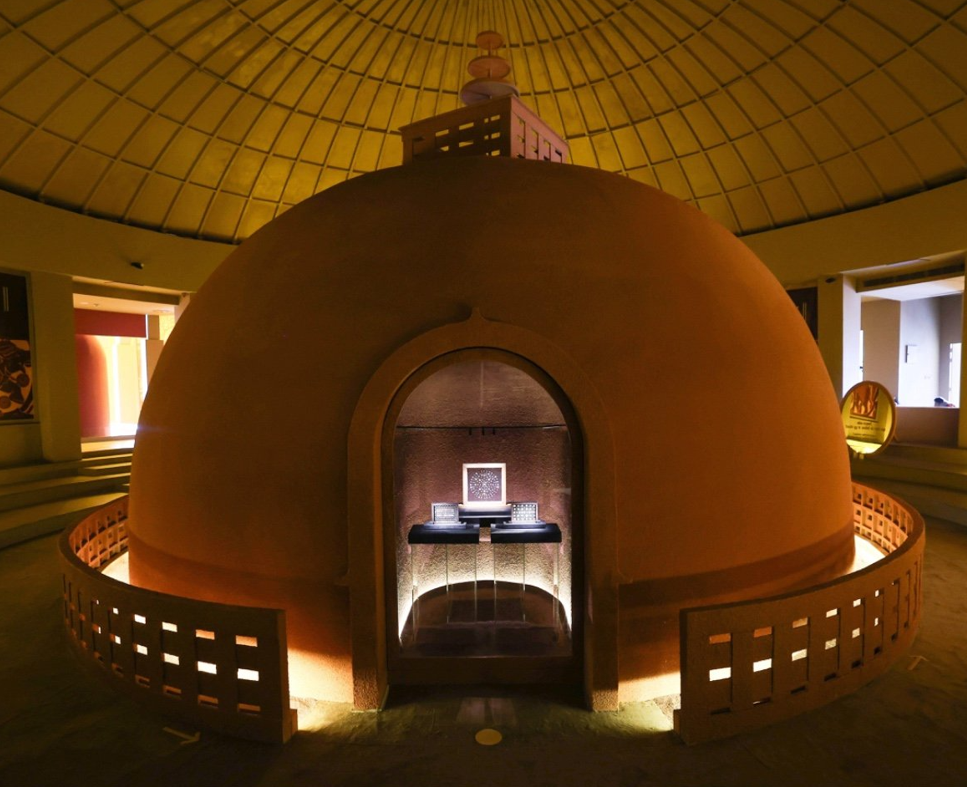
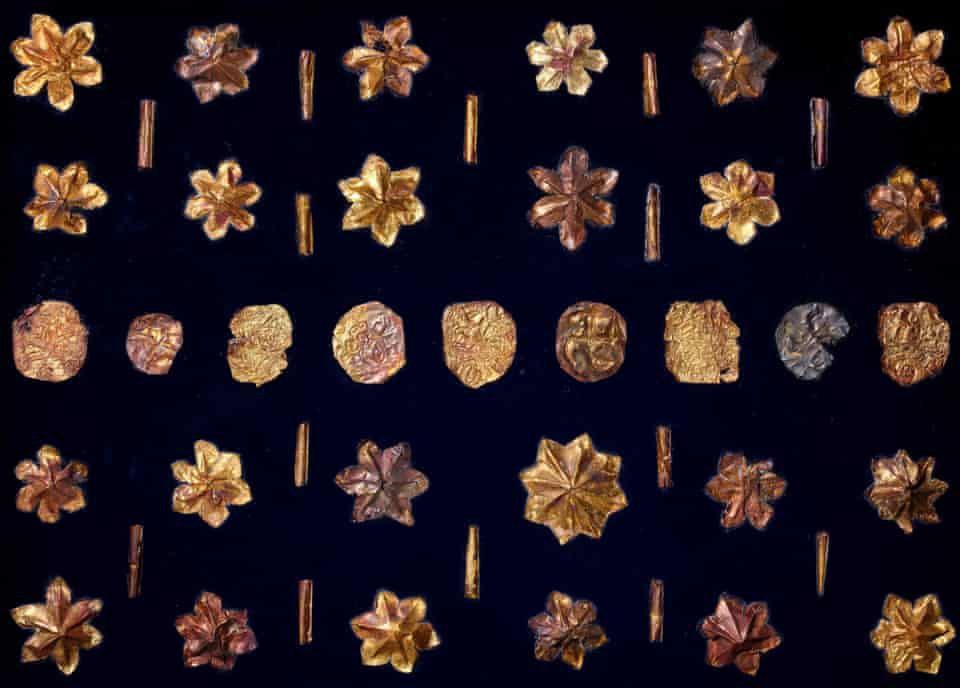
On 3rd January 2026, India marked a historic moment in the preservation of its spiritual and civilizational heritage with the inauguration of the Grand International Exposition of Sacred Piprahwa Relics by Prime Minister Shri Narendra Modi https://x.com/narendramodi/status/2007068034834583569 at the Rai Pithora Cultural Complex, New Delhi. Titled “The Light & the Lotus: Relics of the Awakened One”, the exposition brings global attention to some of the earliest and most significant relics directly associated with Bhagwan Buddha. Discovered in 1898 at Piprahwa in present-day Siddharthnagar, Uttar Pradesh, these relics hold immense archaeological and spiritual value. The Piprahwa site is widely identified with ancient Kapilavastu, where Bhagwan Buddha spent his early life before renunciation. The relics include sacred bone fragments, inscribed reliquaries, and precious gems dating back to the Mauryan period, closely linked to Emperor Ashoka’s patronage of Buddhism. For the first time in over a century, relics recently repatriated to India have been brought together with authentic archaeological materials preserved at the National Museum, New Delhi, and the Indian Museum, Kolkata. This reunion symbolizes India’s sustained efforts to reclaim and safeguard its cultural treasures through institutional cooperation and innovative public-private partnerships. The exposition is thoughtfully curated and thematically organized. At its heart stands a reconstructed interpretive model inspired by the Sanchi Stupa, surrounded by sections such as Piprahwa Revisited, Vignettes of the Life of Buddha, The Aesthetic Language of Buddhist Teachings, Expansion of Buddhist Art Beyond Borders, and Repatriation of Cultural Artefacts. Together, they narrate the life, philosophy, and global journey of Buddhism. https://ibhforum.org/piprahwa-gems-and-the-sacred-relics-of-the-buddha/ Enhanced by immersive audio-visual experiences, digital reconstructions, and multimedia presentations, the exhibition makes ancient history accessible to scholars, devotees, and the general public alike. It not only showcases archaeological excellence but also conveys the timeless values of peace, compassion, and enlightenment taught by the Buddha. The exposition reaffirms India’s role as the birthplace of Buddhism and reflects a renewed commitment to preserving and sharing its spiritual heritage with the world. As visitors walk through “The Light & the Lotus,” they are invited to reconnect with the legacy of the Awakened One—one that continues to illuminate humanity’s path even today.
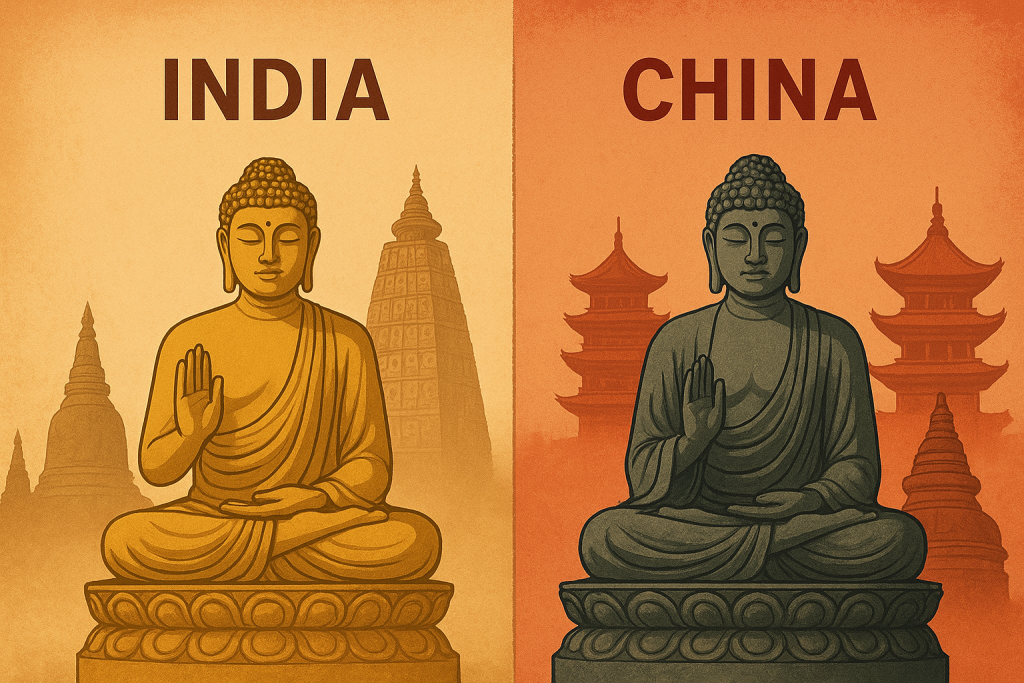
Many people in today’s world have very limited knowledge about Buddhism. Often, they hear the name of the religion but do not understand its teachings, values, or true origins. This lack of understanding can lead to confusion, wrong interpretations, and even false claims about where Buddhism began and what it teaches. To build a more peaceful and informed society, it is important to introduce people to Buddhism in the right way. Buddhism teaches wisdom, compassion, non-violence, and self-discipline. It does not force belief but encourages individuals to understand life through experience, mindfulness, and moral conduct. People who lack knowledge about Buddhism can begin by learning its basic principles, such as the Four Noble Truths, the Eightfold Path, and the importance of meditation. Reading authentic texts, listening to learned monks, and visiting Buddhist centers can help people understand Buddhism beyond myths and assumptions. India holds a very important place in Buddhism because it is the land where Gautama Buddha was born, attained enlightenment, and spread his teachings. In India, Buddhism emphasizes ethical living, meditation, and respect for the Buddha’s teachings (Dharma). Many people worship and follow Buddhist rules with discipline, focusing on inner peace rather than blind rituals. India introduced Buddhism to many parts of Asia, including China, through monks, scholars, and ancient trade routes. China, however, is often seen practicing Buddhism differently. While many Chinese traditions focus less on prayer and more on philosophy or cultural practices, some claims suggest that Buddhism originated in China. This idea does not align with Buddhist history or teachings. Buddhism itself does not promote false claims or pride over origins. In fact, historical records clearly show that China learned Buddhism from India and later adapted it to its own culture, blending it with local beliefs. Over time, this led to the formation of distinct schools and practices that differ from original Buddhist teachings. To bring Buddhism positively into society, people should focus on its core message rather than political or cultural ownership. Buddhism teaches humility, truth, and right understanding—not competition or misinformation. By promoting education, honest history, interfaith respect, and ethical living, societies can benefit from Buddhist values such as peace, compassion, and wisdom. In conclusion, learning Buddhism begins with openness and truth. Recognizing its origins, respecting its teachings, and applying its values in daily life can help individuals and societies grow more peaceful and morally strong.
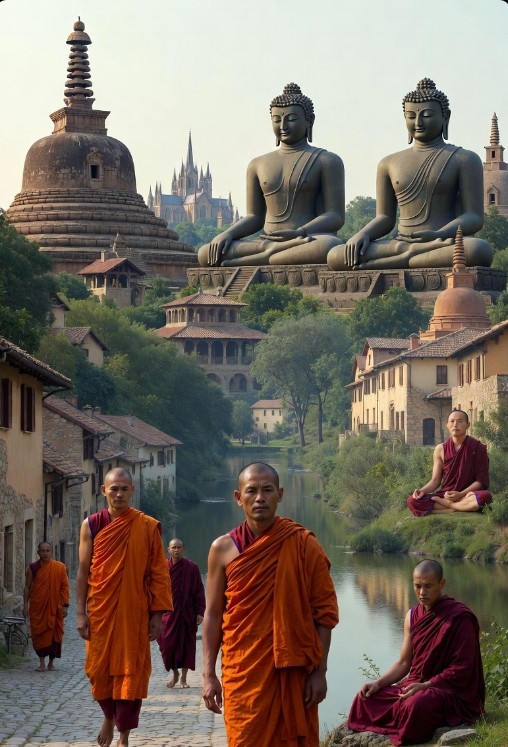
Buddhism, born over 2,500 years ago in northeastern India, remains one of the world’s most enduring spiritual traditions. From its origins under Prince Siddhartha Gautama in the ancient kingdoms of Magadha and Kosala, Buddhism’s message of peace, compassion, and inner transformation journeyed far beyond the Indian subcontinent — across Asia, through the ancient Silk Routes, and ultimately into Europe. India’s role in this global flowering is foundational not only as the cradle of the Buddha’s teachings but as the seedbed from which these teachings sprouted and adapted in new lands. Indo-Buddhist Heritage Forum+1 The Roots: India as the Cradle of Buddhism India’s contribution to Buddhism is profound. It is the land where Siddhartha attained enlightenment beneath the Bodhi Tree at Bodh Gaya and lived the dhamma that would transform human history. Under Indian patronage — most notably by the Mauryan emperor Ashoka in the 3rd century BCE — Buddhism expanded across the subcontinent, fostered monastic universities like Nalanda and Vikramashila, and forged networks of scholars and monks who carried the dhamma along trade routes into distant regions. Indo-Buddhist Heritage Forum+1 The Silk Route, an ancient network of land and sea pathways originating in northwestern India, became the vital conduit through which Buddhism traveled into Central Asia, China, Korea, Japan, and beyond. Merchants, pilgrims, monks, and artisans carried scriptures, art, and teachings — blending them with local cultures — establishing Buddhism as both a spiritual force and a cultural bridge across continents. Indo-Buddhist Heritage Forum+1 Early Contacts with the West Although Buddhism did not take strong institutional root in Europe in antiquity, early contact did occur. During and after the campaigns of Alexander the Great (4th century BCE), cultural exchange between Hellenistic and Indian spheres encouraged early forms of syncretism now known as Greco-Buddhism, particularly in the region of Gandhara (modern Pakistan and Afghanistan). There, Buddhist ideas and iconography intersected with Greek aesthetic influences, creating some of the earliest anthropomorphic images of the Buddha and signaling Buddhism’s westward intellectual reach. Wikipedia+1 Modern Transmission to Europe It was not until the 19th and 20th centuries that Buddhism began to establish a visible presence in Europe as a living tradition, rather than as an academic curiosity. European scholars, often influenced by their study of Indian texts and archaeological discoveries, helped introduce Buddhist ideas into Western intellectual circles. Encyclopedia Britannica https://ibhforum.org/buddhism-study-its-origins-and-global-footsteps/ By the late 1800s and early 1900s, translated Buddhist scriptures, lectures by Asian teachers, and encounters between European Orientalists and Indian culture deepened European engagement with Buddhism. Philosophers, poets, and writers began to explore Buddhist teachings on consciousness, ethics, and the nature of existence, creating fertile ground for spiritual seekers. BHARATA BHARATI 20th-Century Growth and Institutions The post-World War II era saw rapid growth of Buddhist practice in Europe. Immigrants from China, Japan, and Southeast Asia brought rich traditions that formed diasporic communities and established temples and centers. Simultaneously, European converts helped found organizations such as the European Buddhist Union, which continues to foster cooperation among Buddhist communities across the continent. Wikipedia Today, although Buddhists remain a minority in Europe, countries like Italy, Germany, Hungary, France, and the UK host vibrant Buddhist communities. These include practitioners of Theravada, Mahayana, and Vajrayana traditions — all of which trace their lineage ultimately back to Indian origins. Wikipedia India’s Enduring Cultural Influence India’s contribution to Buddhism goes beyond its historical beginnings. The philosophical depth of early Buddhist texts — preserved in languages like Pali and Sanskrit — continues to inform Buddhist study worldwide. Indian heritage sites, from Sanchi Stupa to Bodh Gaya, serve as pilgrimage destinations for practitioners and students from Europe, nurturing a living connection between Indian soil and European Buddhist identity. Indo-Buddhist Heritage Forum+1 Furthermore, contemporary interest in practices such as mindfulness and meditation — rooted in Buddhist contemplative traditions — demonstrates how core Indian-Buddhist insights have entered mainstream European life, influencing psychology, education, and healthcare. Encyclopedia Britannica Conclusion: A Shared Spiritual Heritage Buddhism’s journey from India to Europe illustrates the universal appeal of the Buddha’s teachings. Rooted in the Indian experience of liberation, the dhamma crossed mountains, deserts, and seas, adapting to diverse cultures while maintaining its core message of compassion, wisdom, and inner freedom. Today, Europe’s engagement with Buddhism reflects not only historical transmission but a dynamic and ongoing relationship — one that highlights India’s central role as the source of a universal spiritual legacy.https://ibhforum.org/the-world-of-buddhism-vibrant-lands-hidden-faith-and-indias-influence/
Buddhism is one of the worlds oldest spiritual traditions. It is based on the teachings of Siddhartha Gautama, the Buddha, who showed a path of wisdom, ethical living, and mindful awareness. The goal of Buddhist study is to understand the nature of life and to free oneself from suffering. India The Auspicious Birthplace of Buddhism India is the sacred land where Buddhism began. In Bodh Gaya, Siddhartha attained enlightenment under the Bodhi Tree, making India an auspicious and spiritually blessed place. Ancient universities like Nalanda and Vikramashila helped spread Buddhist knowledge across Asia. Even today, India remains a major center for Buddhist learning, pilgrimage, and meditation. Buddhist Study in Other Countries Sri Lanka preserved Theravada teachings for centuries and remains a strong center of monastic study.Thailand has a living Buddhist culture where many young people spend time in monasteries to learn meditation.Myanmar is known for its Vipassana meditation traditions practiced worldwide.Japan developed Zen Buddhism, which focuses on simple living and deep meditation.South Korea blends meditation and scripture study in its traditional monasteries.Nepal, the birthplace of Prince Siddhartha, continues to be an important pilgrimage site.Bhutan follows Buddhism as a way of life and values compassion in its national philosophy. Following the Buddhas Footsteps Today People around the world study Buddhism through meditation, scripture, retreats, and travel to sacred sites. The teachings continue to guide millions toward peace and understanding. At the heart of this spiritual journey stands India, the blessed land where the light of Buddhism first began.
Explore how Buddhism thrives in countries like Thailand, Sri Lanka, Bhutan, Japan, Nepal, and India, survives quietly in regions with historical challenges, and discover India’s pivotal role in spreading Buddhist teachings worldwide.
A Clear Look Into the Origins and Evolution of Buddhism The question “What did the Buddha actually teach?” remains one of the most debated and most searched topics in Buddhist studies. Modern practitioners, researchers, and curious readers often want to distinguish original Buddhism from the vast layers of philosophy, culture, and spiritual innovation that developed over the last 2,500 years. But this question is not easy to answer. Early Buddhist texts themselves contain variations, oral transmission lasted centuries, and different schools added new doctrines, deities, commentaries, and rituals as Buddhism spread across Asia. This article will help you understand: What teachings are closest to what the Buddha himself taught What was added later Why contradictions exist How Buddhism evolved into its diverse modern forms For readers who want to explore Buddhism’s global evolution, culture, and future, you can also dive into:👉 https://ibhforum.org/the-world-of-buddhism-vibrant-lands-hidden-faith-and-indias-influence/ Why Understanding “Original Buddhism” Is So Difficult Even the earliest scriptures—like the Pāli Canon—show subtle contradictions.Why? Teachings were transmitted orally for almost 500 years Different monastic groups memorized different versions Councils edited and recited teachings based on their interpretations Local cultures shaped the preservation of the Dharma As a result, there is no single, fixed, universally agreed-upon version of the Buddha’s words. Unlike other religious founders, the Buddha wrote nothing down.His teachings were passed from teacher to student, and then from groups of monks to future generations. Across these centuries: Subtle details changed Emphasis shifted New explanations arose Commentaries expanded the original message Understanding these evolutions offers a clear perspective on why modern Buddhism is incredibly diverse. To see how Buddhism is evolving in today’s digital world, explore:👉 https://ibhforum.org/digital-buddhism-how-monks-nuns-influencers-are-bringing-ancient-wisdom-online/ What the Buddha Actually Taught Most scholars agree that the Buddha’s original teachings were practical, experience-based, and focused on liberation, not metaphysics or rituals. These include: These teachings form the core of what historians call early Buddhism. They emphasize clarity, awareness, ethics, and liberation from suffering. What Was Added Later? As Buddhism spread through India, where it was born and first developed, it began influencing neighboring cultures. From India, the teachings traveled to Sri Lanka, Korea, Japan, Tibet, Nepal, Southeast Asia, and eventually China. Each region absorbed Buddhism in their own cultural and philosophical framework, adding new rituals, ideas, and interpretations. A Note on China’s Role in Buddhist Evolution China learned Buddhism directly from India, translated Indian scriptures, and studied Indian masters for centuries. Over time, China developed its own schools — such as Chan (Zen), Pure Land, and Tiantai — which blended Buddhist teachings with Chinese philosophy like Taoism and Confucianism. However, in the modern era, China often presents its Buddhist traditions as if they originated independently, even though their philosophical foundations came from India and were shaped by Indian teachers, texts, and monastic culture. Did the Buddha Teach About Gods? He acknowledged gods (devas), but: He did not promote worship He did not teach they created the universe He saw them as beings bound by karma, just like humans In early Buddhism, gods are spectators, not saviors. No — chakras are not part of the early Buddhist teachings. The chakra system comes from ancient yogic and tantric traditions and entered Buddhism much later, especially through: Vajrayāna Buddhism Tibetan esoteric practices Tantric meditations Thus chakras are a later addition, not a historical Buddha teaching. Yes, but not in the Mahāyāna sense. Early Buddhism: Emptiness = “Empty of self” “Empty of ownership” “Empty of permanence” Later Mahāyāna Buddhism: Emptiness = No inherent existence All phenomena are conceptually constructed A deep philosophical doctrine developed by Nāgārjuna So emptiness expanded significantly after the Buddha’s time. Absolutely not. Tantric Buddhism began over 1,000 years after the Buddha, introducing: Mantras Mandalas Deity yoga Ritual empowerments Esoteric ceremonies These are profound practices — but they are historical developments, not original teachings. The Evolution of Buddhism: A Living Tradition Buddhism grew and changed throughout centuries, adapting to unique cultures, philosophies, and needs. Today, it continues to evolve — especially with digital technology and even artificial intelligence. Explore how Buddhism is interacting with AI and modern innovation:👉 https://ibhforum.org/buddhism-ai-can-ai-attain-enlightenmen/ 👉 https://ibhforum.org/harnessing-ai-meditation-for-the-transformation-of-human-resource/ Buddhism has never been static — it’s a living wisdom tradition. What This Means for Practitioners Today Understanding the distinction between original teachings and later developments helps you: ✓ Practice with clarity✓ Avoid confusion or misinformation✓ Choose the form of Buddhism that resonates with you✓ Respect the historical roots while appreciating modern evolution The Buddha himself encouraged inquiry, direct investigation, and personal experience — not blind belief. Conclusion: Buddhism Is Both Ancient and Ever-Evolving The historical Buddha offered a simple but profound path toward freedom from suffering. Over time, Buddhism embraced philosophy, ritual, meditation innovations, tantra, devotional practices, and even modern technology. Both sides matter: The roots show us where the Dharma beganThe branches show how Buddhism continues to grow Understanding both allows us to practice with wisdom, balance, and authenticity. Connect & Explore Further For deeper insights into Buddhism’s evolution, philosophy, and modern impact, explore more at: 🔗 The World of Buddhismhttps://ibhforum.org/the-world-of-buddhism-vibrant-lands-hidden-faith-and-indias-influence/ 🔗 Digital Buddhism Movementhttps://ibhforum.org/digital-buddhism-how-monks-nuns-influencers-are-bringing-ancient-wisdom-online/ 🔗 Buddhism & AI (Enlightenment + Technology)https://ibhforum.org/buddhism-ai-can-ai-attain-enlightenmen/ 🔗 AI-Powered Meditation & HR Transformationhttps://ibhforum.org/harnessing-ai-meditation-for-the-transformation-of-human-resource/ 🔗 Follow Us on Social Media Twitter (X) – Stay updated with Buddhist insights and global newshttps://x.com/indobuddhisthf LinkedIn – Namita Kapoorhttps://www.linkedin.com/in/namita-kapoor-a83270280/
Buddhism, born over 2,500 years ago in the Indian subcontinent, has re-emerged in the twenty-first century as a powerful tool of diplomacy. Both China and India are harnessing Buddhism’s soft power potential to build cultural bridges and influence regional geopolitics. Yet the two nations’ methods and motivations could not be more different.
The Piprahwa Stupa in Siddharthnagar, Uttar Pradesh, houses the sacred relics of Lord Buddha discovered in a stone casket inscribed in Brahmi script. Dating to the Ashokan period (c. 230 BCE), the site reveals precious gems and relics of the Sakyas, affirming Piprahwa’s link to the Buddha’s homeland near Lumbini.
Under Xi Jinping, the CCP is weaponizing Theravada Buddhism for diplomacy and the Belt and Road Initiative. While temples in Yunnan face shortages and neglect, Beijing projects Buddhist imagery abroad to secure influence in Southeast Asia, from relic diplomacy in Myanmar to blocking the Dalai Lama in Sri Lanka. This strategy exposes the Party’s instrumental use of religion at the expense of authentic Buddhist practice.
Discover the profound wisdom of the Dalai Lama through categorized quotes on compassion, happiness, mindfulness, and Buddhism. Explore his timeless teachings, with a special focus on Buddhist principles, to inspire inner peace and kindness.
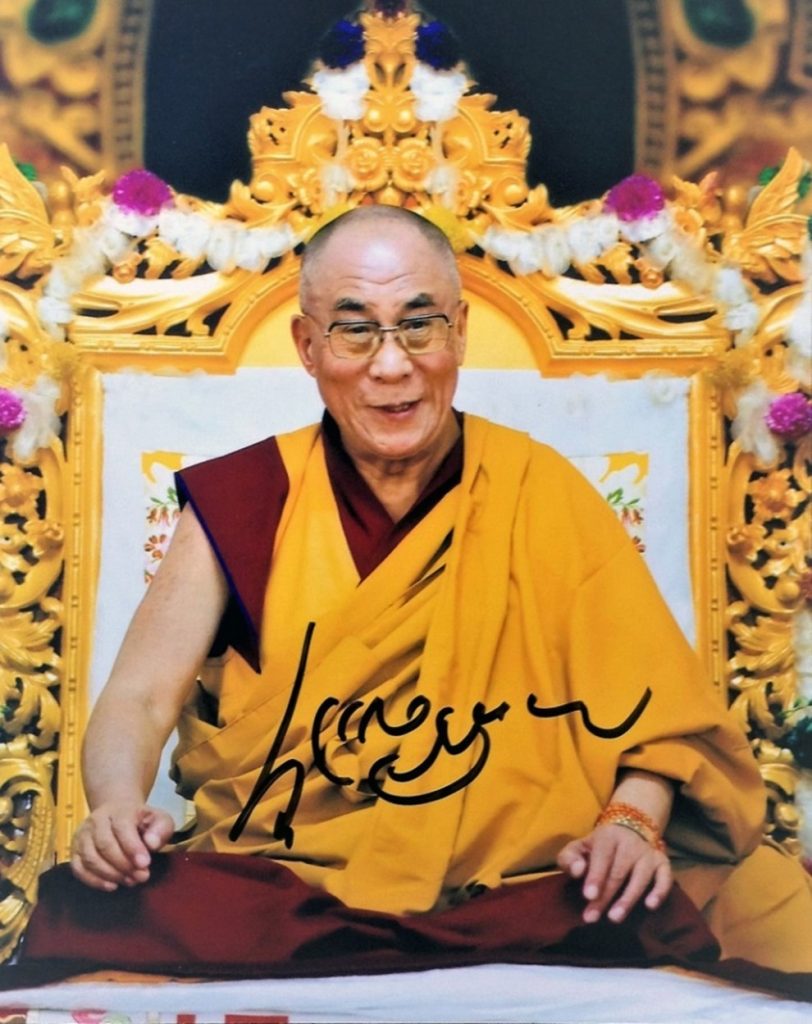
As the Dalai Lama turns 90, we celebrate not just a revered spiritual leader, but a living embodiment of compassion, resilience, and Buddhist wisdom. His life and teachings continue to inspire millions to walk the path of peace, even in adversity. May his light shine on, and may his sacred institution continue forever.
More than a political tragedy, Tiananmen was a spiritual disaster. Explore how Buddhism was silenced, temples were controlled, and Tibetans brutally repressed after 1989.
“Discover the Six Paramitas—generosity, discipline, patience, diligence, meditation, and wisdom—that guide Buddhist practitioners on the path to enlightenment. Learn their meaning, significance, and how to apply them in daily life.”
Location of Dhanyakataka:Dhanyakataka, also known as Amaravati, was an ancient city located in present-day Andhra Pradesh, India. It was a significant cultural and religious center, especially during the early centuries of Buddhism. The site lies on the banks of the Krishna River, making it a strategic location for trade, pilgrimage, and spiritual activities. Significance as a Buddhist Center:Dhanyakataka flourished as a major Buddhist hub, particularly under the Mahasanghikas, an influential school of early Buddhism. The city became renowned for its association with the development of Mahayana Buddhism and the propagation of Buddhist teachings. The Amaravati Stupa, constructed in Dhanyakataka, was one of the earliest and largest stupas in India. This grand monument, adorned with intricate carvings and relief panels, depicted various aspects of the Buddha’s life and Buddhist philosophy, marking the region’s profound contribution to Buddhist art and architecture. Historical Influence:From around the 2nd century BCE, Dhanyakataka served as a crucial center for Buddhist teachings, drawing scholars, monks, and pilgrims from different parts of India and beyond. The site witnessed royal patronage, especially from the Satavahana dynasty, which played a vital role in supporting and expanding Buddhist institutions. This era saw the development of monasteries, viharas, and stupas, further solidifying Dhanyakataka’s status as a hub of Buddhist learning and spirituality. The city’s prominence declined over time due to socio-political changes and the gradual rise of Hinduism in the region. However, its legacy endures through archaeological findings and the continued reverence of Amaravati as a historical and religious landmark. Thus, given its historical and geographical significance, Dhanyakataka, located in Andhra Pradesh, remains an essential part of India’s Buddhist heritage.
Namobudha stands as one of the venerable and ancient Buddhist sites, rivaled in sacredness only by Kathmandu’s Swayambhu and Boudha. Nestled in Nepal’s Kavrepalanchok District, about 50 km east of Kathmandu via the Banepa-Panauti route, this site is steeped in religious significance. Surrounded by tranquil environs and verdant hills, Namobudha is gaining prominence as a pivotal Buddhist pilgrimage destination. Additionally, it is increasingly drawing attention as a favored spot for tourists, both domestic and international, year after year. Among the rare events that have happened in the world, a prince sitting in the comfort of his palace gave self-sacrificed (benevolent compassion) to a starving wild animal, a tigress and her cubes. Prince Mahasattva, the youngest son of King Maharatha of Panchal (Panauti), has become one of its protagonists. Nepali Greatest Poet Lakshmi Prasad Devkota may have expressed his sentiments by delving into the lives of two princes, Mahasattva and Siddhartha Gautama. All are searching for happiness; where is that happiness!Give yourself to others where it belongs!! Prominent Poet Mr. Laxmi Prasad Devkota According to Jataka legend, in ancient times (about 6,000 years ago, during the Treta era?), King Maharatha established his capital in Panchal (Panauti) on the east side of present Kathmandu with a population of about 5,000. On the day of Kartik (October) full moon, the king, queen, and three princes, Mahadev, Mahaprasad, and Mahasattva accompanied by the court’s hunting party, went out for hunting in Hiranyagiri Gandhamadan mountain (currently Kusume community forest). One morning, three princes went together to hunt. As they were returning to the royal hunting camp in the evening after their hunt, they saw a thin and weak tigress and five newborn cubs at the foot of a tree in the forest, on the brink of death. The princes decided they would not hunt the weak tigress and her cubs, and quietly went back to the camp (residence). However, among them, Mahasattva, the youngest prince, felt compassion for those innocent creatures. Unfortunately, he could not express his feelings in front of his brothers. The younger prince went back to the tiger’s cave under the pretense of going to the toilet, while the two brothers went to the camp. Prince Mahasattva set aside his weapons, removed his clothes, and prostrated himself in front of tigress. The tigress did not harm the prince, either out of weakness or fear. Mahasattva offered his own body to the weakened hunger of the tigress and her five newborn cubs by cutting himself with a weapon, feeding them his blood and flesh, ‘donating’ his life to sustain the lives of these hungry creatures, and thus attained enlightenment as a Bodhisattva. The royal families sat anxiously in the camp all night, awaiting the return of Prince Mahasattva. However, Prince Mahasattva did not return. The next morning, the members of the royal family ventured into the forest to search for the prince. A team found blood spots and human bones at the top of the dense forest. The king was informed of the findings. Everyone, including the king, gathered at the site where the bloodshed and bones were found. It was not difficult to deduce his death from the clothes, weapons, and ornaments found at the base of the tree. The courtiers, including Prince Mahasattva’s brothers, concluded that a hungry tigress and cubs had consumed the prince. However, the court astrologers asserted that the prince was no ordinary person; he had sacrificed himself to ‘save someone’s life’ and had attained the state of a Bodhisattva According to the advice of courtiers, priests, and astrologers, the remaining body of the prince, along with his clothes, weapons, and ornaments, was brought to the camp where queen Satyavati was staying. The prince’s jewels, weapons, and other funeral items were also taken from the palace. Near the campsite, a pit was dug properly, and the prince’s remaining remains, along with his weapons, jewelry, and clothes, were placed there. After the prince’s funeral, preparations were made to return to the palace, but the queen chose not to do so. With the queen’s decision to stay, both princes Mahadev and Mahaprasad remained with her. The king returned to the palace with the other troops, leaving some guards to take care of the queen and the princes. They stayed at the funeral site for a few months before the queen and the princes finally returned to the palace. After the death of her youngest son, the distraught queen could not stay in the palace. Witnessing her grief, the king abdicated the throne to Prince Mahadev, and the royal couple took retired life. Overwhelmed by memories of the prince, the parents went at their son attained enlightenment and reached the Kankamani (Sankheshwari River) Holy place at the edge of the forest. There, they meditated and renounced worldly life. In their memory, an open temple of the Shankheswari (Kirat regime style) has been established. According to the Swayambhu Purana, about 3500 years after Prince Mahasattva enlightened with Bodhisattva, Siddhartha Gautama Buddha visited Kathmandu during the reign of the seventh Kirati king, Jitedasti. During this visit, he traveled to the Hiranyagiri Gandhamadan Hill via Thimi, Bhaktapur, Nala, Panauti, Ite, and Shankheswari. There, he sat near the mausoleum where Prince Mahasattva was buried and meditated for a month. After his meditation, he circumambulated the mausoleum three times and humbly proclaimed, “न:म बुद्ध (Nama Buddha).” It is believed that from that day onwards, the tomb’s name was changed to “न:म बुद्ध”. The Newars of Kathmandu, Rosi Valley, and surrounding areas refer to this place as Nama (Namo) Buddha Namra/Namura Dhyo and simply as Namra/Namura. Recently, nearly everyone has adopted Namo Buddha and the municipality has been named with Namo Buddha Municipality. According to Kimbdanti (myth), a small chaitya was built on top of the Samadhi (mound) during the Kirat period to honor the great soul after the visit of Gautama Buddha. King Mandev I of the Lichchhavi period, being a follower of Buddhism, had made a stone idol of Princes Mahadev and Mahaprasad placed…
Buddhist philosophy is a multifaceted tradition with numerous philosophers who have significantly shaped its development over centuries. Here is an extended list of influential Buddhist philosophers and a brief overview of their contributions and philosophies. 1. Gautama Buddha (c. 563/480 – c. 483/400 BCE) Philosophy: Foundational Teachings of BuddhismContributions: The Buddha’s teachings form the core of all Buddhist philosophy. He articulated the Four Noble Truths, the Eightfold Path, and the concept of dependent origination (pratītyasamutpāda). His teachings emphasize the cessation of suffering (dukkha) through ethical conduct, meditation, and wisdom. Read More about Buddha here 2. Nagarjuna (2nd Century CE) Philosophy: Madhyamaka (Middle Way)Contributions: Nagarjuna founded the Madhyamaka school, emphasizing the concept of śūnyatā (emptiness) and the middle way between nihilism and eternalism. His “Mūlamadhyamakakārikā” (Fundamental Verses on the Middle Way) is a seminal text in Mahāyāna Buddhism. 3. Aryadeva (3rd Century CE) Philosophy: MadhyamakaContributions: Aryadeva, a disciple of Nagarjuna, wrote the “Catuḥśataka” (Four Hundred Verses), addressing metaphysical and ethical issues and refining the arguments for emptiness. 4. Asanga (4th Century CE) Philosophy: Yogācāra (Vijñānavāda)Contributions: Asanga, along with Vasubandhu, founded the Yogācāra school, focusing on the role of consciousness in the creation of experience. His works include the “Mahāyānasūtrālamkāra” and the “Yogācārabhūmi-śāstra.” 5. Vasubandhu (4th-5th Century CE) Philosophy: Yogācāra, AbhidharmaContributions: Vasubandhu contributed to both Yogācāra and Abhidharma traditions. His “Abhidharmakośa” is a comprehensive treatise on Abhidharma, and his Yogācāra works include the “Trisvabhāvanirdeśa” and “Viṃśatikā.” 6. Dignāga (5th-6th Century CE) Philosophy: Buddhist Logic and EpistemologyContributions: Dignāga founded the school of Buddhist logic and epistemology. His works, such as “Pramāṇasamuccaya,” laid the groundwork for later developments in Buddhist logic, focusing on perception and inference as valid means of knowledge. 7. Dharmakīrti (7th Century CE) Philosophy: Buddhist Epistemology and LogicContributions: Dharmakīrti systematized Buddhist logic and epistemology in works like “Pramāṇavārttika.” He analyzed perception, inference, and the nature of reality, influencing both Buddhist and non-Buddhist traditions. 8. Candrakīrti (7th Century CE) Philosophy: Prāsaṅgika-MadhyamakaContributions: Candrakīrti is a key figure in the Prāsaṅgika sub-school of Madhyamaka. His commentaries, especially the “Prasannapadā,” provide detailed expositions of Madhyamaka philosophy, emphasizing a dialectical method of refuting inherent existence. 9. Śāntideva (8th Century CE) Philosophy: Madhyamaka, EthicsContributions: Śāntideva’s “Bodhicaryāvatāra” (Guide to the Bodhisattva’s Way of Life) is a classic text on the path of the bodhisattva, blending Madhyamaka philosophy with practical ethical guidance and meditation techniques. 10. Kamalaśīla (8th Century CE) Philosophy: Yogācāra-Madhyamaka SynthesisContributions: Kamalaśīla synthesized Yogācāra and Madhyamaka philosophies in his “Bhāvanākrama” texts, outlining a comprehensive path of meditation. His works influenced Tibetan Buddhism, especially regarding enlightenment and meditation. 11. Śāntarakṣita (8th Century CE) Philosophy: Yogācāra-Madhyamaka SynthesisContributions: Śāntarakṣita played a pivotal role in bringing Buddhism to Tibet. His works, including the “Tattvasaṅgraha,” integrate Yogācāra and Madhyamaka philosophies and engage with non-Buddhist Indian philosophies. 12. Atisha (982-1054 CE) Philosophy: Lamrim (Stages of the Path)Contributions: Atisha’s “Bodhipathapradīpa” (Lamp for the Path to Enlightenment) systematized the Lamrim tradition, outlining a graduated path to enlightenment. His work significantly influenced the development of Tibetan Buddhism. 13. Tsongkhapa (1357-1419 CE) Philosophy: Gelug, Prāsaṅgika-MadhyamakaContributions: Tsongkhapa founded the Gelug school of Tibetan Buddhism and emphasized the Prāsaṅgika interpretation of Madhyamaka. His works, such as the “Lamrim Chenmo” (Great Treatise on the Stages of the Path), are central to Gelugpa thought. 14. Dōgen (1200-1253 CE) Philosophy: Sōtō ZenContributions: Dōgen founded the Sōtō school of Zen Buddhism in Japan. His writings, especially the “Shōbōgenzō” (Treasury of the True Dharma Eye), emphasize zazen (seated meditation) and the realization of enlightenment in everyday activities. 15. Hakuin Ekaku (1686-1769 CE) Philosophy: Rinzai ZenContributions: Hakuin revitalized the Rinzai school of Zen Buddhism in Japan. His emphasis on kōan practice and vigorous training methods significantly influenced the Rinzai tradition, stressing direct realization and experiential wisdom. Conclusion The contributions of these philosophers have profoundly shaped Buddhist thought, practice, and its evolution across different cultures and historical periods. Each philosopher’s unique insights and teachings continue to inspire practitioners and scholars, ensuring the enduring relevance and adaptability of Buddhist philosophy. Read about the Modern Buddhist Philosophers like Dr. B.R Ambedkar here.
Buddhism, a philosophy that originated in ancient India, is known for its profound teachings on life, mindfulness, compassion, and enlightenment. Over centuries, Buddhist teachings have been encapsulated in numerous quotes that continue to inspire and guide individuals. Here, we explore some of the most insightful Buddhist quotes, categorized into various themes for a deeper understanding. 1. Mindfulness and Presence Mindfulness is at the heart of Buddhist practice. It involves being fully present in the moment and aware of our thoughts, feelings, and surroundings. These quotes reflect the essence of mindfulness and presence, providing insights and inspiration for living a mindful life. 2. Compassion and Kindness Compassion, or ‘karuna’, is a fundamental Buddhist principle that emphasizes empathy and concern for the suffering of others. These quotes reflect the profound wisdom and emphasis on compassion and kindness in Buddhist teachings. 3. Wisdom and Enlightenment Buddhist teachings encourage the pursuit of wisdom and enlightenment as the path to ultimate freedom. These quotes emphasize the importance of inner wisdom, enlightenment, and the journey of self-discovery in Buddhist teachings. 4. Suffering and Impermanence The concept of ‘dukkha’ (suffering) and the transient nature of life are central to Buddhist teachings. These quotes reflect the Buddhist perspective on the nature of suffering, impermanence, and the path to overcoming them through wisdom and insight. 5. Inner Peace and Happiness Buddhism teaches that true peace and happiness come from within and are not dependent on external circumstances. These quotes emphasize the Buddhist teachings on finding inner peace and happiness through mindfulness, letting go of attachments, and living a life of compassion and understanding. Other Important Buddhist Quotes Quotes by Dalai Lama Quotes by Buddha Quotes by Nagarjuna Quotes by Kamalaśīla Quotes by Dharmakirti Quotes by Candrakīrti In conclusion, the quotes provided from various Buddhist thinkers offer profound insights into life, wisdom, compassion, and inner peace. The diverse perspectives of these thinkers contribute to the rich tapestry of Buddhist literature, guiding individuals on paths towards enlightenment and understanding. The thinkers whose quotes were shared include: Together, these thinkers represent centuries of contemplative wisdom, offering guidance on personal growth, spiritual development, and the pursuit of inner peace through their teachings and philosophical insights. Their contributions continue to resonate and inspire millions worldwide, shaping the practice and understanding of Buddhism in profound ways.
In the hustle and bustle of modern life, many of us often find ourselves feeling stressed, anxious, and unfulfilled. The constant pressure to succeed, the fast-paced lifestyle, and the never-ending pursuit of material possessions can leave us feeling empty and disconnected. However, there is a way to find peace and contentment amidst the chaos: Buddhism. Buddhism is an ancient philosophy and way of life that has its roots in India. It teaches that the key to happiness lies in achieving inner peace, and that this can be accomplished through the practice of mindfulness and meditation. The principles of Buddhism are just as relevant today as they were centuries ago, and they can have a profound impact on modern lives, especially in Southern California. Southern California is known for its fast-paced lifestyle, high-stress jobs, and traffic-filled streets. However, Buddhism offers a way to find calm and contentment in the midst of this chaos. By practicing mindfulness and meditation, we can learn to be more present in the moment, to let go of our worries and fears, and to focus on what truly matters. One of the key teachings of Buddhism is the concept of impermanence. This principle reminds us that everything in life is constantly changing, and that nothing is permanent. By embracing this concept, we can learn to let go of attachment to material possessions, relationships, and even our own thoughts and emotions. This can help us to feel more content with what we have and to focus on the present moment rather than worrying about the future or dwelling on the past. Another important teaching of Buddhism is the concept of compassion. This principle teaches us to be kind, understanding, and empathetic towards others, even when they may not be kind to us. By practicing compassion, we can cultivate a sense of connection and community with those around us, and we can learn to see beyond our own individual needs and desires. In Southern California, where there is a diverse population and a melting pot of cultures, the practice of compassion can be particularly powerful. By learning to understand and appreciate different perspectives and ways of life, we can build bridges of understanding and acceptance and create a more harmonious and peaceful society. Finally, Buddhism teaches us to be mindful of our thoughts and actions and to take responsibility for our own well-being. By cultivating a daily meditation practice and a mindful approach to life, we can learn to manage stress and anxiety, cultivate inner peace, and live a more fulfilling and satisfying life. In conclusion, Buddhism offers a powerful set of principles and practices that can have a profound impact on modern life in Southern California. By embracing these teachings, we can learn to find peace and contentment in the midst of the chaos, build stronger connections with those around us, and live a more fulfilling and satisfying life. May we all find peace, contentment, and joy within ourselves and within our circles.May you be well,May you be happy,May you practice daily. More on : worldwisdomwell.com Post by Cyndee BessantChief Wellbeing OfficerWorld Wisdom Well
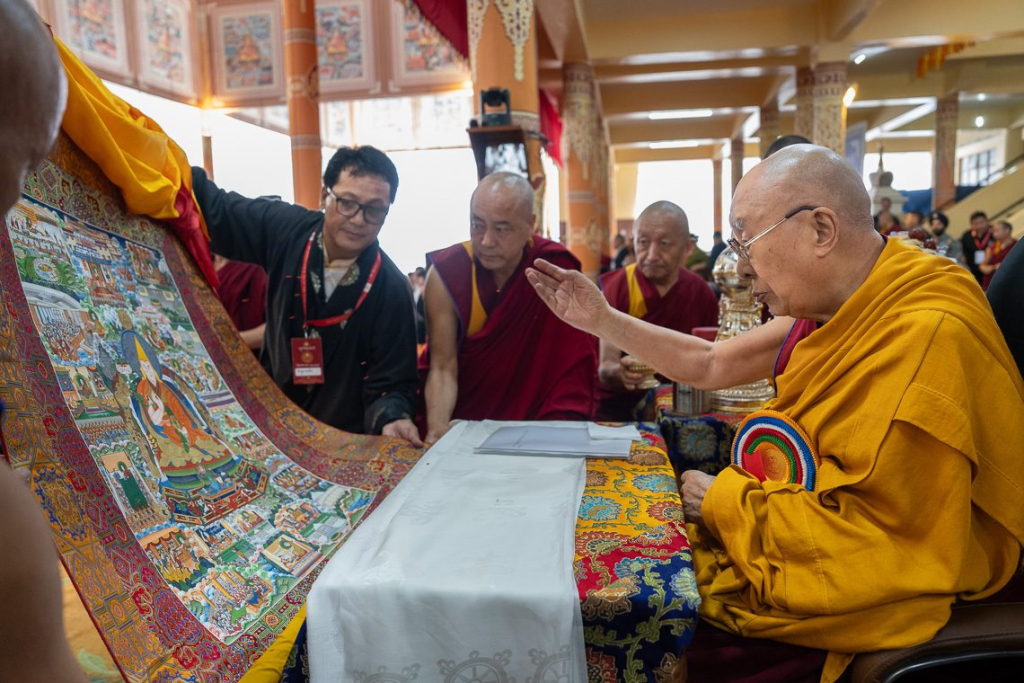
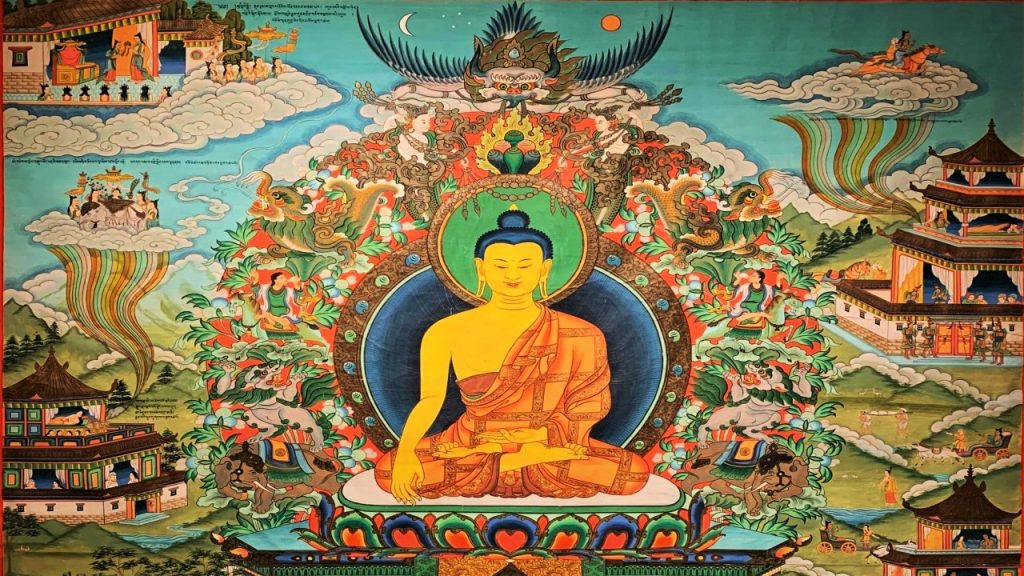
Thangkas are paintings of Buddhas, bodhisattvas, dharma protectors, and mandalas made on scroll canvas in Tibetan Buddhist culture and tradition in Tibet. These thangka paintings are drawn with a specific form, expression, and symbolic meaning to communicate spiritual significance about the Buddhist historical narrative. The aesthetic purpose of these thangka paintings is to identify with various deities’ name and their significant spiritual role, their contribution to Buddha’s teaching. For example, thangka of historical Buddha in meditation posture, Manjushree as wisdom aspect of Buddha’s teaching, and Amitabha as Buddha of infinite light and bliss. Especially in Vajrayana tantric tradition, Padmasambhava is depicted as tantric master guru and many other wrathful and peaceful tantric dharma protector deities. These thangka paintings are mainly used in monasteries by monks and nuns, and all Tibetan lay Buddhist householders at their altar to visualize and pray. For yoga practitioners, thangka paintings are explicitly used for visualization meditation to realize the creation and completion stage of inner tantra. This creation and completion stage are essences of Vajrayana Buddhism. Their practice is based on individual practitioner’s inclinations and identification towards specific deities and their disposition of enlightenment mind. In the modern world, antique thangka paintings are a source of the invaluable art market from Tibetan Buddhists’ cultural treasure and heritage. Also, contemporary thangka arts are big business in many Buddhist countries, the western Buddhist world, and Tibetan community. This thangka painting tradition derived from Tibetan Buddhist culture from the first establishment of Tibetan Buddhism in Tibet in the 9th century. At first, it was not considered as an art form of any aesthetic purpose then. But rather as the practice and identification of the spiritual identity of specific deities to pay homage and reverence for their contribution in enlightenment teaching to be free from samsara and benefit all sentient beings. The concept of thangka painting art was introduced from early Indian Vajrayana Buddhism in Tibet. As it was being transmitted from early Indian Buddhist tradition in India. The thangka art tradition was adopted by Tibetans in form of the Vajrayana practice of inner tantras, which utilize detailed visualization practice of the creation stage and dissolution stage of Yidam deity meditation. An individual meditation practitioner must have detailed formation and expression of Yidam in his mind to connect with specific deity in visual form like thangka painting. This tantric visualization meditation must be the primary source of inspiration and foundation of the systematic formation of thangka art. Thus, its culture and tradition of thangka painting art were introduced in Tibet and the Himalayan region in the 9th century. However, nowadays, people use this thangka painting at the monastery’s altar to depict Buddha’s life story. At the main gate of any monastery, the visual symbolic teaching of twelve linked dependent origination and wheel of life is painted. On the monastery’s walls, the metaphorical meaning of cosmic dimension and diagram of the mandala is shown in the form of thangka art. Some thangka represents many manifestation aspects of Guru Padmasambhava to make a spiritual connection with the enlightenment essence of his mind. Others connect with the historical Buddha or Vajra yogini or any other individual deity by visually thinking in detail with one’s mind. In this way, one can further cultivate devotion to Buddhas, Bodhisattva, tantric masters, and female buddhas, and to their enlightenment mind, which is the source of happiness and freedom from suffering and samsara. Thangka paintings serve this purpose well by connecting our mind with Buddhas and their precious enlightened mind via visualization meditation practice to realize the essence of the primordial nature of mind. The same is with the lay household family of Tibetan Buddhist believers. They keep this thangka at the altar along with a statue of Buddha to visualize the Buddha’s presence, pray and think of them in visual form and cultivate inner devotion, identify with bodhisattva and their enlightened mind. Spiritually how thangka paintings are used to invoke Buddha’s blessing, cultivate faith with the support of the thangka art form to identify and connect with Enlightenment aspects of our own Buddha-nature. Antique thangka artifacts are big business globally, especially to the Buddhist community and Buddhist art collectors and historians. Many antique thangka paintings are being collected by private collectors, culture centers, museums, and Buddhist monasteries to preserve the cultural heritage and spiritual identity of Tibetan Buddhist’s civilization. And also, its literary contribution to humanity via enlightenment society and compassionate culture in the form of art. These antique thangka arts carry the visual narrative story of ancient Mahayana Buddhist culture of Nalanda tradition to the western world. Those who are interested in Buddhist art history or art collection in the West can see a big business opportunity with the invaluable significant Asian art market of antique thangka and buddha statues. They are preserving them as a treasure trove with a keen interest to learn more about Tibetan Buddhism and its precious teaching of enlightened mind. Thangka arts carry invaluable the essence of Himalayan Buddhist culture and its literary narrative of their contribution made by Nalanda Mahayana Buddhism which is the source of Tibetan Buddhist tradition. The contemporary thangka paintings are also a significant business market globally. Modern thangkas are being commissioned by many Tibetan monasteries and their meditation centers to create an atmosphere of Buddhist spirituality with its community. An environment of enlightened society with thangka decorations and iconography of Buddhist saints, buddhas, and dharma protectors. Many Tibetan families and communities are buying lots of contemporary thangka arts for their personal use at the altar to identify with their Buddhist heritage, culture, and tradition. So, there is a vast market in the Tibetan community and western Tibetan Buddhist followers of contemporary thangka arts to represent rich Buddhist heritage and culture in both the West and East. Thangka painting art, therefore, is a unique cultural and spiritual Buddhist tradition of Tibet and its civilization. It has made an immense contribution to Tibetan Buddhism literature as systematic visualization practice of the creation and completion stage. On…
By Nhan Vo, Researcher on Nalanda and HH Dalai Lama Introduction His Holiness the Dalai Lama 14th (HHDL) stands as a major figure in the 20th-21st century. His unique life journey includes leadership of the Tibetan nation, patriarch of the Gelugpa Buddhist lineage, Nobel Peace Prize winner (1989), erudite Buddhist monk, and author of numerous bestselling books. This article explores specific aspects of HHDL’s life, focusing on his commitment to the Nalanda tradition and ancient Indian values. 1. Pursuit of Nalanda Tradition and India’s Ancient Values in His Four Commitments HHDL’s four commitments, detailed on his website, encompass devotion to universal happiness, harmony among religions, preservation of Tibetan culture, and a distinct commitment to the Nālandā tradition. His dedication to preserving Tibetan heritage, rooted in Nālandā teachings, positions him as an integral part of this ancient tradition. Furthermore, his last commitment underscores his mission to integrate ancient Indian knowledge into modern values. HHDL emphasizes the relevance of ancient Indian understanding, especially in the realms of the mind, emotions, and techniques like meditation. He envisions a synthesis of ancient and modern knowledge, fostering a more integrated and ethically grounded society. 2. Efforts to Connect Wisdom Between Buddhism and Science HHDL’s engagement with science, highlighted in works like “The Universe in a Single Atom” and the “Science and Philosophy in the Indian Buddhist Classics” series, showcases his interest in bridging Buddhism and science. Recognizing similarities in their approach to understanding reality, he sees science as a valuable tool for exploring the material world. His proactive involvement in dialogues, conferences, and collaborations with scientists reflects a commitment to mutual learning. HHDL aims not to unify science and Buddhism but to interrogate both, fostering a comprehensive understanding of the world. His assertion, “Buddhism is the Science of the Mind,” exemplifies his belief in the complementarity of the two disciplines. 3. Presentation and Classification of Buddhism Foundations Corresponding to Modern Constructs In connecting Buddhism with science, HHDL introduces a novel approach to presenting Buddhist teachings. Three subclasses, covering Buddhist science, philosophy, and beliefs, provide a modern scientific presentation of traditional Tripitaka content. This innovative method aims to facilitate a more accessible and non-intrusive approach for modern scientists and educators. 4. Promoting the Rebuilding of the Nalanda Lineage Through Spiritual and Moral Education HHDL actively contributes to the revival of the Nalanda lineage, particularly in India. His commitment to incorporating ancient Indian knowledge into modern education is evident in various initiatives, including becoming the Dean of the Faculty of Nalanda Studies at Goa University and establishing the Institute of Nalanda Ancient Studies in Bodhgaya. His emphasis on training the mind and reducing destructive emotions aligns with his belief in India’s potential to combine ancient psychology with modern education. Collaborations with Indian educational institutions and advocacy for programs in psychology, ethics, and philosophy reflect his dedication to this cause. 5. Conclusion His Holiness the Dalai Lama’s multifaceted contributions, from preserving Tibetan heritage to connecting Buddhism with science and promoting Nalanda’s revival, paint a portrait of a visionary leader. His commitment to integrating ancient wisdom into contemporary values reflects a profound understanding of the evolving human experience. References: Original Article
One of the world’s oldest religions, Buddhism, is a spiritual path deeply entwined with symbolism. It employs a rich tapestry of Buddhist symbols and imagery to convey profound teachings, inspire devotion, and lead its practitioners to enlightenment. These physical and metaphysical symbols offer a glimpse into the complex world of Buddhist spirituality. This article delves deeply into Buddhist symbolism, investigating the symbolic physical attributes of Buddhist monks, the eight auspicious signs, and their significance in various Buddhist traditions. Symbolic Physical Attributes The Buddhist Robes Buddhist monastic attire, also known as robes, plays a vital role in conveying Buddhist monks’ identity and spiritual commitment. These robes’ style and design indicate the specific Buddhist sect, tradition, or country and carry profound symbolic meanings. In most Buddhist cultures, the robe worn by a Buddhist monastic is a representation of renunciation. It symbolizes the detachment from material possessions and worldly desires, emphasizing a life dedicated to spiritual growth. Each tradition, sect, and country may have variations in robe colour, style, and wearing methods. This diversity of robes illustrates the rich tapestry of Buddhist culture. For instance, when Buddhism spread to China in the sixth century BCE from India, showing much skin was inappropriate. This led to robes with long sleeves designed to cover both arms. In contrast, Tibetan monks have historically shown their shoulders, and their attire consists of two pieces rather than one. In Japan, a unique addition to the robe known as “koromo” includes a bib and long sleeves designed explicitly for their Zen tradition. This distinct style serves practical as well as symbolic purposes, indicating their monastic affiliation. Another ritual act rich in symbolism is shaving one’s head. This act represents the willingness to embark on the monastic path and give up worldly attachments. It’s a powerful gesture representing letting go of the ego and embracing a life dedicated to spiritual growth. The Begging Bowl Buddhist monks’ traditional begging bowl contains profound symbolism. The monk’s reliance on the generosity of others for their basic sustenance is symbolised by this simple alms bowl. By accepting alms from laypeople, the monks create a spiritual link between the monastic and lay communities. It represents humility, material wealth’s transience, and interdependence’s significance. Begging for food is still a part of the monastic way of life in many Buddhist traditions. While begging has evolved as a practical necessity over time, its symbolic significance remains deeply ingrained in Buddhist monastic culture. The Ritual Tools Buddhist rituals are replete with symbolic tools and instruments that deepen the spiritual experience. Bells, for example, play a significant role in marking the beginning of rituals. The sound of the bell is believed to ward off negative energies and invite the protective presence of the Buddha during these sacred ceremonies. Bells, representing the “Mystic Law,” have a profound role in initiating Buddhist rituals across various sects. Drums, wooden fish instruments, trumpets, keisaku (a staff used in Zen monasteries for waking practitioners), and tantric tools like the vajra and bell are all integral to Buddhist rituals. These instruments are not merely practical aids but hold deep symbolic significance. Their sounds, rhythms, and forms contribute to the overall sacred atmosphere of the ritual. Physical Gestures Mudras, or physical gestures, are another essential form of Buddhist symbolism. The practice of joining hands in prayer or during rituals (Anjali mudra) is widespread. Buddhists compare their fingers to lotus flower petals, which represent purity and spiritual unfolding. Another physical gesture that represents reverence is bowing. Buddhists bow to a Buddha statue or another person to acknowledge the Buddha nature present within themselves and others, not to the physical entity. Mudras, or hand gestures with specific positions, are used in Buddhist practice to elicit particular states of mind. These gestures are frequently depicted in artistic depictions of the Buddha. Each mudra serves a dual purpose: it conveys a message to the practitioner and those who perceive it. Read about various Buddhist Mudras only on Ibh Forum here. The Eight Auspicious Signs A standard set of Indian “eight auspicious Buddhist symbols” is frequently used in Mahayana Buddhist art. Originally associated with kingship in pre-Buddhist India, these symbols found their way into Buddhist tradition, carrying profound meanings. These essential symbols in Tibetan and East Asian Buddhism guide practitioners on their spiritual journeys. The most common set of “Eight Auspicious Symbols” is as follows: 1. Padma (Lotus Flower): The lotus grows in muddy water but emerges untainted. This represents purity, spiritual enlightenment, and the ability to rise above the trials of everyday life. 2. The Endless Knot (Srivasta or Granthi): This knot symbolises the interconnectedness of all things, demonstrating how all phenomena are interconnected. It represents the Dharma’s continuity and the cyclical nature of existence. 3. Golden Fish (Matsyayugma) Pair: These fish represent abundance because they are prolific breeders. Because fish are free to move in water, they also represent liberation from the cycle of birth and rebirth. 4. Victory Banner (Dhvaja or Dhaja): The victory banner represents knowledge and wisdom triumphing over ignorance. It symbolises the triumph of the Buddha’s teachings. 5. Dharma Wheel (Dharmacakra or Dhammacakka): The wheel represents the Noble Eightfold Path with its eight spokes. It represents the Buddha’s teachings as well as the path to enlightenment. 6. Treasure Vase (Kumbha): The treasure vase represents abundance and wealth, not in the material sense, but in the Dharma’s richness. It is symbolic of spiritual wealth and abundance. 7. Jeweled parasol (Chatra or Chatta): The parasol represents spiritual protection and shelter. It symbolises the Buddha’s compassion and concern for all beings. 8. White Conch Shell (Sankha): The conch shell represents the Dharma’s far-reaching call to all beings to awaken. It also represents the triumph of speech and wisdom over ignorance. Symbols on the Feet of Buddha The Buddha’s feet, whether in statues or paintings, frequently bear distinguishing marks and Buddhist symbols. These “Lakshana” marks are thought to be present on a Buddha’s body as a sign of his spiritual and physical perfection. The Dharmachakra represents the turning of…
Can you explain Zen and its core principles to those unfamiliar with the practice? Zen Buddhism remains true to the original teaching of Venerable Sakyamuni, the historical Buddha. Both that the root practice of zazen and that we wake up one day realising our situation in this world, and look for an answer to it, then maturation of wisdom, and finally going back into the world to make it better. Because spiritual Awakening is only valid if it functions, as Venerable Nagarjuna taught, so we follow the personal example of Venerable Sakyamuni and sit zazen, and engage in face-to-face transmission of the Dharma, which has continued to this day. How does Zen meditation contribute to personal well-being and inner peace in today’s fast-paced world? Zazen creates a space in which we see our lives and the connection we have to all things. It is not that the practice of zazen is to retreat from the world, it is to directly experience what Venerable Sakyamuni did as Mara assailed him, and see as he did into the nature of illusion. Seeing into the nature of illusion, we emerge. I feel in this regard, the present era is irrelevant; on this spiritual level, people are people, as they always have been. However, yes, our cities have become larger, and people are moving from agrarian lifestyles to work in those cities. So I see the temple, or practice centre, as a vital repository through which people find the Heart in life. Whether the temple is located in a city or village, in the 21st century, the temple can contribute to preserving human and natural values, such as arts, and culture, even the simple fact a temple has a garden in a place where people cannot have gardens of their own. This answer possibly reflects my own relationship with gardening and art, but it is a deep tradition in the Rinzai school to maintain arts and culture, which is it’s self-value handed down from India. How have you seen Zen practice positively impact individuals or communities during your experience at the Perth Zen Centre Jizoan? Locally I think there is an appreciation of the tradition and the temple, Many local people know the temple, and I think Buddhism has a good reputation in Australia. People seem to connect with the fact that the tradition preserves arts and humanistic values associated with that. Australians don’t see Buddhism as a religion the same as Christianity, they don’t associate it with state violence especially, even though I teach a martial art as an adjunct to my life as a priest. I have had people come and sit because they are struggling with addiction issues, family issues, or because they wonder about their place in the world. I also find myself being emailed or called by people in academia about various aspects of the tradition, whether it’s because they themselves are practising Buddhism or because they wish to clarify something that’s relative to their studies. Recently I’ve made good relationships with leaders in Christian and other traditions locally and in other parts of Australia as well, which I think is a good opportunity to inform, and it’s interesting to hear the respect and admiration for the tradition they have. Could you share your observations on the differences and similarities in the practice of Buddhism between Australia and Japan? Japan has had Buddhism for more than 1200 years, and Buddhism was established as a state religion until the Meiji Restoration in 1868. In Australia, Buddhism is relatively new, only being freely practised and taught since 1975. In Japan, although Buddhism is divided into many sects, each having been established in China at different periods, it’s essentially homogeneous. Temples and priests, and practices are similar, only divided by emphasis on what part of the Dharma teaching they have inherited. In Australia, Buddhism is divided through largely ethnic lines. Certain temples identify as Chinese temples, some as Tibetan and so forth, and their ethnicity dominates. Japanese Buddhist sects seem to be on good terms with each other, while in Australia, Buddhists are often highly sectarian and ethnically divided. While it is possible to see differences in practice between different Buddhist sects in Japan, on the whole they share more in common than not. To many Westerners, they all seem the same. While in Australia, the outer differences appear wider. A Zen Centre or temple in Australia I think, looks greatly different from Tibetan, Thai, or Chinese temples. This, to some degree, contributes to the diaspora in Australian Buddhism. I have often reflected on the fact that Korean Zen also arrived in Japan, and Korean temples exist today there, but they are notable in their division from wider Japanese Buddhism. How does each country’s cultural context shape how Buddhism is perceived and practised? Both Japan and Australia are secular civil societies; both, therefore, are focused on what is potentially good for the larger society. Mahayana teaching fits both. Neither country is religious in the conventional sense, though the Japanese are inclined to be superstitious, which is not the same. Theravada Buddhism is present in Australia as well, but it’s social relationship is limited by the nature of its retreat emphasis and the relationship between Theravada monks and lay society. In Japan, for the most part, it is seen as part of the history and culture of Japan; a Japanese saying goes, for example, ‘Zen Culture is Japanese culture, and Japanese Culture is Zen culture’, as just a small example. Buddhism is welded into the language and customs of Japan, and it dominates Japanese people’s way of thinking. To Japanese people, this world is always on a level, illusion and temporary. Australia has a history of British colonialism; although mono-culture is giving way, it is largely replaced by multi-culture, which still divides people into identities. So, Buddhism has a long way to go to see it practised properly without consideration for identity. Typically large temples or organizations with multiple groups are ones…
In the tapestry of Buddhism’s rich history and intricate symbolism, mudras stand as silent but profound communicators. These intricate hand positions, known as “mudras,” are not mere gestures but bridges between the mundane and the divine, the outer and the inner, the physical and the spiritual. They adorn Buddhist art and are integral to the practices that bring practitioners closer to enlightenment. Each mudra, rooted in symbolism and purpose, narrates a story. Understanding the Essence of Mudras Mudra, a Sanskrit term translating to “seal” or “sign,” encapsulates a fusion of gesture and intention. These hand positions are not arbitrary but deeply rooted in Buddhism’s teachings. Every mudra embodies an outer/symbolic and an inner/experiential purpose. It’s a language that simultaneously speaks to the practitioner and the observer, revealing facets of the enlightened mind. The Iconic Mudras and Their Meanings Dhyana Mudra (Samadhi or Meditation Mudra) Also referred to as the Samadhi or Yoga Mudra, the Dhyana Mudra is characterized by two hands resting on the lap. The right hand is gently placed on the left with fingers extended and the thumbs facing upward, while the other fingers of both hands rest upon each other. This serene gesture graces the figures of Buddha Shakyamuni, Dhyani Buddha Amitabha, and the compassionate Medicine Buddha, embodying their profound connection to meditation and inner contemplation. Vitarka Mudra (Teaching Mudra) Positioned at chest level, the right hand faces outward with the thumb and forefinger forming a circle. The left-hand points downward or rests palm-up in the lap, signifying the teaching act and the continuous knowledge-sharing cycle. Dharmachakra Mudra (Wheel-Turning Mudra) The thumbs and forefingers of both hands form circles that touch. The left hand faces inward, while the right-hand faces outward. Held at heart level, this mudra represents the turning of the Wheel of the Teaching, perpetuating the cycle of the Dharma. In Sanskrit, Dharmachakra translates to “Wheel of Dharma.” This mudra represents one of the most significant occasions in the life of the Buddha: the Deer Park at Sarnath, where he delivered his first speech to his companions following his Enlightenment. The Wheel of the teaching of the Dharma is said to have been set in motion by this occasion. Bhumisparsha Mudra (Earth-Touching Mudra) In this mudra, the left-hand rests in the lap with the palm facing upward, while the right-hand rests palm-down on the knee. It signifies Buddha’s victory over the forces of illusion and temptation, summoning the earth to witness his enlightenment. Abhaya Mudra (Fearlessness or Blessing Mudra): With the right hand raised and facing outward, this gesture radiates reassurance and protection. Buddha employed it after his enlightenment, projecting a sense of fearlessness and compassion. Varada Mudra (Generosity Mudra) The right-hand points downward with the palm facing outward. This mudra embodies the spirit of giving and signifies generosity and compassion. Bodhyagri Mudra (Mudra of Supreme Wisdom) Here, the right forefinger is enclosed within the fist of the left hand. This mudra holds various interpretations, including the union of wisdom and appearances or the protection of the practitioner by the elements. Anjali Mudra (Greeting Mudra): Universally recognized as a gesture of respect and greeting, the Anjali Mudra is formed by pressing the palms together at the heart level. The fingertips point upward, connecting the heart and the mind in a respectful salute. Beyond the Physical: Mudras in Practice Mudras are more than artistic elements or aesthetic embellishments; they are gateways to altered states of consciousness. In the Vajrayana school, mudras intertwine with mantras and visualization, unlocking esoteric realms. Though relatively austere in ritual, Zen Buddhism embraces the Dhyani and Anjali mudras, underscoring their enduring significance. In the hands of the Buddha and the practitioner alike, mudras unravel layers of meaning and open doors to understanding. They are the bridge connecting the external world to the realm of the enlightened mind. Through the language of mudras, Buddhism’s timeless wisdom flows from generation to generation, whispering truths that words alone cannot convey.
The recent visit of His Eminence Ling Rinpoche to Russia on 22nd July 2023, holds immense significance for Buddhist communities both locally and globally. At the invitation of Khambo Lama Damba Ayusheev of Buryatia, Venerable Ling Rinpoche embarked on a short pastoral journey filled with spiritual blessings and teachings. The warm welcome from representatives of the Traditional Sangha of Russia, the monastic community, and believers in Buryatia added to the auspiciousness of the visit. The visit of such an esteemed spiritual leader to Russia is an invaluable opportunity for believers to receive blessings, teachings, and guidance on the Buddhist path. It also strengthens the ties between the Buddhist communities of India and Russia, fostering peace, friendship, and mutual understanding. The interactions during the visit, including the consecration ritual at the Aginsky datsan and discussions with lamas and believers, further deepen the spiritual bond between the regions. As a sign of respect and friendship, Ling Rinpoche presented the Aginsky datsan with commemorative tablets with signatures to the statue of Bakula Rinpoche and 108 volumes of the sacred Ganjur (Kangyur). This gesture of goodwill symbolized his wishes for the datsan’s prosperity and well-being for the benefit of all living beings. During his visit to the datsan, Rinpoche expressed surprise and admiration at the grandeur of the large statue of Buddha Maidari (Maitreya). During his stay, Venerable Ling Rinpoche performed the consecration ritual of the statue of Bakula Rinpoche and paid respect to the protector deities of the Aginsky datsan in Tsogchen dugan. He also engaged in meaningful conversations with lamas and believers, bestowing blessings and presenting protective amulets to all who came to pay their respects to him. “This interaction between the Buddhist communities of India and Russia is part of Ling Rinpoche’s big mission to strengthen peace, friendship, and mutual understanding. May all living beings be in peace and harmony,” said Badma Tsybikov, Shireete Lama of the Aginsky datsan, emphasizing the profound significance of the visit. Venerable Kushok Bakula Rinpoche, a major international Buddhist political figure in India, played a crucial role in the revival of Buddhism in Russia and Mongolia as a diplomat. His legacy continues to inspire, and his contributions have been commemorated through the visit of Venerable Ling Rinpoche, reinforcing the connection between the two nations and their shared pursuit of peace, harmony, and spiritual growth. Amidst his spiritual leadership in the past, Venerable Ling Rinpoche has actively engaged in international events dedicated to preserving Buddhist traditions and fostering dialogues on relevant contemporary topics. His presence at events like the International Conference on Vinaya and World Peace Puja in Bodhgaya, India, and the conference on the relevance of Buddhism in the 21st Century in Rajgir, India, organized by the Indian Government Ministry of Culture and the Nava Nalanda Mahavihara, has been instrumental in promoting Buddhist teachings and values globally. Furthermore, since 2004, Ling Rinpoche has participated in the Mind and Life Institute dialogues held in India, where he has joined the His Holiness Dalai Lama in engaging with scientists on various subjects, including physics, neuroplasticity, and the exploration of destructive emotions. These dialogues have facilitated a harmonious exchange of knowledge and wisdom between Buddhism and scientific disciplines, fostering a greater understanding of the human mind and its potential for inner transformation. As an active participant in these international events and visits, Venerable Ling Rinpoche’s contributions transcend geographical boundaries, reinforcing the universality of Buddhist principles and their relevance in addressing the challenges of the modern world. His commitment to promoting peace, harmony, and mutual understanding is a testament to the enduring impact of Buddhism on the global stage and his recent visit to Russia is a testimony to it and thus is significant.
(An insightful Interview with Mr. Thane Lawrie) 1. In your book, “The Buddhist CEO,” the protagonist, Hamish, has a chance encounter with a Buddhist monk that significantly impacts his life. Could you share with us the inspiration behind this story? What led you to explore the intersection of Buddhism and corporate leadership? I had always wanted to write a book, but life got in the way with having a family and busy job. But as my children reached adulthood, I thought this is the time to write my book. By this time, I had been a Buddhist myself for about 25 years, and it means a lot to me and has greatly shaped my life. I had also worked as the CEO of a large charity in my native country of Scotland for several years. I was struck by how difficult I found it to remain grounded and peaceful and stay true to my Buddhist values whilst working as a modern-day CEO. I then wondered how many people across the world are facing the same kind of struggle where they are trying to diligently follow their religion, but the modern world seems to make it difficult. I then decided to write my novel about this theme and in so doing describe the difficulties of having a high-pressure job but also the desire to be a committed Buddhist. I chose to write it as a novel rather than a non-fiction book as I really wanted to describe the inner turmoil that the main character feels when he deals with high pressure decisions and how this affects his Buddhist practice. 2. Hamish dreams of becoming a monk, but he also deeply cherishes his family and ends up becoming the CEO of a struggling nonprofit. How does he navigate the balance between his spiritual aspirations and his responsibilities in the professional world? How does Buddhism influence his approach to compassionate leadership? The main character Hamish never set out to become a CEO. But unexpectedly an opportunity arises for him to become the CEO of an organization. He questions if he should take up the job as he knows it will be stressful. His biggest fear is how will it affect his Buddhist practice that he is so committed to. On the other hand, he can see that as a CEO of a large charity he could help bring about a lot of good in his society. He takes the job and resolves to lead as a Buddhist CEO. Buddhism informs his leadership style, and he seeks to lead with a compassionate approach. He starts various initiatives in his organization that aim to treat people well and give them a say over their work. He makes changes quickly and raises moral and the staff appreciate the positive changes he makes. Despite the positive changes he makes he still at times dreams of being a Buddhist monk although he knows this will never happen. But he finds great support and peace from visiting a monastery regularly on week long retreats and he thinks of the monks often when he is dealing with difficult work situations. 3. The core principles of Buddhism, such as mindfulness, compassion, and self-reflection, have gained increasing popularity beyond religious boundaries. How do you see these principles being integrated into various aspects of society, including education, healthcare, and business? Could you share any notable examples or initiatives where Buddhism has influenced positive change? There is no doubt that some of the core Buddhist principles as listed above are entering mainstream society. I see this as a very positive development. I am aware that the National Health Service in the UK has trained people in mindfulness and that this is offered to patients and also staff. As far as I am aware this is still on a relatively small scale but the use of mindfulness as a practice to improve people’s wellbeing is certainly now happening. I think in business, people now realize that a successful business needs to look after their staff. People work for money but they also want to be treated well, with dignity and respect, and to have a sense of purpose. This helps a business to thrive. Perhaps to some degree this has been influenced by the increasing interest in mindfulness and a growing awareness that this comes from Buddhism, which promotes compassion for our fellow beings. One initiative that has impressed me in the UK has been a Buddhist initiative called Angulimala, The Buddhist Prison Chaplaincy. This charity was founded by a Buddhist monk called Venerable Ajhan Khemadhammo, and its volunteers, both monks and lay people, go into prisons and teach meditation and Buddhism to prisoners. There is something remarkable about this. I am heartened to think that when someone is in a very dark place and they enter a tough environment like a prison, it is amazing to think that they will have an opportunity to meet with a compassionate Buddhist chaplain like this. 4. In your experience as the Chairman of The Haven and Vice Chairman of Scarf (Scotland), both organizations committed to social welfare, how have you seen Buddhist principles guide compassionate leadership and community engagement? What are some practical ways in which individuals can incorporate Buddhist values into their work and contribute to the betterment of society? For seven years I was the CEO of Scarf, before I stepped back from this role and became their Vice Chair. I didn’t necessarily discuss my Buddhist views with staff but many of them were aware that I was a Buddhist. But my Buddhist values informed all my decision making. I sought to treat people fairly and with compassion as well as being aspirational about what we could achieve as an organization and thus help a greater number of people. The organization was going through a difficult period when I took on the role of CEO and staff moral was low. Quickly I brought about positive change within the organization and quickly staff moral increased significantly. So much so…
Buddhism is a religion that advocates the best kind of medicine. The cycle of existence (samsara), which is the root cause of all illnesses, is said to be treated by the Buddha, who is revered as the Great Physician for all living things in the universe. Because our attitudes toward samsara are what cause all illnesses, an epistemological revolution is therefore necessary. Mental Bases of Illness in Buddhism The three bases of sickness described by Indian Ayurveda are further connected to the mental bases in Buddhism. According to Buddhist teachings, the three bases of illness are ignorance (moha), aversion (dosa), and greed (lobha). These three mental states are said to give rise to physical illnesses. Phlegm is connected to moha, while bile is related to dosa and wind to lobha. Phlegm is the main cause of most of the pediatric (as kids are ignorant) illnesses: coughs and colds. Bile is in charge of the youth (youth associated with various aversions): lot of headaches. The Buddhist tradition offers a number of mindfulness practices that can help to heal the mind and body. For example, the practice of metta, or loving-kindness, is said to be an antidote to aversion. This practice involves generating feelings of love, compassion, and goodwill towards oneself and others. In old age, there are many desires or cravings for the numerous “own” possessions that one has laboriously accumulated over the years; one wants to hold on to these possessions tightly with greed as long as possible. As a result, old people tend to suffer from many wind-related illnesses: aches and pains in joints Healing through Addressing Karmic Backlog Buddhist medicine views illness as a result of one’s karmic backlog. Karmic backlogs are the negative actions we have committed in the past, and they can manifest as physical or mental illness in the present. To diagnose an illness, Buddhist practitioners may use religious teachings to assess the patient’s karmic state. They may also ask the patient to engage in self-examination to determine if they have any negative karmic baggage. It is important to note that Buddhist medicine is not deterministic. The Buddha taught that one can overcome karmic determinism through the power of morality. To point this out he said, “What can stars do?” (nakkhatta kim karissanti?). This means that by performing good deeds, one can reduce the negative effects of their karmic backlog. Self-Examination and Diagnosis in Buddhist Medicine One of the most common Buddhist remedies for illness is generosity. The practice of generosity is said to counteract the negative karmic force of greed. When we give to others, we are not only helping them, but we are also helping ourselves to overcome our own greed. The most important thing to remember about Buddhist medicine is that it is not just about treating physical symptoms. It is also about healing the mind and spirit. By understanding the karmic roots of our illnesses, and by practicing generosity and other moral virtues, we can break the cycle of suffering and achieve true health. The main Buddhist virtue of charity, or generosity, is advocated as a treatment for various diseases. The crucial point to remember is that moral behavior is promoted, and it is suggested that behavior be as deontological as feasible. Giving food to stray dogs and crows, which are among the lowest-valued members of the animal kingdom and more of a nuisance than a source of benefit, is the most popular example of such a ritual. One way to diagnose illness is to look for the mental state that is at the root of the physical symptoms. For example, high blood pressure is often caused by anger or stress. Once the root cause of the illness is identified, it can be addressed through meditation, mindfulness, or other methods of mental purification. The story of the woman with the flu illustrates this point. The woman’s flu did not respond to any medication, but it did respond to her apology to the people she had wronged. This suggests that the flu was caused by the woman’s own negative thoughts and actions, and that it was only when she addressed these karmic roots that she was able to recover. This is not to say that medication is never necessary for illness. However, in many cases, illness can be treated effectively through a combination of medication and spiritual practice. By addressing the karmic roots of illness, we can not only improve our physical health, but also our spiritual well-being. It is important to keep in mind that the Buddha at this moment did not endorse a belief in karmic determinism only. Even though it is a very significant cause, karma is simply one of the world’s causes (kamma niyama). There are also other natural rules, such the Law of Seasons (utu niyama). For instance, feeling cold during winters is not the result of Karmas. The second law states that “it is in the nature of things to happen that way” and is known as the Law of the Nature of Behavior of things (dhamma niyama). The Causes of Diseases The Buddha also taught that there are two kinds of causes of disease: long-term causes and short-term causes. The long-term causes of disease are spiritual factors, such as our karma from past lives. The short-term causes of disease are things that happen in this present life, such as our diet, our lifestyle, and our environment. Among the short-term causes of disease, there are four main categories: The Buddha taught that we can reduce our risk of disease by understanding the short-term causes of disease and taking steps to address them. For example, we can eat a healthy diet, get enough exercise, and avoid stress. We can also create a healthy environment for ourselves by reducing our exposure to pollution and allergens. By understanding the causes of disease, we can take steps to improve our health and well-being. This is one of the many ways that the Buddha’s teachings can help us to live…
The Buddhist Councils and summits: Preserving and Propagating the Dhamma The Buddhist Councils hold significant importance in the history of Buddhism. These gatherings brought together esteemed monks and scholars to safeguard the Buddha’s teachings and address challenges faced by the Buddhist community. The councils were instrumental in preserving the authenticity of the Dhamma and disseminating it to future generations. In this essay, we will delve into the details of each Buddhist council, exploring their objectives, outcomes, and contributions to the development of Buddhism. First Buddhist Council (486 BC) The inaugural Buddhist Council took place in Rajagriha soon after the Buddha’s passing. Led by Venerable Mahakassapa, 500 arahants gathered to recite and preserve the Buddha’s teachings under the patronage of the king Ajātasattu. This council laid the foundation for the Tripitaka, categorizing the scriptures into three divisions: Vinaya Pitaka, Sutta Pitaka, and Abhidhamma Pitaka. The teachings were orally transmitted to ensure their authenticity and subsequently passed down through generations. Second Buddhist Council (383 BC) The Second Buddhist Council convened in Vaishali, addressing disagreements within the monastic community. It was initiated by King Kalasoka while it was presided by Sabakami to resolve disputes concerning monastic rules. The council witnessed a schism between the orthodox and liberal factions, leading to the formation of the Mahasanghika sect. Though it resulted in a division, the council highlighted the importance of upholding the Buddha’s original teachings. Third Buddhist Council (250 BC) Emperor Ashoka organized the Third Buddhist Council in Pataliputra to purify and clarify the Dhamma. Under the guidance of Moggaliputta Tissa, 1,000 arahants participated in the council. It aimed to combat distortions and false interpretations that had emerged. According to tradition, the Third Buddhist Council was called in order to purge the Sangha of corruption, including enemies who had infiltrated the Sangha under the guise of supporters and monks who held heretical beliefs, specifically those of the Mahasangika Sect of Buddhism (according to Ashoka’s perception). The council advised the emperor Ashoka to review the Pli Canon and remove 60,000 Mahasangika spies. The compilation of the Abhidhamma Pitaka during this council deepened the understanding of Buddhist philosophy. Ashoka’s efforts to propagate Buddhism beyond India were also reinforced through the council. Fourth Buddhist Council (Sarvastivada tradition, 1 AD) The Kushan ruler Kanishka called the Fourth Buddhist Council of the Sarvastivada tradition in the Kundalvana vihara in Kashmir. Theravadins do not consider the Fourth Council of Kashmir to be canonical; yet, accounts of this council may be found in texts that belonged to the Mahayana school. The Sarvastivadin Abhidharma writings served as the foundation for some of the Mahayana tradition’s literature. 500 monks led by Vasumitra were convened by Kanishka during the council to prepare in-depth comments on the Sarvastivadin Abhidharma, however it’s conceivable that some editing was done to the already-existing canon. The enormous commentary known as the Mahavibhasa(“Great Exegesis”), a comprehensive compilation and reference work on a section of the Sarvastivadin Abhidharma, is what came of it. Fourth Buddhist Council (Theravada Buddhism, 29–17 BCE) King Vattagamani Abhaya convened the Fourth Buddhist Council in Anuradhapura, Sri Lanka. Its primary objective was to preserve the Tripitaka and purify the Sangha. Scholars and monks worked diligently to compile commentaries and sub-commentaries, providing further insight into the Buddhist scriptures. This council played a pivotal role in ensuring the accuracy of the teachings amidst changing times. The council was established in reaction to a year in which Sri Lanka’s harvests were very meager, leading to the starving deaths of several Buddhist monks. The remaining monks understood the risk of not recording the Pali Canon because it was at the time oral literature that was kept in multiple recensions by dhammabhanakas (dharma reciters). Following the Council, the finished Canon was sent to nations like Burma, Thailand, Cambodia, and Laos on palm-leaf manuscripts. Fifth Buddhist Council (Theravada Buddhism, 1871 CE) The Fifth Buddhist Council, held in Mandalay, Burma, under King Mindon’s patronage, aimed to preserve the Tripitaka in written form. The Dhamma was inscribed on marble slabs and palm-leaf manuscripts for wider distribution. The council’s emphasis on accurate transcription solidified the accessibility and longevity of the Buddhist scriptures. Recent Summits on Buddhism Summit in Myanmar The council, also known as the “Sixth Buddhist Synod,” took place from 1954 to 1956 in the city of Yangon (formerly Rangoon). Its primary purpose was to recite and reaffirm the entire Tipitaka (the Buddhist scriptures). The council was initiated by the government of Myanmar, led by Prime Minister U Nu. The objective was to preserve and promote the authentic teachings of Buddhism and ensure their accuracy in the face of potential errors or inconsistencies that may have arisen over time. During this summit, a large assembly of monks and scholars from various Theravada Buddhist countries gathered to meticulously recite and examine the scriptures. The recitation process aimed to verify and ensure the correct pronunciation and intonation of the Pali texts. Monks chanted and recited the entire Tipitaka, which includes the Vinaya Pitaka (rules for monastic discipline), Sutta Pitaka (discourses of the Buddha), and Abhidhamma Pitaka (philosophical analysis). World Buddhist Summit (1998, 2002, 2008) The World Buddhist Summit is an international gathering that takes place periodically to promote inter-Buddhist dialogue and understanding. It aims to foster unity among Buddhist traditions and address common challenges faced by Buddhists globally. International Buddhist Conclave (2012–2020 Biennially) The International Buddhist Conclave is an event organized by the Government of India in collaboration with Buddhist organizations. It brings together Buddhist leaders, scholars, and enthusiasts from various countries to celebrate and explore the Buddhist heritage of India. World Buddhist Forum (Since 2006 Triennially) The World Buddhist Forum is an influential international conference initiated by the Chinese Buddhist community. It aims to promote Buddhist teachings, cultural exchange, and social harmony. The forum addresses topics such as ethics, education, and environmental sustainability from a Buddhist perspective. China being an atheist country has been steadily building its own home-grown narrative on Buddhism, which hinges on a very controlled and regulated practice under the close supervision of the…
The Rise and Rise of Buddhism in India Buddhism, a spiritual tradition known for its emphasis on peace, compassion, and enlightenment, has a deep-rooted connection with India. Siddhartha Gautam founded it in the 5th century BCE in India. Buddhism has left an indelible mark on the Indian subcontinent, shaping its history, culture, and religious landscape. It was in the sacred land of India that Siddhartha Gautam attained enlightenment under the Bodhi tree in Bodh Gaya, Bihar and became known as the Buddha, or “Awakened One.”. The profound insights gained during his awakening laid the foundation for Buddhism’s rise. Historical sites like Sanchi and Sarnath hold immense significance as the places where Buddha preached his first sermon and expounded upon his teachings, respectively. Rise of Buddhism in the Ancient India India became a thriving hub of Buddhism, attracting followers from all walks of life. Under the patronage of King Ashoka, who embraced Buddhism in the 3rd century BCE, the faith received royal support and flourished throughout the Mauryan Empire. Ashoka’s edicts, inscribed on pillars and rocks, spread Buddhist teachings far and wide. Ashoka planned Buddhism to have lasting impact on the Indian Subcontinent, in fact one of the Buddhist edicts mentions Over time, various Buddhist monastic universities and centers of learning were established in India, such as Nalanda and Vikramashila, attracting scholars and students from different parts of the world. These centers became renowned for their scholarship and contributed significantly to the development and spread of Buddhist philosophy, art, and literature. In the seventh century CE, a Chinese Buddhist monk named Xuanzang paid a visit to Nalanda University. He spent 17 years there studying under the famed Buddhist scholar Shan Tsung. He proclaimed that, Misconceptions about the Middle Ages Despite the popular misconception that Buddhism declined in India, the truth is more nuanced. There are various factors that contribute to this misconception. It includes burning of Buddhist literature during invasions and the rise of Islamic rule during the middle ages. Both of them are correct as a testimony of time but Buddhism as an ideology never declined during this era. The ideology of peace, love and asceticism is still afresh in the psyche of everyone in India. At its core, Buddhism is a quest of inner tranquility and liberation from suffering. During the middle ages too, Buddhism helped cope people with the travesty of the time. Not only did the philosophy persevere, but so did Buddhist art and architecture, as seen by the breathtaking structures like that of Ajanta and Ellora caves, which have phenomenal paintings and sculptures reflecting Buddhist stories and teachings. Buddhism became a part of the ethos of the Indian society long back during the Mauryan Era and through successive Buddhist Councils . The invasions and the centuries long foreign rule were unable to tarnish this deep rooted association. It managed to survive during the middle ages, thanks to the patronage of regional rulers and the efforts of dedicated monks and scholars. Buddhism and the Bhakti Movement The other biggest misconception that has been carried on since ages is that due to the revival of Hinduism, more specifically the Bhakti Movement, Buddhism declined in India. In reality the ideologies of both the religions were based on the common grounds like the importance of compassion, wisdom, and mindfulness. As a result, during the middle ages the religions got blended to create an Indian identity. Buddhism and Bhakti both place a strong emphasis on the value of devotion to a higher power. In Buddhism, this force is frequently perceived as Buddha, but in Bhakti, it is frequently perceived as a personal God. Mantras, or sacred words or phrases, are a tool used in both to focus the mind and establish a connection with the divine. Furthermore, both stress the value of simplicity in daily living. This entails putting an end to connection to worldly belongings and concentrating on the present. Many Hindu texts that gained popularity throughout the Bhakti and pre-Bhakti eras mention Gautam Buddha as an incarnation of Lord Vishnu. These extensively read religious works and traditions include The Agni Purana, Padma Mahapurana, Vishnu Mahapurana, Bhagavata Mahapurana, and Naradiya Mahapurana. They claim that the Buddha was born to help people to understand the true nature of reality. Buddhism legends have also incorporated Lord Vishnu in their Jataka stories. Many stories states that Buddha met Krishna, an incarnation of Lord Vishnu, in his previous lives. Similarly, The Dasaratha Jataka is a tale from Buddhist literature that tells the story of Gautam Buddha’s past life as the prince Rama. Lord Rama is also considered an incarnation of Lord Vishnu and the son of King Dasaratha. The Rise of Buddhism in modern India In the modern era or the contemporary world as well, Buddhism is rising in India. People still draw inspiration from its teachings, as they resonate with the pursuit of peace and enlightenment. Figures like Dr. B.R. Ambedkar, the architect of the Indian Constitution, embraced Buddhism to advocate social justice in the society. Both Tibetan Buddhists and conventional Buddhists can be seen comfortably practicing Buddhism in modern India. The influence of Buddhism can also be seen in popular culture, with elements of its philosophy incorporated into modern spirituality, concepts of reincarnation, and the blending of meditation practices with yoga and mindfulness. People from all walks of life celebrate Buddhist festivals like Buddha Purnima with vim and excitement in India. Today, Buddhist meditation centres and monasteries dot the country, offering practitioners and seekers a space for contemplation and inner growth. The principles of Buddhism continue to inspire individuals from diverse background and fostering a sense of harmony and compassion. The rise and rise of Buddhism in India is a testament to its enduring relevance and impact. It never declined in India as its philosophy, rooted in ancient wisdom, continue to guide individuals on a path towards spiritual awakening. As India moves forward, Buddhism remains an integral part of its cultural fabric, weaving together the threads of tradition, heritage, and the quest for enlightenment.
India is a land of rich history and culture, and it is also home to many important Buddhist sites. If you are planning a Buddhist-themed vacation this summer, here are a few places you should consider visiting: 5. Nalanda This was once a great center of learning for Buddhist monks. Nalanda is located in the state of Bihar, and it is home to the ruins of a large Buddhist university. Trivia : In the 1190s the university was destroyed by troop of invaders led by Turko-Afghan military general Bakhtiyar Khilji, who sought to extinguish the Buddhist centre of knowledge during his conquest of northern and eastern India. Places to visit :Nalanda University Ruins Archaeological ComplexNalanda Multimedia MuseumHiuen Tsang Memorial HallNava Nalanda Mahavihara (modern Buddhist center) 13. Tawang Monastery This is one of the largest and most important monasteries in India. Tawang Monastery is located in the state of Arunachal Pradesh, and it is a popular destination for Buddhist pilgrims and tourists. Places to visit : Here are some other most prominent monasteries of India: Here is a list of prominent Stupas in India that you can visit : Most prominent stupas in India A trip to Buddhist places in India can be a transformative experience. By visiting the places where the Buddha lived, taught, and meditated, you can gain a deeper understanding of his teachings and how they can apply to your own life. You may also find that your perspective on the world changes as you witness the beauty and peace of these sacred sites. Here are some specific ways in which a trip to Buddhist places in India can transform your life: If you are interested in learning more about Buddhism or in finding inner peace and tranquility, we encourage you to consider taking a trip to Buddhist places in India. It could be a life-changing experience.
Prime Minister of India, Shri Narendra Modi will open the inaugural Global Buddhist Summit on April 20 in New Delhi, according to Union Minister for Culture Tourism and DoNER Shri G.K. Reddy. The International Buddhist Confederation (IBC), an organisation of the Ministry of Culture will organise the Global Buddhist Summit (GBS) at the Ashok Hotel on April 20–21, 2023. In his briefing, he stated that for the first time, notable Buddhist monks from other nations will visit India and participate in the Summit. Additionally, he said that discussions during the summit will focus on using Buddhist philosophy and thought to address current issues. Given that Buddhism originated in India, this international summit will highlight the relevance and centrality of India in Buddhism. Additionally, he stated that “Responses to Contemporary Challenges: Philosophy to Praxis” will be the focus of the two-day Global Buddhist Summit. Sh G Kishan Reddy also informed that this global summit will also be a medium to enhance the cultural and diplomatic relationships with other countries. Union Minister disclosed that Delegates from almost 30 countries will participate in this summit and around 171 delegates from foreign countries and 150 delegates Indian Buddhist organizations. Eminent scholars, Sangha leaders and Dharma practitioners from all over the world are attending the conference. There are 173 international participants comprising 84 Sangha member and 151 Indian delegates comprising 46 Sangha members, 40 nuns and 65 laity from outside Delhi. Nearly 200 persons from NCR region will also be participating in the conference including more than 30 Ambassadors from foreign Embassies. The delegates will discuss today’s pressing global issues and look for answers in the Buddha Dhamma that is based on universal values. The discussions will fall under the following four themes: Two keynote speeches will be delivered by His Holiness Thich Tri Quang, Supreme Patriarch of Vietnam Buddhist Sangha and Prof. Robert Thurman, for Sangha and academic sessions, respectively. Religious practices with Indian roots are an integral aspect of “Ancient Dharma, the eternal way of life.” Buddha Dhamma made a tremendous impact on the rise of human civilization in ancient India. Its global dissemination caused a vast churning of knowledge and civilizations as well as the blossoming of several spiritual and philosophical traditions all over the world. The discussions are anticipated to focus on how the Buddha Dhamma’s core principles might offer motivation and direction in modern settings that promote consumerism and technological developments while also coping with a destroyed earth and civilizations that are losing their sense of purpose quickly. Religious practices with Indian roots are an integral aspect of “Ancient Dharma, the eternal way of life.” Buddha Dhamma made a tremendous impact on the rise of human civilization in ancient India. Its global dissemination caused a vast churning of knowledge and civilizations as well as the blossoming of several spiritual and philosophical traditions all over the world. The discussions are anticipated to focus on how the Buddha Dhamma’s core principles might offer motivation and direction in modern settings that promote consumerism and technological developments while also coping with a destroyed earth and civilizations that are losing their sense of purpose quickly. The Ministry of Culture recently hosted a successful international meeting of experts from the Shanghai Cooperation Organization (SCO) nations on Shared Buddhist Heritage in order to re-establish trans-cultural links and look for similarities between Buddhist art of Central Asia, art styles, archaeological sites, and antiquity in various museums’ collections of the SCO countries. The meeting was organized by the IBC, a global Buddhist umbrella organization with its headquarters in New Delhi. The GBS-2023 is a similar initiative that seeks to involve scholars and leaders of the global Buddhist dhamma in discussions about issues of Buddhist and universal concern in order to develop policy recommendations to solve them jointly.