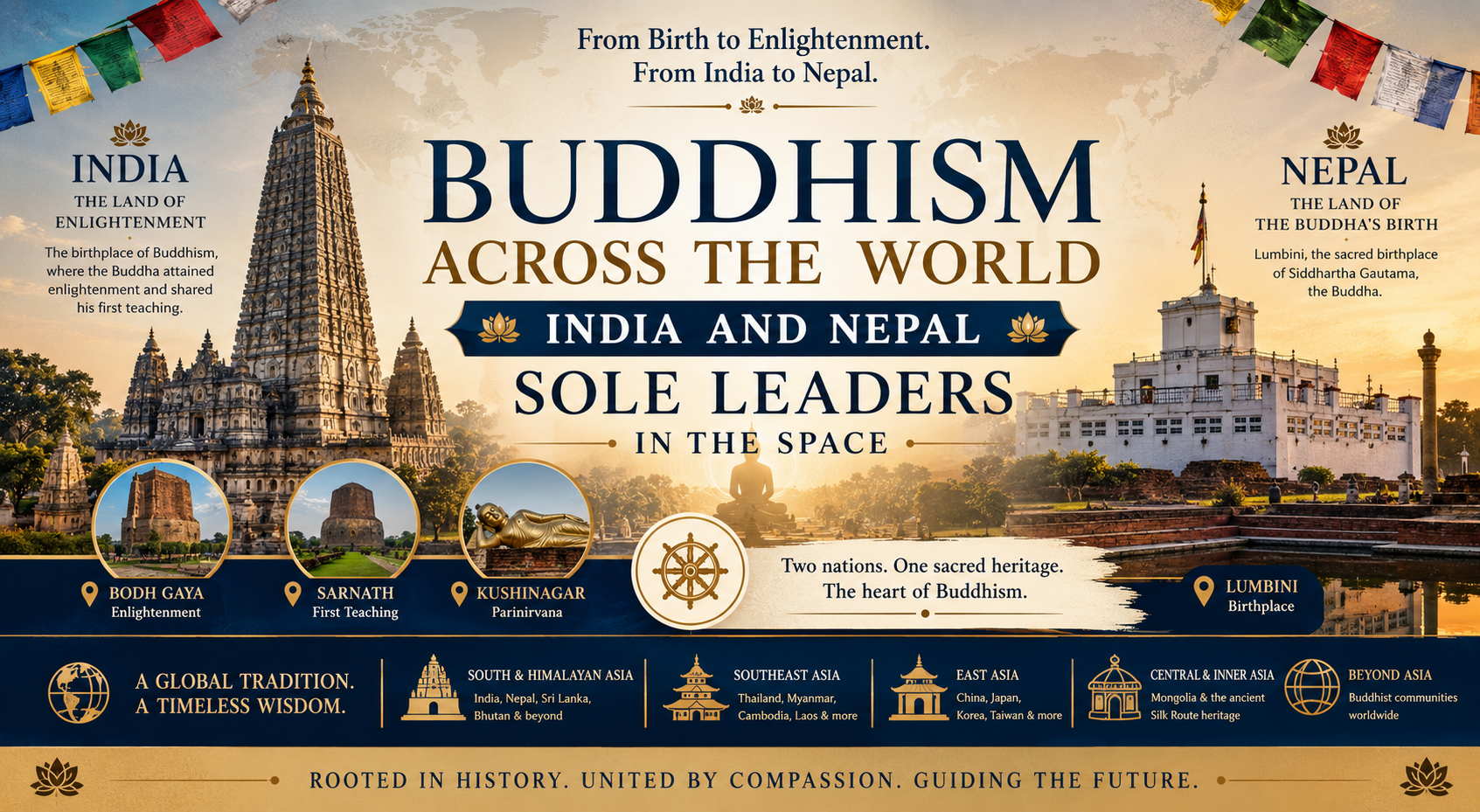
India occupies a unique place in the history of Buddhism. It was the land where Siddhartha Gautama attained enlightenment, delivered many of his most important teachings, and where major centres of Buddhist learning such as Nalanda, Vikramashila and Bodh Gaya developed. Although Buddhism subsequently spread across Asia, India continues to be an important centre for Buddhist study, pilgrimage, monastic education, meditation and the preservation of Buddhist heritage.
Today, a wide range of Buddhist organisations and institutions operate in India. Their activities include teaching the Dhamma, meditation, Pali and Sanskrit studies, preservation of manuscripts, monastic education, inter-Buddhist dialogue and the conservation of Buddhist cultural traditions.
1. Indo-Buddhist Heritage Forum
The Indo-Buddhist Heritage Forum (IBH Forum) is a platform dedicated to preserving, promoting and celebrating the rich heritage of Buddhism in the Indian subcontinent. The Forum brings together individuals, organisations, scholars and enthusiasts interested in Buddhist teachings, history and heritage.
A central part of its work is the protection and conservation of Buddhist heritage sites, including monasteries, stupas, viharas and ancient Buddhist artefacts. The Forum also focuses on research and education relating to the history, philosophy and cultural significance of Buddhism. Its activities include cultural exchange, pilgrimages and retreats, as well as efforts to encourage interfaith dialogue and intercultural understanding.
The Forum’s work also extends into public education and digital dissemination. Its platform features articles and resources on Buddhist history, philosophy, architecture, heritage sites, monasteries and contemporary Buddhist developments. It maintains dedicated sections covering prominent stupas, Buddhist heritage sites and monasteries across India.
Through these activities, the Indo-Buddhist Heritage Forum seeks to contribute to a wider understanding of India’s Buddhist heritage and its continuing relevance in the contemporary world.
2. Maha Bodhi Society of India
The Maha Bodhi Society of India is one of the most historically important Buddhist organisations in modern India. Its work is closely associated with the revival and preservation of Buddhist pilgrimage centres, particularly Bodh Gaya and Sarnath.
The organisation maintains Buddhist centres and viharas and conducts activities such as Buddhist worship, Pali chanting, meditation and religious instruction. Its centres include the Mahabodhi Society’s Buddha Gaya Centre, the Mulagandha Kuti Vihara at Sarnath, the Sri Dharmarajika Chetiya Vihara in Kolkata and Buddhist centres in other parts of India.
The society has therefore played an important role in connecting modern Buddhist practice with India’s ancient Buddhist pilgrimage landscape.
3. International Buddhist Confederation
The International Buddhist Confederation (IBC), headquartered in New Delhi, is an international Buddhist umbrella organisation bringing together monastic and lay Buddhist organisations from different countries and traditions.
The organisation was conceived in 2011 and has developed a network consisting of hundreds of Buddhist organisations, monasteries and institutions. Its activities include Buddhist conferences, inter-tradition dialogue, scholarly discussions and programmes concerning Buddhist philosophy, heritage and contemporary applications of Buddhist teachings.
Among its major activities are the International Conference of Young Buddhist Scholars, Buddhist cultural programmes and international Buddhist summits. Its conferences have addressed subjects such as Buddhist literature, education, research, healthcare, Buddhist pilgrimage, heritage and the transmission of Buddhist teachings to younger generations.
The IBC is particularly significant because it provides a platform where Theravada, Mahayana, Vajrayana and other Buddhist traditions can interact.
4. Vipassana Research Institute
The Vipassana Research Institute (VRI), associated with the Vipassana tradition of S. N. Goenka, is based at Dhamma Giri in Igatpuri, Maharashtra.
Its principal areas of work include research into Vipassana meditation and its textual sources, Pali studies and the publication and preservation of Buddhist literature. The institute has made the Pali Tipitaka available to the public and has published books and other educational material dealing with the Buddha’s teachings and Vipassana practice.
VRI is particularly noteworthy for its contribution to making Buddhist texts and meditation literature accessible to contemporary students and practitioners.
5. Central Institute of Buddhist Studies, Leh
The Central Institute of Buddhist Studies (CIBS) in Leh is an important centre for Buddhist education and scholarship, particularly in the Himalayan region.
Established in 1959, the institute preserves and promotes Buddhist education and culture. Its curriculum includes Buddhist philosophy as well as the traditional Buddhist sciences known as the Panchamahavidya, covering areas such as philosophy, arts, medicine and culture. Bhoti is an important medium of instruction.
CIBS has thus contributed to the preservation of the intellectual and cultural traditions of Himalayan Buddhism while providing formal academic education.
6. Central Institute of Higher Tibetan Studies, Sarnath
The Central Institute of Higher Tibetan Studies (CIHTS) at Sarnath, Varanasi, is one of India’s major institutions for the study of Tibetan Buddhism and Buddhist philosophy.
Established in 1967, the institute was created to provide education to Tibetan and Himalayan communities while preserving Tibetan language, culture and traditional systems of learning. It subsequently developed into an autonomous university-level institution.
Its importance extends beyond religious instruction. It has supported academic research and the study of Buddhist philosophy, Tibetan language, literature and traditional knowledge systems.
7. Nava Nalanda Mahavihara
The Nava Nalanda Mahavihara (NNM) in Bihar was established in 1951 with the objective of reviving the study of Pali and Buddhism in the region historically associated with the ancient Nalanda Mahavihara.
It functions as a residential institution and provides higher education and research opportunities in Buddhist and Pali studies. Its modern academic work represents an attempt to reconnect contemporary scholarship with the intellectual heritage of ancient Nalanda.
The ancient Nalanda archaeological site itself provides an important historical context. Excavations have revealed monasteries, temples, stupas and other structures, demonstrating the scale of Buddhist learning and monastic life that once existed there.
8. Namgyal Institute of Tibetology
The Namgyal Institute of Tibetology in Gangtok, Sikkim, is another important institution devoted to Tibetan Buddhist studies and Himalayan culture.
Its work contributes to the preservation and study of Tibetan Buddhist literature, art, history and philosophy. The institution is also significant for its role in maintaining collections and scholarly resources related to the Buddhist traditions of the Himalayan region.
The Ministry of Culture has recognised the institute among the organisations receiving support for the promotion of Buddhist culture and art.
9. Library of Tibetan Works and Archives
The Library of Tibetan Works and Archives (LTWA) in Dharamshala is an important centre for the preservation and study of Tibetan Buddhist literature.
Its significance lies particularly in the preservation, cataloguing, translation and study of Tibetan textual traditions. Such work is important because a substantial body of Indian Buddhist philosophical and scholastic literature survived through its transmission into Tibetan.
The Ministry of Culture has included the Library of Tibetan Works and Archives among organisations supported for the promotion of Buddhist culture and art.
10. Buddhist Educational and Cultural Institutions in the Himalayan Region
India is also home to numerous monasteries, monastic schools and cultural institutions in Ladakh, Himachal Pradesh, Sikkim, Arunachal Pradesh and other Himalayan regions.
These institutions preserve living Buddhist traditions through monastic education, ritual practice, language training, manuscript preservation, traditional arts and philosophical study. Institutions such as the Central Institute of Buddhist Studies, the Central Institute of Himalayan Culture Studies and Buddhist cultural centres connected with major monasteries are examples of this wider network.
The Central Institute of Himalayan Culture Studies, for example, offers programmes connected with Buddhist and Himalayan studies and works toward preserving traditional arts, culture and knowledge systems.
The Role of Buddhist Organisations in Contemporary India
The activities of these organisations show that Buddhism in contemporary India is not limited to religious practice alone. Buddhist institutions contribute to several interconnected fields:
- Buddhist education through monastic and university-level programmes.
- Pali, Sanskrit and Tibetan studies through language and textual research.
- Meditation through Vipassana and other Buddhist traditions.
- Manuscript preservation through libraries and research institutes.
- Buddhist philosophy through academic and monastic scholarship.
- Cultural preservation through the maintenance of Buddhist art, architecture, ritual and traditional knowledge.
- Pilgrimage through the development and maintenance of important Buddhist centres such as Bodh Gaya and Sarnath.
- International Buddhist dialogue through conferences and networks connecting Buddhist communities across Asia and beyond.
The Government of India’s Ministry of Culture has itself identified several institutions working in these fields, including Nava Nalanda Mahavihara, the Central Institute of Higher Tibetan Studies, the Central Institute of Buddhist Studies, the Central Institute of Himalayan Culture Studies, the Library of Tibetan Works and Archives and the Namgyal Institute of Tibetology.
Archaeological Survey of India and Buddhist Heritage
Although the Archaeological Survey of India (ASI) is not a Buddhist organisation, it deserves a separate place in any discussion of Buddhism in India because of its extensive responsibility for the archaeological and architectural remains of India’s Buddhist past.
Established in 1861, the ASI is the principal government organisation responsible for archaeological research and the protection, conservation and maintenance of monuments and archaeological sites of national importance. It works through archaeologists, conservators, epigraphists, architects and scientists, as well as specialised excavation, epigraphy and conservation branches.
ASI and Sanchi
The Buddhist Monuments at Sanchi are among the most important Buddhist sites protected and maintained within India’s archaeological heritage system. Sanchi contains stupas, monasteries, temples, pillars and sculptural remains associated with centuries of Buddhist activity.
ASI’s work at Sanchi has included archaeological investigation, conservation and museum development. Objects recovered during clearance and excavation at Sanchi were brought together in the archaeological museum, which developed into an important repository for sculptures and other Buddhist antiquities from the site.
Sanchi is also recognised as a UNESCO World Heritage property, reflecting its international importance as a centre of Buddhist architecture and art.
ASI and Nalanda
The ASI has played a major role in the archaeological study and preservation of Nalanda Mahavihara in Bihar.
Excavations at Nalanda exposed a large complex of Buddhist monasteries, temples, stupas, shrines and associated structures. The ASI’s Patna Circle records that excavation revealed eleven major monasteries and six temples, together with numerous smaller shrines, votive stupas and other remains.
The Archaeological Site of Nalanda Mahavihara is now a UNESCO World Heritage property.
ASI and Ajanta
The Ajanta Caves in Maharashtra represent one of the greatest surviving collections of ancient Buddhist religious art in India. The caves contain monasteries, prayer halls, sculptures and celebrated paintings depicting Buddhist themes.
The Ministry of Culture describes the Ajanta complex as consisting of 30 rock-cut monuments dating broadly from the 2nd century BCE to the 6th century CE. The site is particularly important for its murals, sculptures and architecture.
ASI’s responsibilities at Ajanta include the protection, conservation and maintenance of this exceptionally fragile archaeological and artistic heritage.
ASI and Buddhist Archaeological Sites in Other Regions
ASI’s Buddhist heritage work extends well beyond Sanchi, Nalanda and Ajanta. Its protected-site records include Buddhist stupas and remains at numerous locations, including Satdhara, Sonari, Andher, Murelkhurd, Saru-Maru and Gyaraspur in Madhya Pradesh.
In Odisha, ASI’s archaeological work has been particularly important at the Buddhist sites of Ratnagiri and Udayagiri. Excavations at Udayagiri revealed an extensive Buddhist complex, including a large monastic establishment, shrine complex and water reservoir. The excavation report identifies the monastery through inscribed seals as Simhaprastha Mahavihara.
ASI and Bodh Gaya
Bodh Gaya is another central part of India’s Buddhist heritage. The Mahabodhi Temple Complex, associated with the Buddha’s enlightenment, is recognised as a UNESCO World Heritage property.
The preservation of the archaeological and architectural heritage of Bodh Gaya forms part of the wider national responsibility for protecting India’s Buddhist monuments.
Conclusion
India’s Buddhist institutional landscape is diverse. Some organisations concentrate on meditation and spiritual practice, others on monastic education and philosophy, while universities and research institutes focus on Pali, Sanskrit, Tibetan and Buddhist studies. Libraries and cultural institutions preserve manuscripts and traditions, while international Buddhist organisations create opportunities for dialogue between different Buddhist schools.
Alongside these living institutions, the Archaeological Survey of India provides the archaeological foundation for understanding India’s Buddhist past. Through excavation, conservation, documentation, museums and heritage management, ASI protects physical evidence of Buddhist civilisation—from the stupas of Sanchi and the monasteries of Nalanda to the paintings of Ajanta and the Buddhist complexes of Odisha.
Together, these organisations and institutions demonstrate that Buddhism in India survives through both living traditions and preserved heritage: through meditation halls and monasteries, universities and libraries, manuscripts and archaeological sites, and through the continued study and practice of the Buddha’s teachings.
For the Indo-Buddhist Heritage Forum, documenting and highlighting these institutions is also part of a broader effort to encourage greater public understanding of India’s Buddhist inheritance and the need to preserve it for future generations.