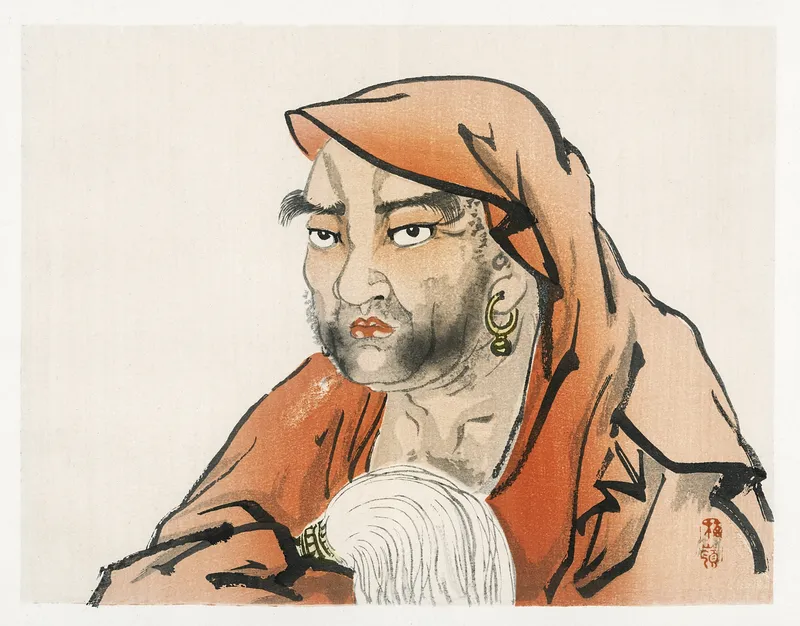
Acharya Santideva: From a prince to an adept
Śāntideva was an 8th-century CE Indian philosopher, Buddhist monk, poet and scholar at the erstwhile Nalanda University. The Tibetan historians Butön and Taranātha tell us that Śāntideva was a Brahmin prince, the son of the King Kalyanavarman and Queen Vajrayogini from Saurāṣṭra; a western coastal region that now forms part of the Indian state of Gujarat. He went by the name Shantivarman. He renounced the princely life and became a monastic. He was an adherent of the Madhyamaka philosophy and is also considered to be one of the 84 mahasiddhas. Legends say at the age of six, he met with a yogi from whom he received his first initiation and teachings on the practice of Manjushri. It is said that on the eve of his enthronement, Manjushri and Arya Tara appeared to him in his dreams. When he awoke, he saw his impending kingship as a poisonous tree and hastily fled the kingdom. He is believed to have received teachings directly from Arya Manjushri and also carried with a wooden sword which symbolized the wisdom sword of Manjushri. He travelled to the Kingdom of Pancamasimha and was appointed by the king as a minister. During his tenure, he introduced the skill of various crafts and urged the King to rule his kingdom always in accordance with the Dharma and suggested twenty Dharma Foundations be established. Then Śāntideva left for the great Nalanda University. At Nalanda, he received ordination of a monk from the Abbot Jayadeva and was given the name Śāntideva. Though there, he came to be known as a Bhu-Su-Ku, a kind of Sanskrit acronym derived from words meaning “eat”, “sleep”, and “defecate” as that was all anyone had seen him do. While none knew he was receiving teachings from Manjushri and realized all important points of both Sutra and Tantra. In an attempt to encourage their apparently lazy student to return to his proper path, some of the monks in authority at Nālandā decided to assign him to recite a text at an upcoming religious festival; and, just to humiliate him even more, built him an elaborate throne from which to speak. On the day of the festival, Śāntideva ascended the throne and asked the audience whether they would like to hear something old or something new; or in other words, whether he should recite something he had memorized, or an original composition of his own Bodhicaryāvatāra. During the recitation, while seated in meditation posture, the master began to levitate above the throne. At the recitation of verse 34 of Chapter 9, he levitated in the air and vanished. Later those who possessed clairaudience noted down the remaining chapters of which two versions came up; one had seven hundred stanzas (Pandits of Kashmir) while some had a thousand (Magadha, Central India) or more. Later Acharya Santideva confirmed that the correct version corresponded to what the scholars of Magadha had produced. Works of Santideva Two major works are unanimously attributed to Śāntideva: Bodhicaryāvatāra (A Guide to a Bodhisattvas Way of Life) written c. 700 AD in Sanskrit, the most widely read philosophical poem, and Śikṣā–samuccaya a valuable and intellectually rich anthology of quotations from the Mahāyāna sūtras with commentary by Śāntideva. Two major versions of Bodhicaryāvatāra exist, one comprising thousand verses that was regarded as canonical in Tibet (see Butön 2013: 259). The Bodhicaryāvatāra has been translated into several modern languages, including Chinese, Danish, Dutch, English, German, Hindi, Newari, and Spanish, for a total of at least twenty-seven contemporary translations (as surveyed by Gómez 1999: 4–5). It has ten chapters dedicated to the development of bodhicitta (the mind of enlightenment) through the practice of the six perfections (Skt.Pāramitās). Chapters 1-3 comprises of the practice of Perfection of Generosity; Chapters 4-5 is on Perfection of Ethical Discipline; Chapter 6 is on Perfection of Patience; Chapter 7 is on Perfection of Enthusiasm; Chapter 8 is on Perfection of Meditative Concentration; and Chapter 9 is on Perfection of Wisdom. Śikṣā-samuccaya contains a number of passages of ethical and philosophical interest in Śāntideva’s own voice, as well as numerous beautiful and moving poems and a wide variety of scriptural materials drawn from over a hundred sūtras. Textual scholars have often relied on Śikṣā-samuccaya as a crucial source, as it preserves passages in Sanskrit from dozens of sūtras that have been lost in their original language. It also contains twenty-seven “root verses” that express important themes of the book. Bodhicaryāvatāra is a widely taught and studied by South Asian Buddhists community. The 14th Dalai Lama has been teaching this text to a wide audience of all Buddhist communities at their request. It is one of the treasures of the Indian wisdom that is pertinent in today’s modern world. Acharya Santideva is one of the greatest masters of the Indian sub-continent whose work is still influencing millions of Buddhist across the globe.