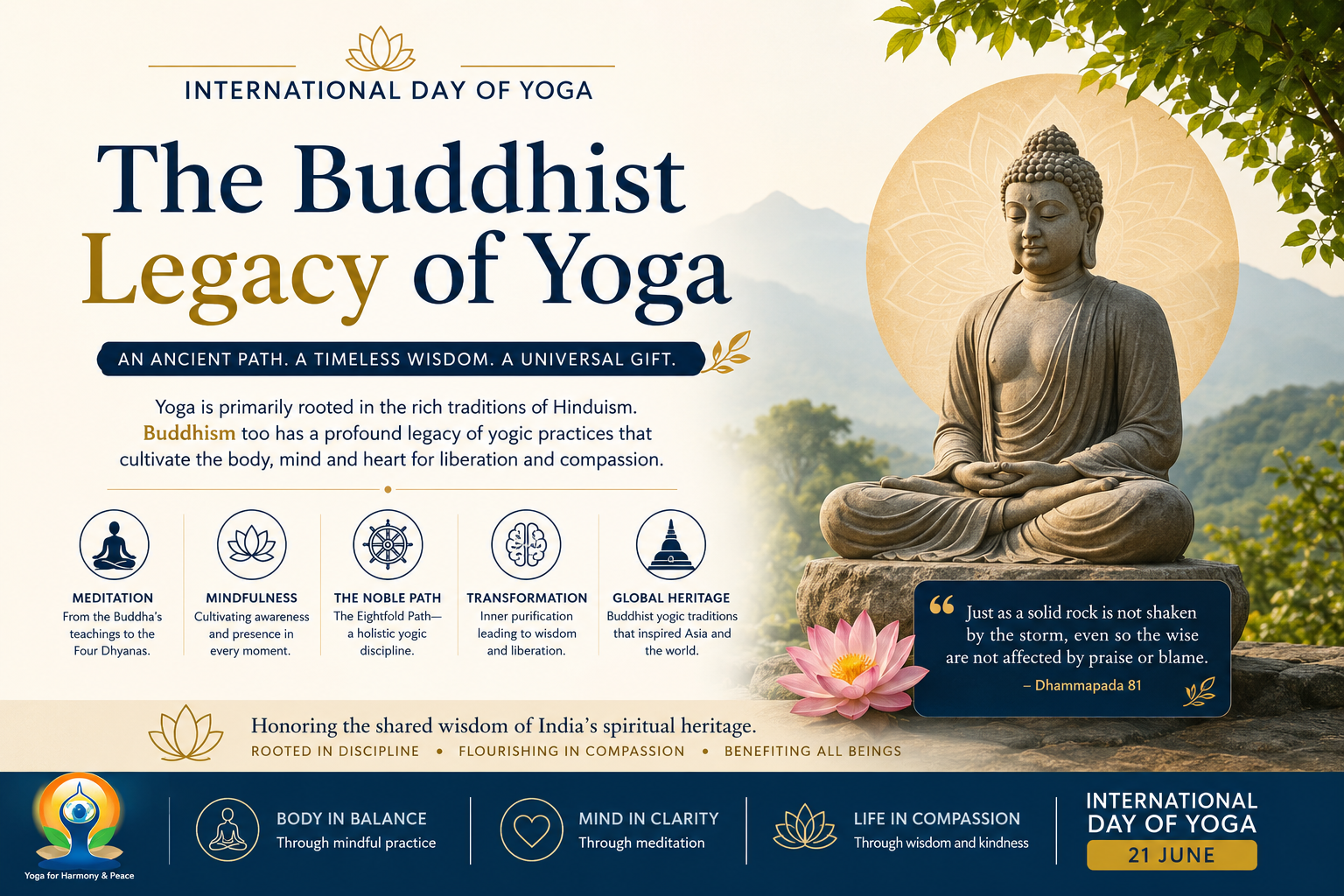
Every year, the International Day of Yoga celebrates one of humanity’s most profound gifts to spiritual and physical well-being. Yoga is primarily associated with the ancient traditions of India and finds its most extensive philosophical and practical development within Hindu traditions. However, the history of yoga is also deeply intertwined with Buddhism, which preserved, refined, and transmitted numerous yogic practices across Asia for more than two millennia.
On the occasion of International Day of Yoga, it is worthwhile to recognize the rich Buddhist contribution to the evolution of yogic thought and practice. Far from being a separate phenomenon, Buddhist yoga forms an integral chapter in the broader history of Indian contemplative traditions.
Yoga in the Time of the Buddha
The historical Buddha, Siddhartha Gautama (c. 5th century BCE), lived in an environment where various forms of meditation, asceticism, breath control, and contemplative discipline were already being practiced. Early Buddhist texts record that before his enlightenment, the Buddha studied under renowned meditation teachers such as Alara Kalama and Uddaka Ramaputta, mastering advanced states of concentration.
While the Buddha eventually charted his own path, he retained and transformed many contemplative techniques that would today be recognized as yogic practices. His teachings emphasized the cultivation of mental discipline, mindfulness, concentration, ethical conduct, and insight—elements that remain central to many traditions of yoga.
The Meaning of Yoga in Buddhism
The Sanskrit root yuj, from which the word “yoga” derives, means “to yoke,” “join,” or “discipline.” In Buddhism, the emphasis is less on union with a supreme reality and more on the disciplined cultivation of the mind leading to liberation from suffering.
Buddhist texts often use related concepts such as bhavana (mental cultivation), samadhi (meditative concentration), and dhyana (meditation). The latter term, dhyana, would travel across Asia, becoming Chan in China, Seon in Korea, and Zen in Japan.
Thus, while Buddhist yoga developed distinctive goals and philosophical interpretations, it shared with other Indian traditions a commitment to systematic training of body, mind, and consciousness.
The Noble Eightfold Path as a Yogic Discipline
One of Buddhism’s greatest contributions to yogic thought is the Noble Eightfold Path. Rather than viewing yoga merely as physical postures, Buddhism presents a comprehensive path of transformation involving:
- Right View
- Right Intention
- Right Speech
- Right Action
- Right Livelihood
- Right Effort
- Right Mindfulness
- Right Concentration
This framework integrates ethics, mental discipline, and wisdom into a unified spiritual practice. Modern scholars often describe it as one of the world’s most sophisticated systems of contemplative training.
Meditation and the Four Dhyanas
Among the most influential Buddhist yogic practices are the Four Dhyanas (Pali: Jhanas), states of deep meditative absorption characterized by increasing tranquility, clarity, and concentration.
The Buddha taught these meditative attainments as powerful tools for calming the mind and preparing it for insight into reality. These practices profoundly influenced later traditions of meditation throughout South, Central, East, and Southeast Asia.
Today, mindfulness and meditation programs practiced around the world often trace their roots, directly or indirectly, to these ancient Buddhist contemplative methods.
Yogācāra: The “Yoga Practice” School
One of the most significant Buddhist philosophical traditions is Yogācāra, literally meaning “Practice of Yoga” or “Yoga Conduct.” Emerging around the fourth century CE through the works of great scholars such as Asanga and Vasubandhu, Yogācāra developed sophisticated theories concerning consciousness, perception, and meditation.
The tradition emphasized rigorous contemplative training aimed at transforming the mind and overcoming ignorance. Its influence extended across India, Tibet, China, Korea, and Japan, shaping Buddhist meditation for centuries.
The very name of this school demonstrates how deeply the concept of yoga was embedded within Buddhist intellectual and spiritual life.
Buddhist Yoga in the Himalayan Tradition
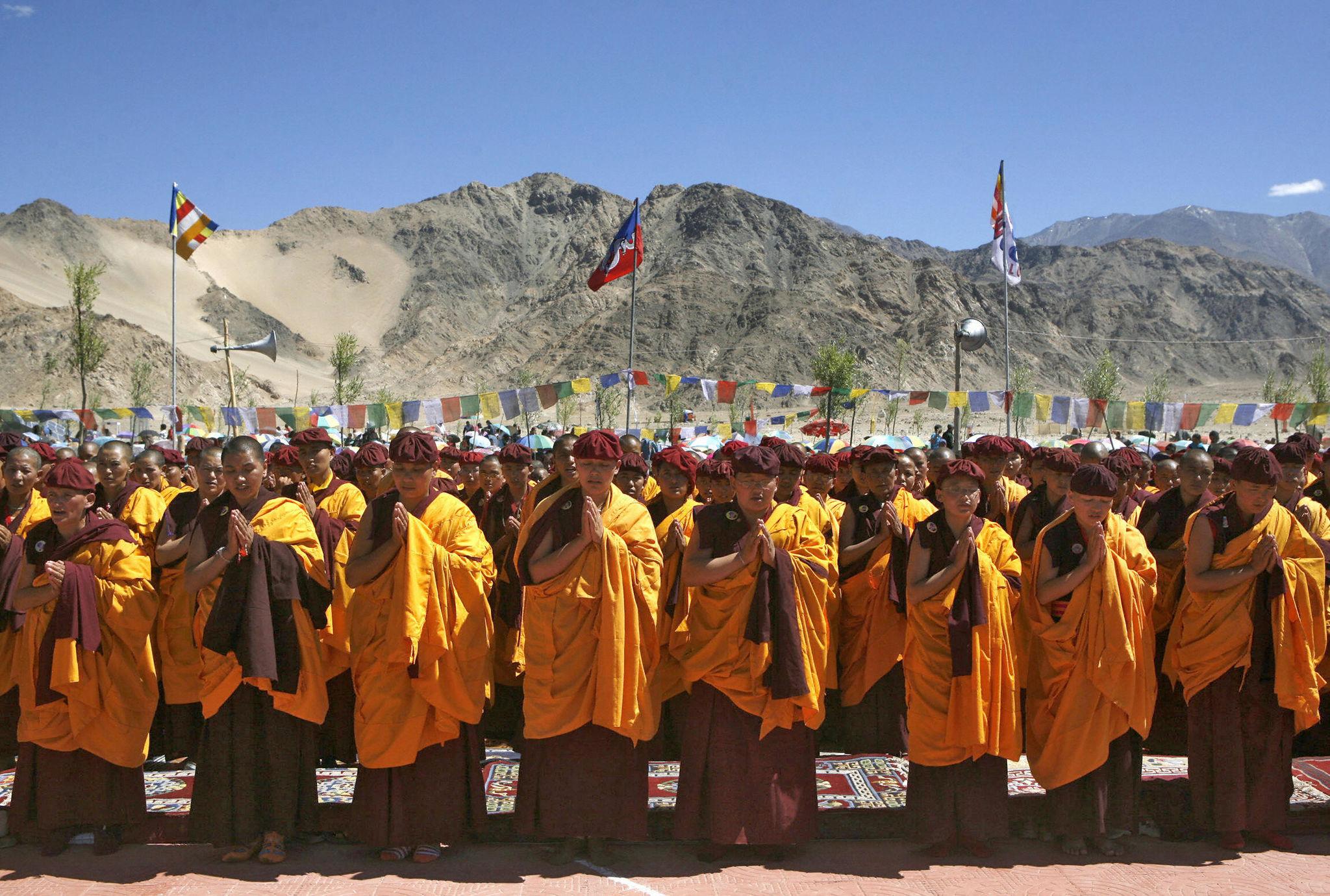
Tibetan Buddhism developed some of the most elaborate yogic systems in the world. Practices such as:
- Shamatha (calm abiding meditation)
- Vipashyana (insight meditation)
- Tummo (inner heat yoga)
- Dream Yoga
- Deity Yoga
- Mahamudra and Dzogchen contemplative systems
represent highly sophisticated methods of mental and spiritual cultivation.
These traditions integrate posture, breath regulation, visualization, concentration, and mindfulness, demonstrating that Buddhist yoga evolved far beyond simple seated meditation.
The Global Spread of Buddhist Yogic Traditions
As Buddhism spread across Asia, it carried yogic practices to diverse cultures. Monasteries became centers of meditation training, contemplative scholarship, and spiritual discipline.
In China, Buddhist meditation contributed to the emergence of Chan Buddhism. In Japan, Zen developed methods emphasizing seated meditation (zazen). In Tibet, yogic traditions flourished within Vajrayana Buddhism. Across Southeast Asia, mindfulness and concentration practices became central aspects of monastic and lay life.
Through these movements, Buddhist forms of yoga reached millions of practitioners over the centuries and continue to inspire people worldwide.
Relevance for the Modern World
Modern discussions of yoga often focus on physical postures and health benefits. While these aspects are valuable, the Buddhist legacy reminds us that yoga is also a profound science of the mind.
Mindfulness, compassion, concentration, emotional balance, and self-awareness are increasingly recognized by psychologists, neuroscientists, and healthcare professionals as essential components of human well-being. Many of these qualities have been cultivated within Buddhist contemplative traditions for over 2,500 years.
The Buddhist contribution therefore enriches our understanding of yoga as a holistic path encompassing ethical living, mental discipline, and wisdom.
Conclusion
The International Day of Yoga provides an opportunity to celebrate the diversity and depth of India’s spiritual heritage. While yoga finds its primary historical expression within Hindu traditions, Buddhism has also made a remarkable and enduring contribution to the development of yogic theory and practice.
From the meditation teachings of the Buddha and the Four Dhyanas to the Yogācāra school and the sophisticated contemplative systems of Tibet, Buddhism preserved and expanded many dimensions of yoga that continue to benefit humanity today.
Recognizing this shared heritage allows us to appreciate yoga not merely as a physical exercise, but as a timeless tradition of inner transformation—one that has been nurtured by multiple streams of Indian civilization and transmitted across the world for the welfare of all beings.
Selected References
- Johannes Bronkhorst, The Two Traditions of Meditation in Ancient India (Motilal Banarsidass, 1993).
- Rupert Gethin, The Foundations of Buddhism (Oxford University Press, 1998).
- James Mallinson and Mark Singleton, Roots of Yoga (Penguin Classics, 2017).
- David J. Kalupahana, The Principles of Buddhist Psychology (State University of New York Press, 1987).
- Geoffrey Samuel, Introducing Tibetan Buddhism (Routledge, 2012).
- Bhikkhu Analayo, Satipatthana: The Direct Path to Realization (Windhorse Publications, 2003).
- Asanga, Yogācārabhūmi Śāstra (various translations and studies).