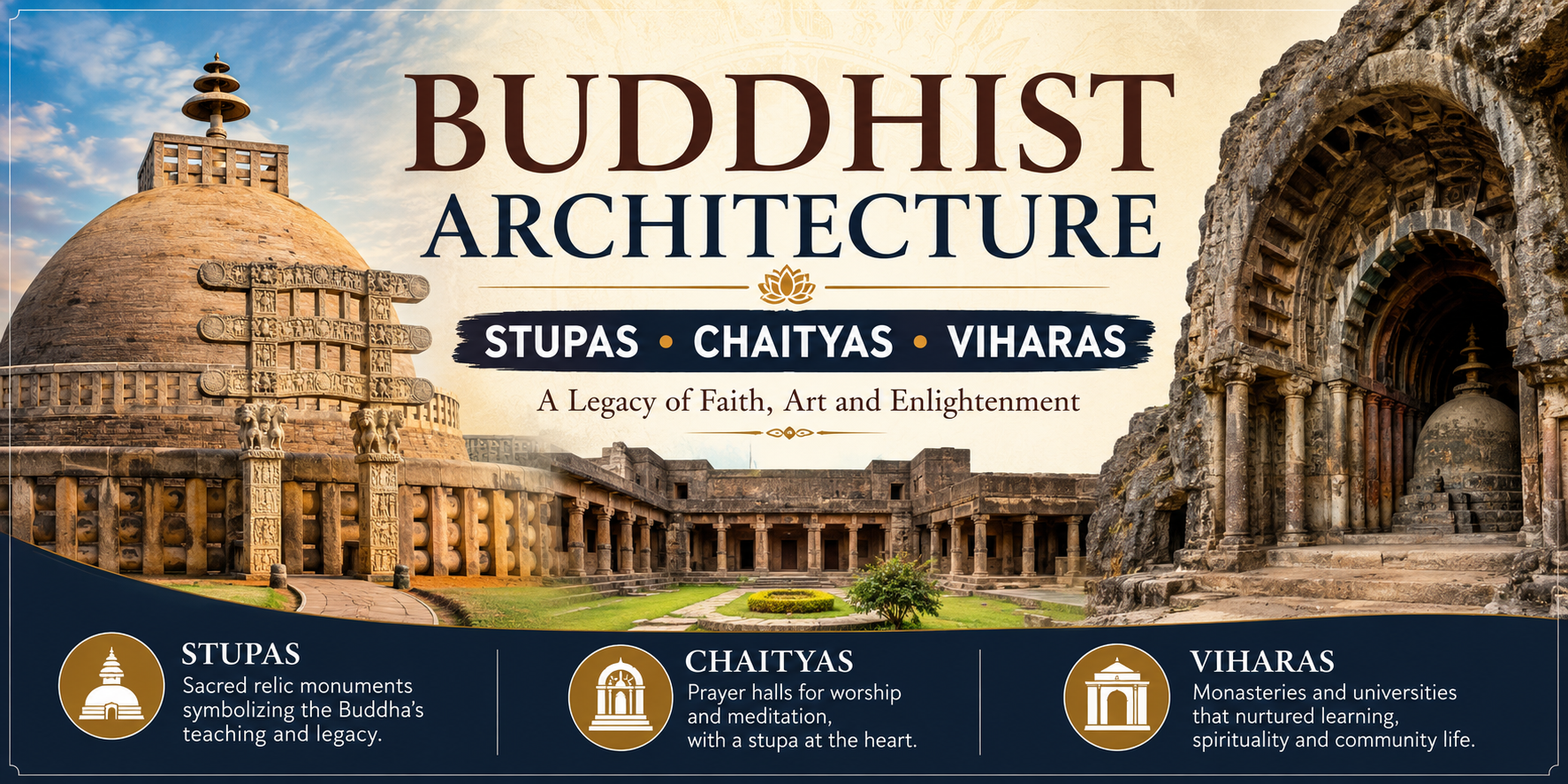
Buddhist architecture is one of the finest expressions of India’s ancient artistic and spiritual heritage. Beginning in the 3rd century BCE, it developed into a distinct architectural tradition that reflected the teachings of Buddhism while also influencing art and architecture across Asia. From magnificent stupas that enshrined sacred relics to rock-cut prayer halls and monastic residences, Buddhist monuments reveal how religion, architecture, and craftsmanship came together to create timeless masterpieces.
Many of these structures still stand today, offering valuable insights into the evolution of Buddhist thought, ancient engineering, and India’s cultural history.
The Evolution of Buddhist Architecture
The earliest Buddhist monuments were built to commemorate the life and teachings of Gautama Buddha. After the Buddha attained Mahaparinirvana, his relics were divided among different kingdoms and preserved in burial mounds known as stupas.
During the reign of Emperor Ashoka in the 3rd century BCE, Buddhism received extensive royal patronage. Ashoka is believed to have constructed numerous stupas across the Indian subcontinent and played a crucial role in spreading Buddhist architecture beyond India. In the centuries that followed, dynasties such as the Shungas, Satavahanas, Kushanas, Guptas, and Palas expanded this architectural tradition, leading to the construction of impressive monasteries, cave complexes, and educational institutions.
Stupa: The Sacred Relic Monument
A stupa is the oldest and most recognizable form of Buddhist architecture. The word stupa means “heap” or “mound,” reflecting its earliest form as a simple earthen burial mound built over the relics of the Buddha or revered monks.
Over time, these simple structures evolved into elaborate stone monuments that became important centres of pilgrimage and devotion.
Unlike temples, a stupa is generally not meant to be entered. Instead, devotees worship by walking around it in a clockwise direction, a ritual known as pradakshina, symbolizing reverence and spiritual contemplation.
Main Components of a Stupa
Every traditional stupa contains several architectural elements with symbolic meanings:
- Anda – The large hemispherical dome representing the universe and housing sacred relics.
- Harmika – A square railing placed above the dome, symbolizing the heavenly realm.
- Yashti – A central pillar rising from the harmika.
- Chhatra – One or more umbrella-shaped discs placed on the yashti, representing spiritual protection and enlightenment.
- Medhi – A circular terrace surrounding the dome.
- Pradakshina Patha – The pathway used by devotees for circumambulation.
- Vedika – A protective stone railing enclosing the monument.
- Torana – Beautifully carved gateways, often depicting scenes from the life of the Buddha and stories from the Jataka tales.
Famous Stupas
Some of the most celebrated stupas include:
- The Great Stupa at Sanchi (Madhya Pradesh) – One of the oldest surviving stone structures in India, famous for its intricately carved gateways.
- Bharhut Stupa – Known for detailed narrative sculptures illustrating Buddhist legends.
- Amaravati Stupa (Andhra Pradesh) – Renowned for its elegant limestone carvings.
- Dhamek Stupa (Sarnath) – Built at the site where the Buddha delivered his first sermon after attaining enlightenment.
Chaitya: The Buddhist Prayer Hall
A chaitya is a prayer hall designed for collective worship and meditation. Unlike a stupa, devotees enter a chaitya to offer prayers.
The defining feature of every chaitya is a stupa placed at the far end of the hall. Worshippers would gather inside and circumambulate the stupa within the hall itself.
Many early chaityas were carved directly into hillsides, demonstrating the remarkable skill of ancient Indian rock-cut architecture.
Architectural Features of a Chaitya
A typical chaitya includes:
- A long rectangular hall
- An apsidal (semi-circular) rear end
- A central nave with side aisles
- Rows of stone pillars
- A barrel-vaulted roof, often imitating wooden construction
- A stupa positioned at the end of the hall
These prayer halls were designed to create a peaceful atmosphere suitable for meditation and religious gatherings.
Famous Chaityas
Some important examples include:
- Karle Chaitya (Maharashtra) – The largest and one of the best-preserved rock-cut chaitya halls in India.
- Bhaja Caves – Among the earliest examples of Buddhist cave architecture.
- Ajanta Cave 9 and Cave 19 – Outstanding examples that reflect different phases of Buddhist artistic development.
- Nasik Caves – Important centres of Buddhist worship and monastic life.
Vihara: The Monastery of Buddhist Monks
A vihara served as the residence of Buddhist monks. Initially, monks stayed in temporary shelters during the rainy season, but permanent monasteries gradually emerged as Buddhism expanded.
Over time, viharas evolved into important centres of education, learning, and manuscript preservation.
Many renowned scholars lived, studied, and taught in these monasteries, making them some of the earliest organised educational institutions in the world.
Architectural Features of a Vihara
Most viharas consisted of:
- A central hall or courtyard
- Small residential cells for monks
- Verandahs
- Assembly rooms
- Storage spaces
- Prayer or shrine rooms (in later developments)
As Buddhist art evolved, many viharas also included large images of the Buddha placed in dedicated shrine chambers.
Famous Viharas
Some of the best-known examples include:
- Ajanta Caves – Most of the caves at Ajanta functioned as monasteries.
- Nalanda Mahavihara (Bihar) – One of the world’s earliest residential universities, attracting students from across Asia.
- Vikramashila Mahavihara – A major centre of Buddhist learning established during the Pala period.
Stupa, Chaitya and Vihara: Understanding the Difference
Although all three are associated with Buddhism, they served different purposes.
A stupa is a sacred monument built to preserve relics and is worshipped from the outside through circumambulation.
A chaitya is a prayer hall where devotees gather for worship, usually containing a stupa within the hall.
A vihara is a monastery that provides living quarters for monks while also functioning as a centre of education and meditation.
Together, these three architectural forms formed the foundation of Buddhist religious life.
Rock-Cut Buddhist Architecture
One of the most remarkable achievements of ancient Indian architecture is the development of rock-cut caves.
Instead of constructing buildings using bricks or stones, craftsmen carved entire monasteries, prayer halls, and temples directly into solid rock. This architectural tradition flourished between the 2nd century BCE and the 7th century CE.
Some of the most important rock-cut Buddhist sites include:
- Ajanta
- Ellora
- Karle
- Bhaja
- Kanheri
- Bedsa
- Nasik
These cave complexes showcase extraordinary engineering skills alongside magnificent sculptures and paintings that continue to attract visitors from around the world.
Patronage of Buddhist Architecture
The growth of Buddhist architecture was supported by rulers, merchants, guilds, and ordinary devotees.
Among the major patrons were:
- Mauryas, particularly Emperor Ashoka, who promoted the construction of stupas across the subcontinent.
- Shungas, who expanded and decorated several earlier monuments.
- Satavahanas, under whom many famous cave complexes were excavated.
- Kushanas, who encouraged the spread of Buddhist art, especially in northwestern India.
- Guptas, whose period witnessed remarkable artistic refinement.
- Palas, who established great monasteries and centres of higher learning in eastern India.
UNESCO World Heritage Sites
Several Buddhist monuments have been recognised as UNESCO World Heritage Sites for their outstanding cultural significance:
- Sanchi
- Ajanta Caves
- Ellora Caves
- Mahabodhi Temple Complex at Bodh Gaya
- Nalanda Mahavihara
These sites continue to preserve the architectural, artistic, and spiritual legacy of Buddhism.
Legacy of Buddhist Architecture
Buddhist architecture is much more than a collection of ancient monuments. It reflects a philosophy centred on peace, compassion, meditation, and the pursuit of enlightenment. The elegant simplicity of stupas, the grandeur of chaitya halls, and the scholarly atmosphere of viharas together illustrate how architecture can serve both spiritual and social purposes.
Even after more than two thousand years, these monuments remain enduring symbols of India’s cultural heritage and continue to inspire architects, historians, pilgrims, and travellers across the world.