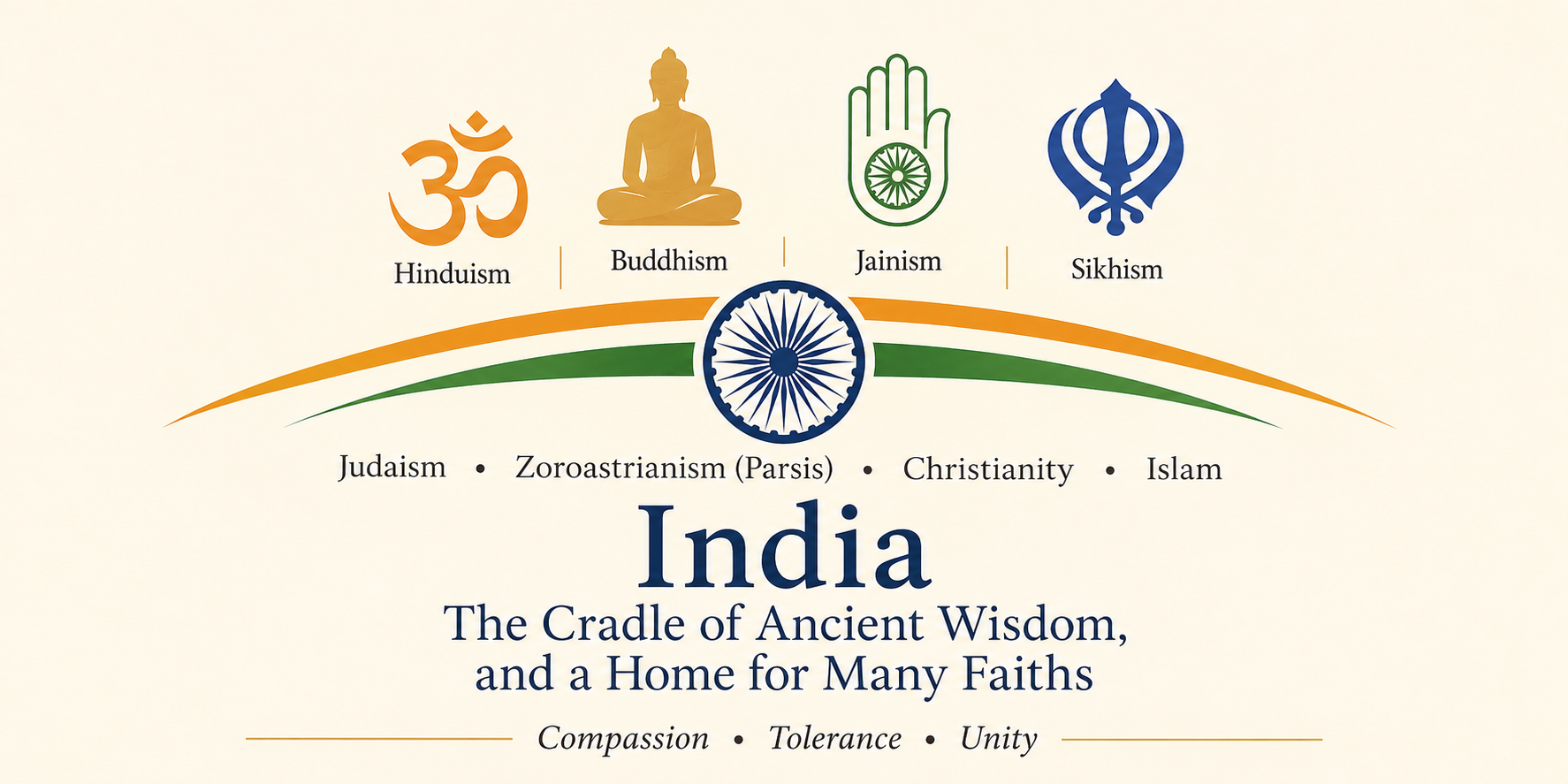
India occupies a unique place in the spiritual history of humanity. It is not merely a land where religions are practised; it is the birthplace of four major religious traditions—Hinduism, Buddhism, Jainism and Sikhism-and a civilisation that, over centuries, has provided a home to communities following faiths that originated elsewhere. Its spiritual legacy is a remarkable tapestry of philosophical inquiry, compassion, non-violence, service, tolerance and the search for truth. Few civilisations have contributed so profoundly to the religious and ethical imagination of the world. Source: University of Wisconsin–Madison, Center for South Asia
Buddhism: A Philosophy of Compassion, Wisdom and Responsible Governance
At the heart of India’s spiritual inheritance lies Buddhism, founded on the teachings of Siddhartha Gautama, the Buddha, in the ancient Indian subcontinent. His journey from princely privilege to enlightenment was a profound exploration of the human condition: suffering, its causes, and the possibility of liberation through ethical conduct, wisdom and disciplined awareness.
The Buddha’s message transcended ritual and social distinctions. He emphasised compassion (karuna), non-violence, the Middle Way, right conduct and the importance of understanding the consequences of one’s actions. His teachings encouraged individuals to overcome hatred, greed and ignorance, offering a path towards inner freedom and harmonious coexistence.
Buddhism’s significance, however, extends beyond personal spirituality. It offers a powerful ethical framework for public life. Its emphasis on compassion rather than cruelty, dialogue rather than dogmatism, restraint rather than excess, and the welfare of others rather than narrow self-interest provides enduring guidance for political leadership.
The reign of Emperor Ashoka in the third century BCE offers one of the most compelling historical illustrations of this connection between Buddhism and governance. Following the devastating Kalinga War, Ashoka embraced a policy of Dhamma that stressed moral responsibility, compassion, respect for different religious communities and the welfare of his subjects. His inscriptions and public works reflected an understanding that the strength of a ruler lies not simply in military conquest, but also in ethical conduct and concern for human well-being.
This legacy continues to resonate in modern India. The national emblem is adapted from Ashoka’s Lion Capital at Sarnath, while the Dharma Chakra at the centre of the national flag draws upon the same broader heritage of the wheel of law. These symbols connect the modern Republic to an ancient tradition that placed ethical responsibility, truth and public duty at the centre of political life. Source: Government of India’s Ministry of Home Affairs
Buddhism should not be understood as the sole foundation of India’s political system, which also reflects constitutional democracy, modern institutions and many other intellectual traditions. Yet its contribution to India’s moral vocabulary is unmistakable. It reminds the polity that power must be tempered by compassion, authority by responsibility, and national strength by respect for human dignity.
Hinduism: The Richness of Pluralism and the Search for Truth
Hinduism, one of the world’s oldest living religious traditions, evolved over millennia rather than emerging from the teachings of a single founder. Its philosophical traditions encompass a remarkable range of perspectives on duty, truth, consciousness, self-realisation and the relationship between the individual and the universe.
The concept of dharma places responsibility and righteous conduct at the centre of life. The Upanishadic tradition encourages deep philosophical inquiry, while the Bhagavad Gita explores duty, self-discipline, devotion and action without attachment to its fruits.
Hinduism’s diversity of philosophical schools and devotional practices demonstrates that a civilisation can sustain different understandings of the divine and of ultimate reality. This intellectual breadth, together with its long history of debate and interpretation, has contributed to India’s rich culture of spiritual exploration.
At its best, this heritage encourages humility before the vastness of truth and respect for the many paths through which people seek meaning. It provides an important complement to Buddhism’s emphasis on mindful conduct, compassion and the overcoming of suffering.
Jainism: The Ethics of Non-Violence and Respect for Life
Jainism contributes another indispensable dimension to India’s ethical inheritance. Its emphasis on ahimsa, or non-violence, extends respect to all living beings. The Jain principles of aparigraha, or non-possessiveness, and anekantavada, the recognition that reality can be understood from multiple perspectives, offer powerful lessons for contemporary society.
In a world marked by conflict, excessive consumption and ideological polarisation, these teachings encourage restraint, empathy and intellectual humility. Jainism challenges individuals and institutions alike to consider the consequences of their actions and to recognise the limits of their own perspectives.
Its ethical vision complements Buddhist compassion and Hindu philosophical inquiry, reinforcing the idea that India’s spiritual inheritance is strongest when its traditions enrich rather than diminish one another.
Sikhism: Equality, Courage and Selfless Service
Emerging in the Punjab region in the fifteenth century, Sikhism, founded by Guru Nanak and developed through the teachings of the ten Sikh Gurus, brought a powerful message of devotion to one God, human equality, honest work and service to others.
The Sikh traditions of seva (selfless service) and langar (the community kitchen, where people share meals regardless of background) translate spiritual values into everyday social practice. Sikhism also upholds courage, dignity and the responsibility to stand against injustice.
These principles are essential to a healthy polity. Compassion must be accompanied by action, equality by institutional commitment, and spiritual conviction by a willingness to serve the wider community. Sikhism’s contribution demonstrates how religious values can become practical expressions of solidarity and social responsibility.
India: A Historic Home for Communities of Many Faiths
India’s spiritual identity is not defined only by the religions that originated within its borders. It is also shaped by the communities that arrived from other lands and established lasting roots here.
Jewish communities have lived in India for centuries, developing distinct traditions and contributing to local society while maintaining their religious identity. The Parsis, followers of Zoroastrianism whose ancestors migrated from Persia, found a lasting home in India and made significant contributions to its commercial, cultural and civic life. Their histories are important reminders of India’s longstanding connections with the wider world.
Christianity and Islam, both originating outside the Indian subcontinent, also became deeply rooted in Indian society. Christian communities have ancient historical connections with parts of India, particularly Kerala, while Islam became established through centuries of trade, migration, scholarship, cultural exchange and political history.
These faiths are not marginal elements of Indian life. They are integral to the country’s social and cultural fabric. According to the 2011 Census, India’s Muslim population was approximately 172.2 million, or 14.2 per cent of the population, while its Christian population was approximately 27.8 million, or 2.3 per cent. These figures are from the 2011 Census, the latest completed Indian census for which religion-wise population figures are available in the cited official data. Source: Government of India’s Press Information Bureau
The historical experience of religious communities in India has not always been free of conflict, prejudice or discrimination. Nevertheless, the continued presence of diverse communities, their institutions and their contributions to Indian life illustrate the country’s deep and enduring religious plurality.
Constitutional India: The Protection of Freedom of Conscience
Independent India gave this plural inheritance a modern constitutional framework. The Constitution establishes India as a sovereign, socialist, secular, democratic republic and recognises freedom of conscience and religion as a fundamental right. Source: Supreme Court of India
Article 25 guarantees all persons freedom of conscience and the right freely to profess, practise and propagate religion, subject to public order, morality, health and the other provisions of the Constitution. Article 26 protects the rights of religious denominations to establish and maintain religious and charitable institutions and to manage their religious affairs, subject to constitutional limitations. Articles 29 and 30 provide important protections for cultural interests and the educational rights of minorities. Sources: Articles 25 and 26 of the Constitution, Article 26, Part III of the Constitution
These protections are central to the idea that citizenship and human dignity do not depend on religious affiliation. India’s constitutional promise is not that every community will always agree, nor that every historical grievance will disappear. It is that the state must operate within a framework of rights, equality and lawful protection, enabling people of different faiths to coexist as members of one republic.
This is where India’s ancient spiritual inheritance and its modern constitutional order meet. The traditions of compassion, non-violence, service and respect for human dignity provide ethical resources for a society whose institutions must protect the freedom and equality of all its people.
The Way Forward: A Polity Guided by Compassion and Wisdom
India’s religious traditions offer complementary lessons for the future of its democracy.
From Buddhism comes compassion, the Middle Way, mindful conduct and the principle that authority must be exercised with moral responsibility. From Hinduism comes a rich culture of philosophical inquiry, dharma and diverse approaches to spiritual understanding. From Jainism comes an uncompromising commitment to non-violence, restraint and respect for multiple perspectives. From Sikhism comes equality, courage and the ideal of selfless service.
Together, these traditions can inspire a political culture that values dialogue over division, public welfare over narrow self-interest, and equal citizenship over religious antagonism. Their contribution is not to replace constitutional law or democratic institutions with religious authority, but to deepen the ethical foundations on which public life rests.
The Buddhist ideal of compassion is particularly relevant in an age when political discourse can become polarised and social differences can be exploited. A polity informed by karuna would seek to protect vulnerable communities, treat opponents with dignity, pursue justice without hatred and measure progress by the well-being of its people. The Buddhist ideal of the Middle Way also offers a reminder that responsible governance requires balance, restraint and thoughtful judgment rather than extremes.
India’s greatest spiritual achievement is therefore not simply that several religions originated here. It is that the subcontinent has sustained a continuing conversation among different visions of truth, duty, liberation, equality and service. Its greatest constitutional achievement is the attempt to translate the dignity of diverse citizens into enforceable rights and democratic institutions.
India’s enduring strength lies in the meeting of its civilisational wisdom and its constitutional promise. Buddhism gives this inheritance a particularly compelling language of compassion and ethical governance, while Hinduism, Jainism and Sikhism enrich it with pluralism, non-violence, humility, equality and service. Together, these traditions offer India not merely a proud account of its past, but a moral compass for its future: a nation confident in its heritage, respectful of every faith, and committed to the dignity of every human being.