Buddhism is one of the world’s great transnational religions, with a presence stretching from the Himalayas and South Asia across Southeast Asia, East Asia and, increasingly, North America, Europe and Australia. Yet the geography of Buddhism tells a story that is more complicated than simply counting the number of Buddhists in each country.
According to Pew Research Center’s latest global estimates, approximately 324 million people identified as Buddhist in 2020. Nearly 98% lived in the Asia-Pacific region, and the ten countries with the largest Buddhist populations accounted for about 91% of the global Buddhist population.
Countries such as Thailand, Cambodia, Myanmar, Sri Lanka, Bhutan, Laos and Mongolia have Buddhist majorities. Japan, China, Vietnam, Taiwan, South Korea, Singapore, Malaysia and others have substantial Buddhist communities or deep Buddhist cultural traditions. Buddhism has also established communities in countries far beyond Asia, including the United States, Canada, Australia and several European countries.
But if Buddhism is understood not merely as a demographic category, but as a civilizational, historical and pilgrimage tradition, two countries occupy a uniquely important position: India and Nepal.
Buddhism’s Asian heartland
Buddhism began in the Indian subcontinent more than two millennia ago and subsequently spread throughout Asia. Today, its strongest demographic presence is concentrated in East, Southeast and South Asia.
Thailand and Cambodia are among the world’s most heavily Buddhist societies, with Buddhists making up approximately 94% and 97% of their populations respectively, according to Pew’s 2020 estimates. Myanmar is about 89% Buddhist, Bhutan about 75%, Sri Lanka about 70%, Laos about 64%, and Mongolia about 51%.
Other countries have large Buddhist populations without Buddhist majorities. China, Japan, Vietnam, South Korea, Taiwan, Malaysia and Singapore all contain significant Buddhist populations or retain important Buddhist cultural institutions.
This distinction matters. A country can have millions of Buddhists without being the historical centre of Buddhism, while another country can have relatively few Buddhists today but possess extraordinary importance to Buddhist history.
India is the clearest example.
India: the birthplace of the Buddhist tradition
Modern India is not a Buddhist-majority country. Pew estimates that roughly 9.6 million Indians identified as Buddhist in 2020, representing less than 1% of India’s population.
Yet demographic size alone cannot measure India’s importance to Buddhism.
The Buddha’s teachings emerged in the Indian subcontinent, and many of the foundational events of his life occurred in what is now India. The region became the setting for the development of Buddhist philosophy, monastic institutions, universities, artistic traditions and pilgrimage networks that subsequently influenced much of Asia.
Most importantly, India contains Bodh Gaya, traditionally regarded as the place where Siddhartha Gautama attained enlightenment.
The Mahabodhi Temple Complex at Bodh Gaya is a UNESCO World Heritage Site and one of the four principal holy sites associated with the Buddha’s life. UNESCO describes Bodh Gaya as the place associated with the Buddha’s enlightenment and notes that it has been venerated by Buddhists from around the world for centuries.
India is also home to other foundational Buddhist sites, including Sarnath, where the Buddha is traditionally understood to have delivered his first sermon, and Kushinagar, associated with his passing into parinirvana.
The result is a remarkable paradox: India is not among the world’s leading countries by percentage of Buddhists, yet it remains arguably the most important country in Buddhist sacred geography.
That distinction gives India a form of leadership that demographic tables cannot capture.
Nepal: the sacred geography of Buddha’s birth
Nepal’s importance is complementary to India’s.
In southern Nepal lies Lumbini, traditionally recognized as the birthplace of Siddhartha Gautama, the Buddha. UNESCO identifies Lumbini as one of the holiest and most significant places associated with one of the world’s major religions. Archaeological remains at the site demonstrate the existence of Buddhist pilgrimage activity dating back to antiquity.
Lumbini is not simply a historical attraction. It is a living international pilgrimage centre, visited by Buddhists from across Asia and the wider world.
The site’s importance is reinforced by archaeological evidence, including the Ashoka Pillar and remains of ancient Buddhist monasteries and stupas. UNESCO notes that Emperor Ashoka visited Lumbini and erected the commemorative pillar in the third century BCE.
Nepal therefore possesses something no other modern nation can replicate: the birthplace of the Buddha itself.
And when combined with India’s Buddhist sacred sites, the two countries form a remarkably coherent pilgrimage geography.
India and Nepal: two halves of Buddhism’s sacred core
The relationship between India and Nepal is especially significant because the most important places associated with the Buddha’s life do not fit neatly within today’s political borders.
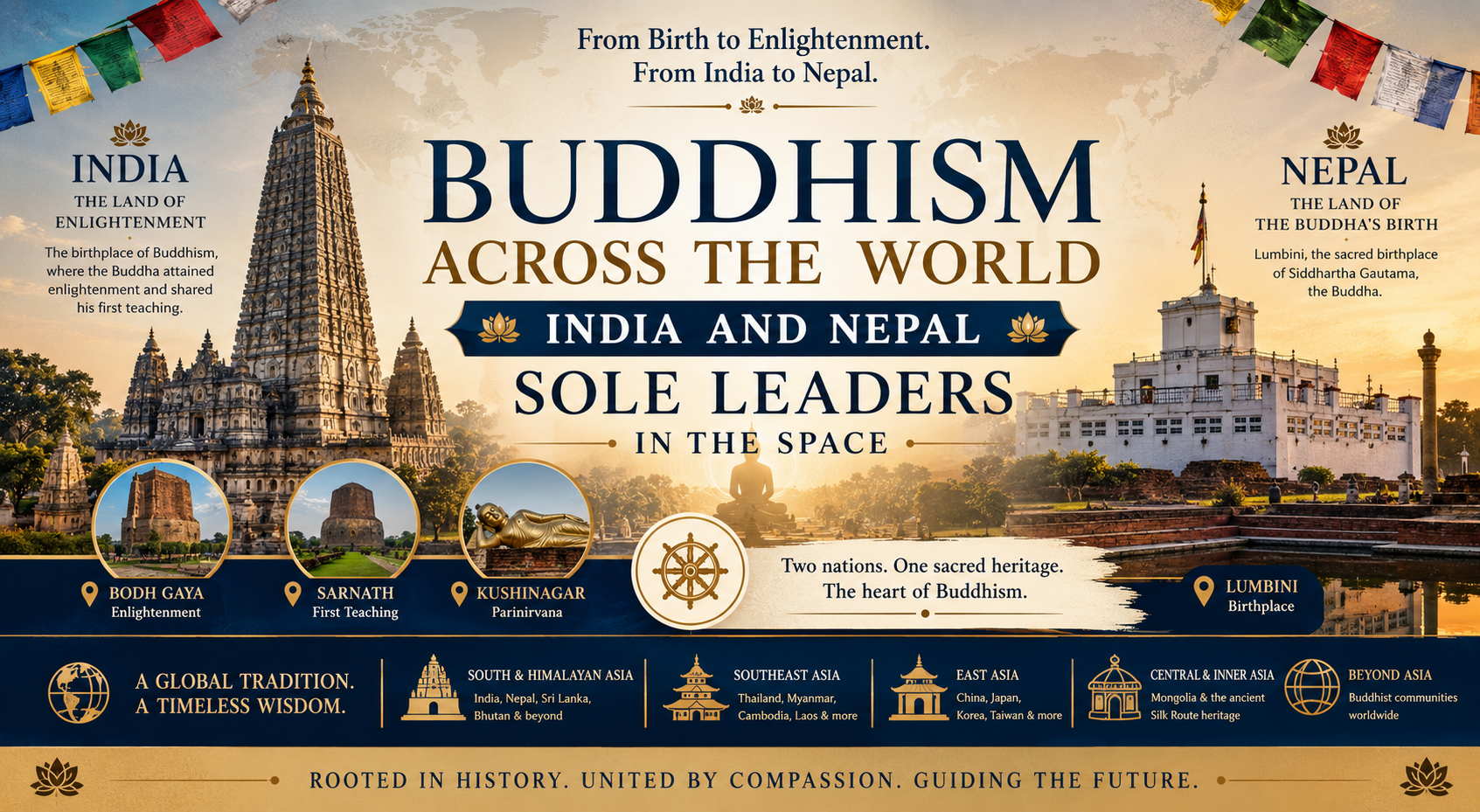
Nepal holds Lumbini, the Buddha’s birthplace.
India holds Bodh Gaya, associated with his enlightenment; Sarnath, associated with his first teaching; and Kushinagar, associated with his passing.
Together, they form the central pilgrimage circuit of the Buddha’s life.
This gives India and Nepal a unique position in the global Buddhist landscape. Thailand may have a larger Buddhist population. Cambodia may have a higher percentage of Buddhists. Japan and China possess immense Buddhist artistic and intellectual legacies. Sri Lanka has preserved an exceptionally influential Theravada tradition.
But India and Nepal possess the physical geography of the Buddha’s life itself.
That is a fundamentally different kind of leadership.
The wider Buddhist world
The Buddhist world can broadly be understood through several major cultural zones.
South and Himalayan Asia include India, Nepal, Sri Lanka and Bhutan. Sri Lanka became a major centre of Theravada Buddhism, while Bhutan developed a distinctive Himalayan Buddhist tradition.
Southeast Asia includes Thailand, Myanmar, Cambodia and Laos, where Theravada Buddhism remains deeply embedded in national culture and everyday life. Cambodia, Thailand and Myanmar are among the countries with the world’s highest proportions of Buddhists.
East Asia includes China, Japan, South Korea and Taiwan. These societies developed distinctive forms of Mahayana Buddhism and, in Japan, traditions such as Zen and Pure Land Buddhism.
Central and Inner Asia historically played an important role in the movement of Buddhism along trade routes linking India with China and beyond. Mongolia today remains one of the world’s Buddhist-majority countries.
Beyond Asia, Buddhist communities have developed across Europe, North America and Australia. These communities are generally much smaller than those in Asia, but they demonstrate the global reach of Buddhist philosophy, meditation and religious practice.
Why “leadership” should not be measured only by population
There is a danger in describing India and Nepal as “leaders” without defining what kind of leadership is meant.
If leadership means the largest Buddhist population, India and Nepal do not lead. China, Thailand, Myanmar, Japan and other countries have substantially larger Buddhist populations. Pew’s estimates show that India has roughly 9.6 million Buddhists, while Buddhism is a minority religion in the country.
If leadership means the percentage of the population that is Buddhist, countries such as Cambodia, Thailand, Myanmar and Bhutan are clearly ahead.
But if leadership means historical origin, sacred geography and global pilgrimage significance, India and Nepal are in a category of their own.
India represents the civilization in which Buddhism emerged, developed and spread outward. Nepal represents the land where the Buddha was born. Their importance is therefore rooted in the origins of the tradition rather than simply in contemporary religious demographics.
A changing Buddhist world
This leadership is becoming even more significant as the global Buddhist landscape changes.
Pew estimates that the world’s Buddhist population declined from approximately 343 million in 2010 to 324 million in 2020, making Buddhism the only major religious group whose global population declined during that period. The decline has been particularly pronounced in East Asia, where ageing populations, low fertility and religious switching have affected Buddhist populations.
That does not mean Buddhism is disappearing. Rather, its demographic centre of gravity is changing, while its historical and cultural geography remains remarkably durable.
In this environment, pilgrimage and heritage can become increasingly important. Places such as Bodh Gaya and Lumbini provide tangible connections to a religious tradition that otherwise spans thousands of kilometres and many different cultures.
A shared opportunity for India and Nepal
India and Nepal therefore have an opportunity to frame Buddhism not as a competition over which country is “more Buddhist,” but as a shared civilizational heritage.
A stronger cross-border Buddhist pilgrimage network could connect Lumbini with Bodh Gaya, Sarnath and Kushinagar, while integrating monasteries, archaeological sites, museums, universities and cultural institutions along the route.
The potential audience is enormous. UNESCO has described the wider Lumbini landscape as spiritually significant to hundreds of millions of Buddhists worldwide.
For Nepal, Lumbini can serve as the international gateway to the story of Buddha’s birth.
For India, Bodh Gaya, Sarnath and Kushinagar can anchor the story of enlightenment, teaching and parinirvana.
Together, they can offer something no other pair of countries can provide: a journey through the foundational geography of Buddhism itself.
The real meaning of Buddhist leadership
The Buddhist world today extends far beyond the borders of India and Nepal. Its living traditions are particularly powerful in Southeast and East Asia, while Buddhist communities are present across virtually every major region of the world.
Yet Buddhism’s global expansion should not obscure its point of origin.
India and Nepal possess a unique historical advantage: they contain the landscapes in which the Buddha’s story began. India is the land of Buddhism’s emergence and enlightenment tradition; Nepal is the land of the Buddha’s birth.
That makes their leadership less about numbers and more about authenticity, heritage, pilgrimage and civilizational memory.
In demographic terms, Buddhism’s contemporary power is distributed across Asia.
In sacred-geographical terms, however, its deepest roots lead back to India and Nepal.
And that is why, when discussing the future of Buddhist heritage, pilgrimage and global cultural diplomacy, India and Nepal should not merely be considered two countries with Buddhist sites. They should be regarded as the custodians of Buddhism’s foundational sacred geography.