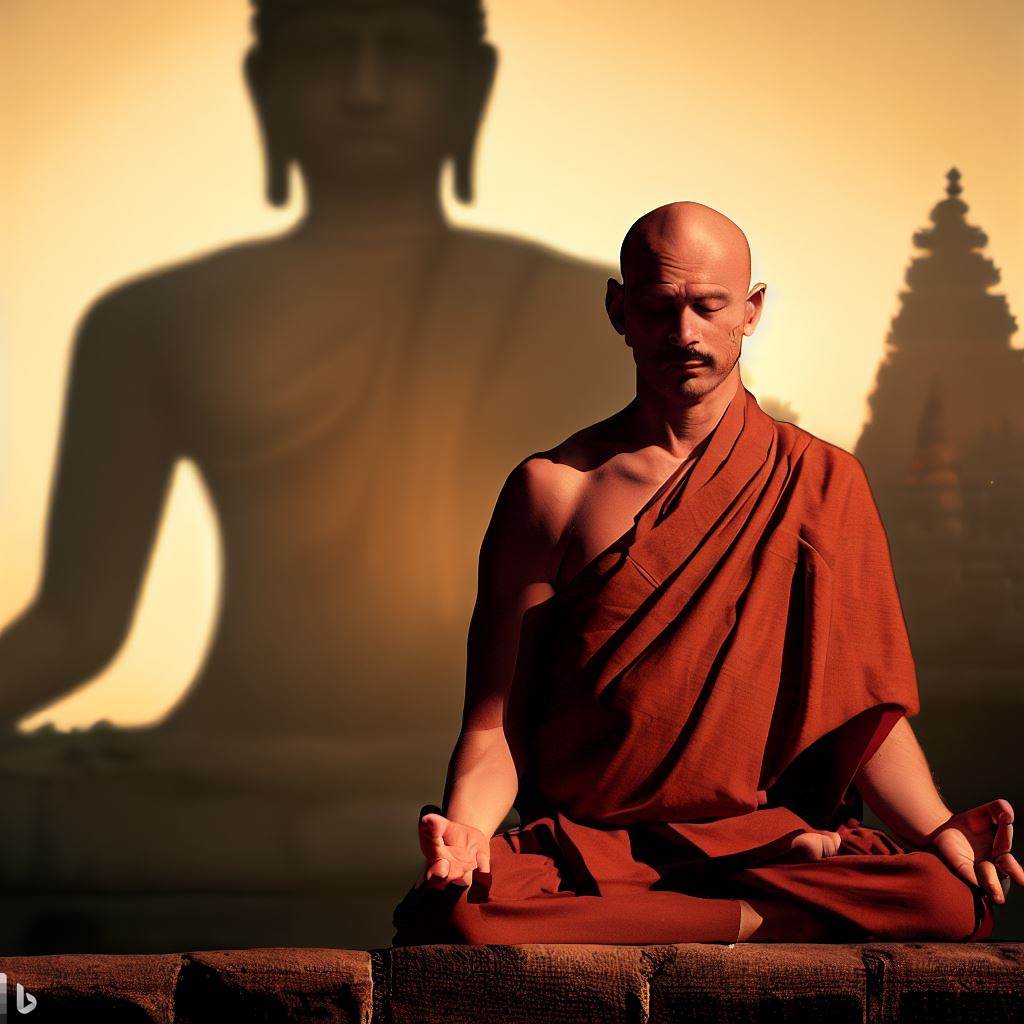
Buddhism in California USA

Discovering Tranquility in the Chaos: Embracing Buddhism in Southern California

In the hustle and bustle of modern life, many of us often find ourselves feeling stressed, anxious, and unfulfilled. The constant pressure to succeed, the fast-paced lifestyle, and the never-ending pursuit of material possessions can leave us feeling empty and disconnected. However, there is a way to find peace and contentment amidst the chaos: Buddhism. Buddhism is an ancient philosophy and way of life that has its roots in India. It teaches that the key to happiness lies in achieving inner peace, and that this can be accomplished through the practice of mindfulness and meditation. The principles of Buddhism are just as relevant today as they were centuries ago, and they can have a profound impact on modern lives, especially in Southern California. Southern California is known for its fast-paced lifestyle, high-stress jobs, and traffic-filled streets. However, Buddhism offers a way to find calm and contentment in the midst of this chaos. By practicing mindfulness and meditation, we can learn to be more present in the moment, to let go of our worries and fears, and to focus on what truly matters. One of the key teachings of Buddhism is the concept of impermanence. This principle reminds us that everything in life is constantly changing, and that nothing is permanent. By embracing this concept, we can learn to let go of attachment to material possessions, relationships, and even our own thoughts and emotions. This can help us to feel more content with what we have and to focus on the present moment rather than worrying about the future or dwelling on the past. Another important teaching of Buddhism is the concept of compassion. This principle teaches us to be kind, understanding, and empathetic towards others, even when they may not be kind to us. By practicing compassion, we can cultivate a sense of connection and community with those around us, and we can learn to see beyond our own individual needs and desires. In Southern California, where there is a diverse population and a melting pot of cultures, the practice of compassion can be particularly powerful. By learning to understand and appreciate different perspectives and ways of life, we can build bridges of understanding and acceptance and create a more harmonious and peaceful society. Finally, Buddhism teaches us to be mindful of our thoughts and actions and to take responsibility for our own well-being. By cultivating a daily meditation practice and a mindful approach to life, we can learn to manage stress and anxiety, cultivate inner peace, and live a more fulfilling and satisfying life. In conclusion, Buddhism offers a powerful set of principles and practices that can have a profound impact on modern life in Southern California. By embracing these teachings, we can learn to find peace and contentment in the midst of the chaos, build stronger connections with those around us, and live a more fulfilling and satisfying life. May we all find peace, contentment, and joy within ourselves and within our circles.May you be well,May you be happy,May you practice daily. More on : worldwisdomwell.com Post by Cyndee BessantChief Wellbeing OfficerWorld Wisdom Well

Read More
Zen Buddhist meditation

Zen Buddhism, the Udumbara Flower

First, a general background to Zen, then a brief, as long as it may be, this is a brief description of Japanese Zen and a summary of Western Zen as well, both in no way conclusive, followed by thoughts for the future of Zen. I won’t go too deeply into explaining the practice of Zen except where it’s appropriate for context. I suggest going to other sources for that. However, any comments on contemporary Zen and its future must be understood in some context of past and present East and West development and practice. I’ll use the conventional term Western Zen, though there is no such thing as such, for shorthand discussing Zen in the West, just as it can be argued there is no such thing as ‘Japanese Zen’ in much the same way, ultimately, there is only Zen. The influence of Korean and Vietnamese Zen is substantial, but for reasons I’ll outline as I go, I will concentrate here on the relationship between Japanese Zen and Western Zen. Overall, Zen Buddhism is a Mahayana school and, as such, carries characteristics and framework of the tradition and, therefore, some familiar to other traditions in the Mahayana movement as well. That means teachings of the Bodhisattva Way – Compassion doctrine, religious rituals, and customs from India intermingled with the development of Chinese customs and the development of Chinese Mahayana scriptures and practices. Its meditation practices combine and evolve Samatha and Vipassana and are mainly developed in India. It’s challenging to go into the development of Zen in India, and I won’t try here in any great detail; that would be an essay on its undertaking after Venerable Sakyamuni, the historical Buddha, but Zen claims to continue his example of personal searching and direct insight, and this forms the core of the tradition that was transmitted to China. The notion of evolving Dharma is quite crucial in Zen. This, among other things, sets Zen apart and is quite crucial to this discussion; the capacity for evolution sets Zen and other Mahayana schools apart from contemporary Theravada Buddhism, which in any country or epoch looks the same and stands in principle on that. Zen Buddhism is considered to have spread from India to China in the 5th century C.E., and traditional dates and people are somewhat representative. It’s questionable whether the exact historical details will ever be known. Nonetheless, the school continued to develop in China, and by the 9th Century, its distinctiveness had taken shape sufficiently to spread from there to Vietnam and Korea and, finally, during the Sung Dynasty, to Japan. This staged spread resulted in differences between lineages in the development of thought and practice, with their ethnic dimension and temporal characteristics depending on when they split from the main lineage in China. Rinzai Zen amalgamates several Sung dynasty schools and their methodologies, known for the Chinese Zen master Rinzai Kigen. Zen in Asia remained mainly monastic, though as a Mahayana school, it has civil characteristics, and it is impossible not to consider a solid relationship to culture. Buddhism and the Arts have always gone hand in hand in China and Japan, hence the narrative in China that Bodhidharma introduced Tea, Martial Arts and painting into China. Naturally, this is a legend; of course, there’s broad archaeological evidence that China’s cultural arts predate the introduction of Zen Buddhism, but the narrative illustrates the role Zen has played in providing metaphorical inspiration and spiritual depth in all the societies it has been practised in. Both Artists and Monks work to ‘See’ and to ‘act’ truthfully, so it’s naturally convergent that Zen training provides a vehicle to do that, and the world of the temple is also that of the artist and many others who seek the same. Zen entered Japan in the 12th century, corresponding with the late Chinese Sung dynasty; well-developed Rinzai teaching centred for the most part on Zen meditation, which developed in India as a combination of Samatha and Vipassana practices, and koan practice developed in China, often misunderstood as enigmatic riddles but in fact tools for triggering metaphorical understanding. Chinese and Indian literature and ritual liturgy are similar to any other school of Mahayana Buddhism. To understand the development of Koans in the Zen tradition, see Hogen Sori’s work Zen Sand, in which he gives an in-depth discussion of the format and function of the tradition, I’ll say here that koans form a unique metaphorical insight method of Zen. Shingon and Tendai Buddhism were introduced into Japan by the priests Kukai and Saicho, respectively, in the 8th century, and it was predominantly from these two sects of monks who took up Zen, among the most famous was Esai, a Japanese Tendai sect monk, regarded as the founder of Kenninji Zen Temple, and Enni Bennin a former Shingon monk regarded as the founder of Tofukuji Zen Temple, Ehei Dogen founder of Soto Zen in Japan was also a former Tendai master. This relationship has left a character on Japanese Rinzai and Soto Zen. 13 Chinese Rinzai Zen masters were invited to Japan, and numerous Japanese monks travelled to China in the 11th and 12th centuries, and together established the Rinzai and Soto lineages that survive today. A second wave of Chinese Zen teachers arrived in Japan in the 1600s, introducing latter-day Rinzai practice as it was in China by then, and that lineage became known as Obaku Zen in Japan to differentiate its practices and lineage from those established earlier. Obaku Zen never became widespread and has largely died out in the post-war period. To briefly mention, though it’s of solid importance both in Japan’s past and the future of global Zen, the introduction of Zen into Japan concurred with the rise of the Samurai warrior class as a power in Japanese society, and this too contributed to the establishment of Zen Buddhism, and Zen to the growth in cultural arts which the Samurai wished to take up in emulation of the Japanese aristocracy. This interstate…

Read More

An Exploration of Anicca, Anatta and Dukkha in Buddhism

In the profound tapestry of Buddhist philosophy, two threads stand out as the very heart of its wisdom: Anicca and Anatta. These concepts, deeply rooted in the teachings of the Buddha himself, offer a unique perspective on the nature of existence and self. Anicca: The Dance of Impermanence Anicca, often called impermanence, directs our attention to the ever-changing nature of all things. It is a reminder that in the grand symphony of life, there are no constants; everything is in a perpetual state of flux. From the rhythmic rise and fall of our breath to the shifting seasons, impermanence weaves its melody through every facet of our existence. Understanding Anicca is akin to acknowledging the impermanent nature of the world and our own experiences. It urges us to recognize the transient quality of joy and suffering alike. By comprehending the fleeting nature of our attachments, we unravel the causes of our suffering. This profound insight encourages us to let go of our clinging, for we understand that grasping at the ephemeral only deepens our anguish. Anatta: The Illusion of Self Anatta, often translated as ‘no-self,’ challenges a fundamental assumption – the existence of an unchanging, permanent self. It guides us to inspect the notion of ‘I’ or ‘self’ we hold dear. According to this teaching, what we perceive as our self is not an unalterable entity but a composition of ever-changing components. The concept of Anatta strips away the illusion of an enduring self. Instead, it reveals that the self we cling to is a dynamic interplay of thoughts, emotions, and physical sensations. This revelation forces us to question the attachments we harbour toward this constructed ‘self.’ As the illusion of an unchanging self dissolves, so does the ego’s stronghold on our actions and perceptions. The Triad of Dukkha: Understanding the Roots of Suffering In the heart of Buddhist philosophy lies the concept of Dukkha, often translated as ‘suffering’ or ‘unsatisfactoriness.’ Dukkha is the third integral concept that, together with Anicca and Anatta, forms the core of Buddhist wisdom. Dukkha reminds us that suffering is an intrinsic part of life. It encompasses not only the apparent pain and hardship but also the subtle sense of dissatisfaction that permeates our existence. Whether it’s the fleeting nature of pleasure or the relentless yearning for more, Dukkha teaches us that suffering is an ever-present companion on life’s journey. Understanding Dukkha is the key to addressing the causes of our suffering. By recognizing the inherently unsatisfactory nature of worldly pleasures and attachments, we are prompted to seek a more profound, lasting form of contentment. The Buddha’s teachings guide us towards a path of liberation by unravelling the roots of suffering and illuminating a way to transcend it. As we grasp the triad of Anicca, Anatta, and Dukkha, we embark on a transformative journey towards a life free from suffering and rich in wisdom, compassion, and inner peace. The Liberating Path of Understanding Anicca and Anatta are not merely abstract ideas; they are profound lenses through which we perceive the world. By integrating these concepts into our daily lives, we embark on a transformative journey toward liberation. This journey does not lead to nihilism, as some might fear, but to a deeper engagement with life. We are liberated from the illusions of permanence and self. The relentless pursuit of stability gives way to an authentic embrace of life’s impermanence. It is a shift from illusion to insight, from suffering to freedom. The path to awakening in Buddhism is intrinsically tied to grasping Anicca and Anatta. These concepts invite us to see through the veils of permanence and self, guiding us towards an enlightened existence. They grant us the wisdom to navigate life’s uncertainties with equanimity. In embracing Anicca and Anatta, we unlock the core of Buddhist wisdom, transcending the ordinary and touching the profound. These teachings beckon us to dive deep into the nature of existence, offering a unique path to liberation – one that is both radical and profoundly serene. Browse our YouTube Channel : https://www.youtube.com/@ibhforum

Read More