Life and Works of Guru Padmasambhava
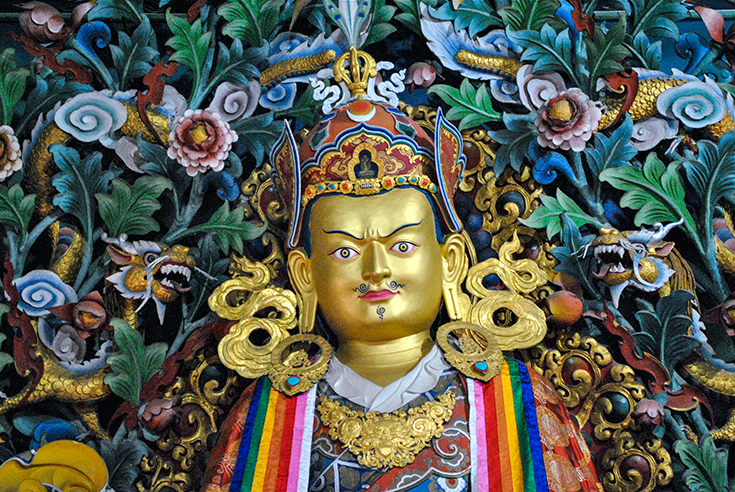
Submitted by Phuntsog Dolma (Ph. D) Guru Padmasambhava, a great Indian tantric master of 8th century is an important figure in Buddhism. He was instrumental in establishing Vajrayana Buddhism in Tibet and Bhutan and is popularly known as Guru Rinpoche means the Precious Master among his followers. Regarding his birth there is both mythical and legendary story. The first one states that Guru Padmasambhava was miraculously born as an eight-year-old boy form a blossoming Lotus flower in the Danakosha Lake, in the land of Uddiyana. His Tibetan, name is Padma Jungney, translated from the Sanskrit name Padmakara, which means “originated from a lotus.” Thus he is indeed named after his manner of birth. While in his biography titled ‘The Lotus Born: The Life Story of Padmasambhava’ recorded by one of his consorts Yeshe Tsogyal mentions that Padmasambhava was the son of the King Mahusita of Uddiyana and given the name Danarakshita who later took the ordination and given the name Sakya Senge. However, the actual location of Uddiyana is debated; some scholars locate this land to be the state of Odisha in India while others believe it to be in the Swat valley area the erstwhile undivided India and modern-day Pakistan. Interestingly, the birth of Guru Padmasambhava was prophesized by Gautama Buddha in Mahaparinirvana Sutra or Myang-hDas-mDo in Tibetan. In the Mahaparinirvana Sutra, Buddha Shakyamuni announced his own mahaparinirvana to the students who were with him at the time. Many of them, particularly Ananda, the Buddha’s cousin and personal attendant, were quite upset upon hearing this, so the Buddha turned to Ananda and told him not to worry. “Twelve years after my mahaparinirvana, a remarkable being with the name Padmasambhava will appear in the center of a lotus and reveal the highest teaching concerning the ultimate state of the true nature, bringing great benefit to all sentient beings.” Tibetan history credits Guru Padmasambhava as one of the founding fathers of Buddhism in Tibet along with Acharya Shantarakshita from India. He was one of the famous seventeen exceptional pandit scholars at Nalanda Monastic University in India (the great centre of Buddhist learning). Tibetan tradition records that when then king of Tibet Trisong Detsan was building a monastery, strong demonic forces caused disruption in the building of the monastery, therefore, the King in order to tame the forces invited the great Indian adepts Shantarakshita and Padmasambhava to Tibet. Later, King Trisong Detsan, Shantarakshita and Padmasambhava together built the first Buddhist monastery known as Samye Ling in Tibet where the first monk ordination ceremony was held for seven Tibetans. Besides, a school for the Sanskrit study was also established and a large number of Buddhist Sanskrit texts were translated into Tibetan language. The arrival and teachings of Padmasambhava in Tibet mark the beginning of the Nyingma tradition of Tibetan Buddhism. The name Nyingma literally means the old one, in the sense of being the earliest Tibetan tradition. Guru Padmasambhava mainly promulgated the tantric teachings. Since the study of logic and Buddhist philosophy was not well established, tantra teachings and practice were extremely kept secret. At that time, Guru Padmasambhava realized that the time had not yet arrived for many of his teachings to be revealed because very few Tibetan disciples were sufficiently ripened. In order to benefit future generations throughout the Tibetan cultural region, Padmasambhava left behind ‘Termas’, hidden teachings concealed by him and his consorts for discovery in the future by ‘Tertons’ (enlightened minds), destined to find the termas. In vajrayana buddhism, the termas can be tangible objects hidden in the earth, lakes or in the sky or intangible- those which come to tertons as revelations. In the early 8th century, Guru Padmasambhava is said to have visited Bhutan on invitation of King Sindhu Raja of Bumthang. Here also he subdued the unruly demons and malevolent forces that were creating obstacles in the way of the spread of Buddhism. Today, the figure and worship of Guru Padmasambhava dominate Bhutanese Buddhism and most sacred sites including the two most holy places in Bumthang and Paro are dedicated to him. Thus, during his lifespan Guru Padmasambhava travelled across Tibet, Bhutan, Nepal and the different Himalayan regions of India where he founded the Nyingma tradition of Tibetan Buddhism. Today, the imprints of Guru Padmasambhava in these countries are existing in the form of monuments, relics and folklore associated with his spiritual and religious activities. Thus, among his followers he is considered an enlightened force who exists beyond spatial and temporal constructions, beyond birth and death. The annual Hemis Festival in Ladakh commemorates the birth anniversary of Guru Padmasambhava. Similarly, in Bhutan, the annual Tseshu festival is celebrated on the tenth day of the months in Bhutanese calendar to honour Guru Padmasambhava. Over the centuries, Guru Padmasambhava’s teachings have spread far and wide, and his influence has grown from just the Himalayan region to other parts of the globe. While it is highly impossible to encapsulate his life and work in few pages, it is safe to say that the world owes its knowledge of Vajrayana Buddhism to Guru Padmasambhava, the precious teacher. Today, the great Indian tantric master is credited with having spread the message of Lord Buddha to the countries and regions located in the Himalayan belt, including Ladakh, Himachal Pradesh, Uttarakhand, Sikkim and Arunachal in India and in Nepal and Bhutan and Tibet to the north.